
Understanding Topological Sort and Build Graphs
Topological sort is a fundamental algorithm for ordering tasks in a directed acyclic graph (DAG). It finds a linear ordering of vertices such that for every directed edge from vertex u to vertex v, u comes before v in the ordering. This is crucial in many computing scenarios, including dependency resolution, task scheduling, and compilation.
A common application is in build systems, where tasks have dependencies. For instance, a build process might require parsing code, then type-checking it, and finally bundling it. If these tasks are represented as nodes in a graph, and dependencies as directed edges, a topological sort can determine a valid execution order. However, build systems can also contain cycles—where a task indirectly depends on itself—rendering a topological sort impossible.
The challenge isn't just identifying that a cycle exists, but understanding why it exists. A robust system should not merely fail; it should report the specific cycle that prevents ordering. This article explores how to build such a system using Python, focusing on Kahn's algorithm for sorting and a depth-first search (DFS) for cycle detection and reporting.
The core idea is to implement Kahn's algorithm, which naturally handles DAGs. When Kahn's algorithm fails to produce a complete ordering, it implies the presence of a cycle. The next step is to employ a DFS to pinpoint the exact sequence of nodes forming that cycle.
Implementing Kahn's Algorithm
Kahn's algorithm operates by maintaining the in-degree (number of incoming edges) for each node. The process is as follows:
- Initialization: Calculate the in-degree for every vertex in the graph. Initialize a queue with all vertices that have an in-degree of 0. These are the tasks that have no prerequisites and can be started immediately.
- Processing: While the queue is not empty:
- Dequeue a vertex (let's call it u). Add u to the result list (the topological order).
- For each neighbor v of u (i.e., for each task that depends on u):
- Decrement the in-degree of v.
- If the in-degree of v becomes 0, enqueue v.
- Cycle Detection: After the loop finishes, if the number of vertices in the result list is less than the total number of vertices in the graph, it signifies that a cycle exists. The graph is not a DAG.
The prerequisite tasks for this implementation are Python 3.11+ and basic familiarity with Python's standard library, specifically dictionaries, sets, and queues. The provided code aims to be self-contained.
Representing the Graph
A common way to represent a graph for topological sorting is using an adjacency list. In this case, each task is a key in a dictionary, and its value is a list or set of tasks it depends on. However, for Kahn's algorithm, it's more convenient to represent the graph such that each task maps to the tasks that depend on it (its successors). This allows us to easily iterate over neighbors when decrementing in-degrees.
Let's define the graph structure. A dictionary where keys are task names (strings) and values are sets of task names that depend on the key task is a good choice. We also need to efficiently track in-degrees. A separate dictionary mapping task names to their in-degree counts will suffice.
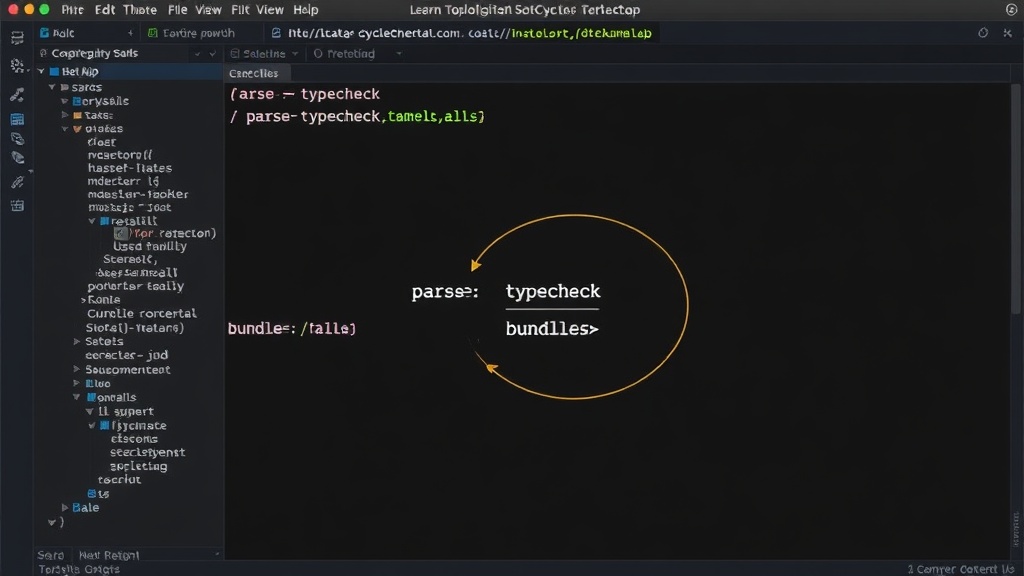
Consider the example graph: parse -> typecheck -> bundle -> parse.
In an adjacency list representation where keys are tasks and values are their direct prerequisites, this might look like:
graph_prereqs = {
    "parse": set(),
    "typecheck": {"parse"},
    "bundle": {"typecheck"}
}
# This representation is insufficient for cycle detection as it doesn't show 'parse' depending on 'bundle'
For Kahn's algorithm, we need the reverse: tasks that depend on a given task. Let's call this the successor graph.
successor_graph = {
    "parse": {"typecheck"},
    "typecheck": {"bundle"},
    "bundle": {"parse"} # This edge creates the cycle
}
We also need to compute the initial in-degrees. In the cyclic example:
in_degrees = {
    "parse": 1,      # From 'bundle'
    "typecheck": 1,  # From 'parse'
    "bundle": 1      # From 'typecheck'
}
The algorithm starts by finding nodes with an in-degree of 0. In this cyclic graph, no node has an in-degree of 0. If we were to initialize Kahn's algorithm with this graph, the queue would remain empty, and the algorithm would terminate immediately, having processed zero nodes. The count of processed nodes (0) would be less than the total number of nodes (3), correctly indicating a cycle.
Detecting and Reporting the Cycle with DFS
When Kahn's algorithm completes and the number of nodes in the sorted list is less than the total number of nodes, a cycle is present. To provide a meaningful error, we need to identify the nodes forming this cycle. Depth-First Search (DFS) is well-suited for this.
A DFS-based cycle detection typically involves tracking the state of each node during the traversal:
- Unvisited: The node has not been visited yet.
- Visiting: The node is currently in the recursion stack of the DFS.
- Visited: The node and all its descendants have been fully explored.
A cycle is detected if, during the DFS traversal from a node u, we encounter a neighbor v that is currently in the 'Visiting' state. This means we have found a back edge, indicating a cycle.
To report the specific cycle, we can augment the DFS. When a back edge (u -> v, where v is 'Visiting') is found, we can reconstruct the cycle by tracing back from u using the parent pointers maintained during the DFS until we reach v. The path from v to u, plus the edge u -> v, forms the cycle.
Let's illustrate with the example parse -> typecheck -> bundle -> parse.
Suppose DFS starts at 'parse'.
- Visit 'parse'. Mark 'parse' as 'Visiting'.
- Explore neighbors of 'parse': 'typecheck'. Recurse on 'typecheck'.
- Visit 'typecheck'. Mark 'typecheck' as 'Visiting'. Parent of 'typecheck' is 'parse'.
- Explore neighbors of 'typecheck': 'bundle'. Recurse on 'bundle'.
- Visit 'bundle'. Mark 'bundle' as 'Visiting'. Parent of 'bundle' is 'typecheck'.
- Explore neighbors of 'bundle': 'parse'.
- 'parse' is already in the 'Visiting' state. Cycle detected! The back edge is
bundle -> parse. - To reconstruct the cycle: Start from 'bundle'. Its parent is 'typecheck'. Its parent is 'parse'. We have reached the node 'parse' that was already being visited. The cycle is 'parse' -> 'typecheck' -> 'bundle' -> 'parse'.
This detailed cycle reporting provides developers with actionable information, allowing them to break circular dependencies in their build configurations.
Putting It Together: A Python Implementation
The Python implementation would involve creating a class or functions to manage the graph, compute in-degrees, perform Kahn's algorithm, and if a cycle is detected, initiate a DFS to find and report it.
The graph contract would be defined by a dictionary representing the successor relationships. The algorithm would first compute in-degrees for all nodes. Then, it would use a queue for nodes with zero in-degrees. As nodes are processed, their successors' in-degrees are decremented. If, at the end, the count of processed nodes doesn't match the total, a cycle-finding DFS is invoked.
The DFS function would need to maintain three sets of nodes: visiting, visited, and unvisited (implicitly, all nodes not in the other two). It would also need a way to reconstruct the path, perhaps by passing a path list or parent pointers down the recursion.
This approach transforms a generic