%22%20%2F%3E%0A%20%20%3C%2Fsvg%3E)
The Need for Formal Verification
Software systems today are increasingly complex. From critical infrastructure to financial systems and AI models, the stakes for reliability and correctness are higher than ever. Traditional testing methods, while essential, have limitations. They can only prove the presence of bugs, not their absence. This is where formal verification steps in. Formal verification uses mathematical methods to prove the correctness of a system with respect to a formal specification. It offers a higher degree of assurance, especially for mission-critical components.
Introducing Lean
Lean is an open-source interactive theorem prover and programming language. Developed by Microsoft Research and now maintained by a global community, it's designed to be a powerful tool for formalizing mathematics and developing verified software. Think of Lean less like a typical programming language and more like a highly precise mathematician's notebook combined with a rigorous proof assistant. It allows developers and researchers to write mathematical definitions, theorems, and proofs, and then have the system check the logical validity of those proofs. This rigorous checking process is what enables formal verification.
Why Lean for Verification?
Several factors make Lean a compelling choice for formal verification tasks. Firstly, its expressive type system allows for rich specifications of software properties. Secondly, it supports a powerful proof automation system, which can significantly reduce the manual effort required for complex proofs. Thirdly, Lean has a growing ecosystem and a vibrant community, fostering collaboration and the development of useful libraries. The language itself is designed to be approachable, with a syntax that aims to be familiar to programmers while accommodating mathematical notation. This blend of power and usability is crucial for making formal verification accessible beyond a small group of specialized researchers.
Core Concepts in Lean
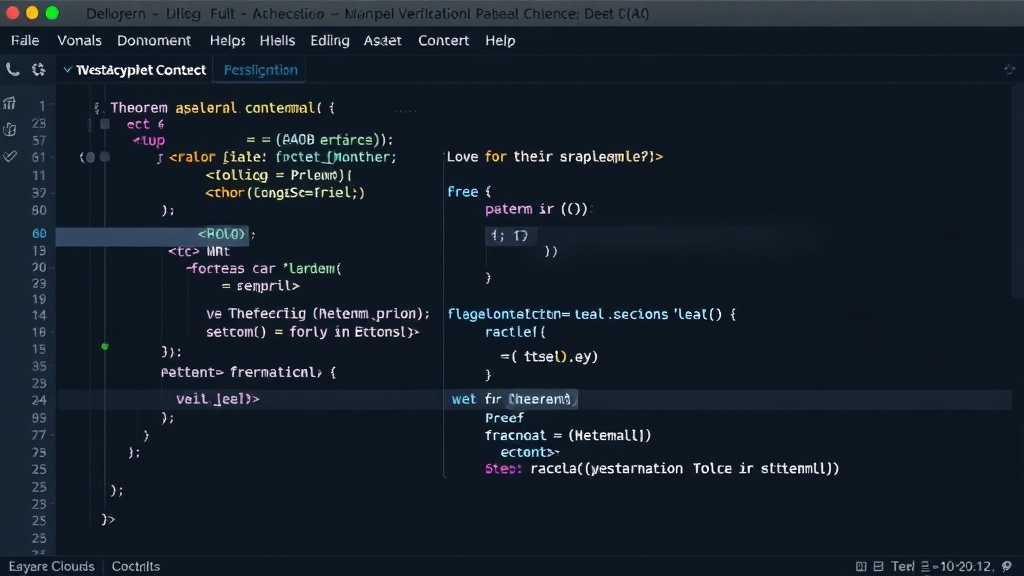
At its heart, Lean operates on the principle of constructing proofs. When you define a theorem in Lean, you are essentially stating a property that you want to prove. Lean then provides tools to build this proof step-by-step. Each step must be logically sound and justifiable. This could involve applying existing theorems, using built-in logical rules, or performing specific computations. The interactive nature means that the user guides the proof process, and Lean verifies each step. This is akin to a highly attentive editor who not only checks your grammar but also the logical coherence of your arguments, demanding a citation or justification for every claim.
Formalizing Properties
To formally verify software, we first need to express the desired properties in a formal language. This involves defining what the software is supposed to do. For example, in a sorting algorithm, a key property is that the output list is a permutation of the input list and is ordered. In Lean, these properties are expressed as theorems. The theorem statement itself is a formal specification. For instance, one might define a function `sort` and then state a theorem `is_sorted (sort input) ∧ is_permutation input (sort input)`. The goal then becomes to prove this theorem holds true for all valid inputs.
Proof Strategies in Lean
Proving theorems in Lean can range from straightforward to highly challenging. Lean offers various tactics that can be employed to construct proofs. These include:
- `intro` / `assume`: Used to introduce assumptions or hypotheses.
- `apply`: Applies an existing theorem to a goal, breaking it down into subgoals.
- `rewrite`: Substitutes a known equality into an expression.
- `simp` (simplifier): A powerful tactic that automatically applies a set of simplification rules and known theorems.
- `induction`: A fundamental tactic for proving properties about recursive data structures or functions, analogous to mathematical induction.
The art of formal verification with Lean lies in knowing which tactics to apply and in what order to guide the system towards a complete proof. This often requires a deep understanding of the problem domain and the logical structure of the properties being verified.
The First Steps for Developers
For developers new to formal verification and Lean, the journey begins with understanding the basic syntax and proof commands. Setting up Lean and its integrated development environment (IDE) support, such as the VS Code extension, is the initial practical step. Then, working through simple examples is key. This might involve proving basic mathematical facts, like the commutativity of addition, before moving on to more complex properties of algorithms or data structures. The Hacker News discussion around this topic highlights community interest and the potential for Lean to be adopted more widely in software development, particularly in areas where correctness is paramount.
Challenges and the Road Ahead
Formal verification, even with powerful tools like Lean, is not a silver bullet. The primary challenge is the effort involved. Writing formal specifications and constructing proofs can be time-consuming and requires a different mindset. Furthermore, the expressiveness of the formal system must match the complexity of the software being verified. As systems grow, so does the complexity of their formal proofs. However, the benefits in terms of guaranteed correctness for critical components can outweigh these costs. The ongoing development of Lean, including improved automation and more extensive libraries for common programming constructs, is steadily lowering the barrier to entry. This tutorial series, by breaking down the process into manageable parts, aims to equip developers with the foundational knowledge to start exploring this powerful technique.