
The Problem: Fragile, Interdependent Code
Software development often grapples with a common enemy: fragility. Changes made in one part of the system can trigger a domino effect, breaking seemingly unrelated components. This phenomenon, often a symptom of deeply intertwined code, makes maintenance a nightmare. Developers spend an inordinate amount of time tracking down and fixing these cascading bugs, slowing down development cycles and increasing costs.
The Law of Demeter (LoD), also known as the Principle of Least Knowledge, emerged from observations made during the Demeter research project. This project focused on creating software that could grow incrementally and adaptively, much like a cultivated plant. Researchers noted that a significant portion of software maintenance issues stemmed from classes that possessed intimate knowledge of the internal structures of other classes. When the internal structure of one class changed, it would inevitably break other classes that depended on that specific internal detail, even if they only needed a small piece of information.
This empirical observation was later supported by academic research. In 1994, Chidamber and Kemerer published their seminal work, "A Metrics Suite for Object Oriented Design." Within this suite, they introduced several Object-Oriented Design metrics, including Coupling Between Objects (CBO). While CBO measures the general coupling between classes, the underlying principle aligns with the LoD's concern about excessive dependencies. High CBO often indicates a violation of the LoD, suggesting that classes are too aware of each other's internals.
The Law of Demeter: What It Says
At its core, the Law of Demeter dictates that a method of an object should only call methods belonging to:
- The object itself.
- Its direct parameters.
- Any objects it creates or instantiates.
- Its direct component objects.
More colloquially, an object should only talk to its immediate friends and never to strangers. If an object needs to interact with a more distant object, it should ask its friend to do it. This principle aims to minimize the knowledge an object has about other objects, thereby reducing coupling and increasing modularity.
Consider an analogy: Imagine you need to ask a friend, Alice, for a specific book. You know Alice has a bookshelf, and on that bookshelf are several books. You also know that Alice has a library card to borrow books from the public library. According to the Law of Demeter, you should ask Alice to get the book for you. You should not ask Alice for her library card, then use the library card yourself to go to the public library and get the book. You are interacting with a stranger (the public library) through a series of intermediaries (Alice's bookshelf, Alice's knowledge of how to use the library card), which violates the principle.
Why It Matters: Benefits of Adhering to LoD
Adhering to the Law of Demeter yields significant benefits:
- Reduced Coupling: This is the primary goal. When objects know less about each other, changes in one object are less likely to affect others. This makes the system more robust.
- Improved Maintainability: With reduced coupling, bug fixes and feature additions become simpler. Developers can modify a class with greater confidence, knowing the ripple effect will be minimized.
- Increased Modularity: The system becomes a collection of more independent, self-contained modules. This makes it easier to understand, test, and reuse components.
- Enhanced Testability: Loosely coupled components are easier to isolate and test. Mocking dependencies becomes more straightforward when an object has fewer direct collaborators.
Common Violations and How to Fix Them
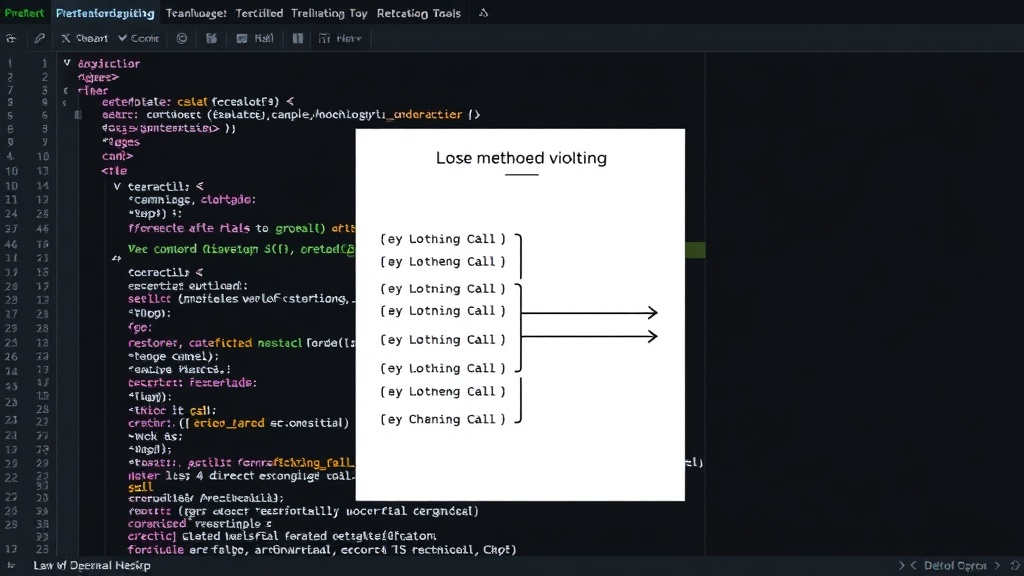
Violations of the Law of Demeter often manifest as code that chains method calls, accessing properties or calling methods on results that are themselves results of method calls. For example:
// Violation
user.getAddress().getCity().getName();
In this snippet, the `user` object is reaching through its `address` object to get the `city` object, and then through the `city` object to get its `name`. This code has deep knowledge of the structure: `user` knows about `address`, `address` knows about `city`, and `city` knows about `name`. If `address` or `city` structure changes, this code breaks.
A corrected version, adhering to LoD, might look like this:
// Adhering to LoD
String cityName = user.getCityName();
Here, the `user` object is responsible for knowing how to provide its city name. It might internally call `getAddress()` and then `getCity()` and then `getName()`, but the caller of `user` doesn't need to know any of that. The `user` object acts as a facade, encapsulating the interaction with its components.
Another common violation occurs when passing entire objects as parameters when only a specific piece of data is needed. For instance, passing a `User` object to a method that only needs the user's email address.
// Violation
userService.sendWelcomeEmail(user); // Method needs only user.getEmail()

// Adhering to LoD
userService.sendWelcomeEmail(user.getEmail());
By passing only what is necessary, the `userService` method reduces its knowledge of the `User` object's structure.
The Nuance: When Strict Adherence Might Be Overkill
While the Law of Demeter is a valuable guideline, rigid adherence can sometimes lead to code that is overly verbose or introduces unnecessary intermediary methods. In some contexts, particularly within a tightly controlled module or when dealing with simple data structures, a slightly more relaxed approach might be pragmatic. The key is to strike a balance. Ask yourself: does this method call introduce significant coupling that will likely cause problems down the line? If the answer is no, a slight deviation might be acceptable. However, the default should always be to follow the principle.
The original Demeter project's goal was to cultivate software that grows adaptively. The Law of Demeter is a crucial principle for achieving this. By ensuring objects interact only with their immediate collaborators, we build systems that are more resilient to change, easier to understand, and ultimately, more cost-effective to maintain. For any developer tasked with long-term software ownership, understanding and applying the Law of Demeter is not just good practice—it's essential for building sustainable software.