
The Problem with Chunks in Laravel
Developers frequently face the task of segmenting large documents into smaller, manageable chunks. These chunks are then typically embedded into vector representations and stored in a search engine like Meilisearch. The common workflow assumes these chunks reside solely within the search index. There's no need for a separate database copy because chunks are not joined with other data, rarely edited manually, and the primary use case is retrieving relevant chunks based on a query and specific filters.
However, querying these chunks directly from a Laravel application presents an awkward challenge. Laravel Scout, the popular search integration package, is designed to mirror Eloquent models into a search index. This approach is inverted for chunked data, where the search index is the source of truth, not a reflection of a database table. Consequently, developers often resort to interacting with the raw Meilisearch client. This involves manually constructing filter strings and then painstakingly mapping the returned arrays back into a usable format within Laravel.
This manual process is verbose, error-prone, and detracts from developer productivity. It requires a deep understanding of Meilisearch's query syntax and filter DSL, which can be a steep learning curve, especially when dealing with complex filtering requirements.
Introducing Larameili
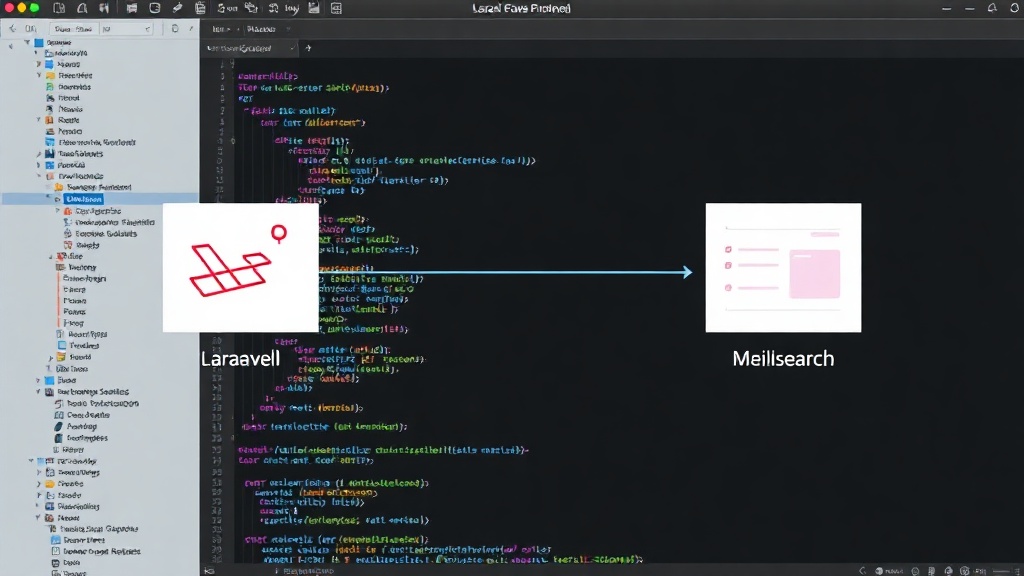
Larameili emerges as the solution to this specific problem. It provides a seamless integration between Meilisearch indexes and Laravel's Active Record pattern, effectively giving a Meilisearch index an Eloquent-like interface. This means that developers can interact with their stored chunks as if they were standard Eloquent models, even though these chunks never actually touch a relational database. Larameili abstracts away the complexities of the raw Meilisearch client, filter construction, and data mapping, allowing developers to focus on building features rather than wrestling with low-level search interactions.
The core benefit of Larameili is its ability to treat a Meilisearch index as a first-class citizen within the Laravel ecosystem, akin to an Eloquent model. This paradigm shift simplifies data retrieval and manipulation, making it significantly easier to build sophisticated search functionalities powered by Meilisearch within a Laravel application. It bridges the gap between the document-centric nature of Meilisearch and the object-relational mapping (ORM) paradigm familiar to Laravel developers.
Installation and Setup
Installing Larameili is as straightforward as any other Laravel package. It leverages Composer for dependency management. Once installed, the package's service provider automatically registers itself with the Laravel application, making its features immediately available.
The primary step after installation is configuring the connection to your Meilisearch instance. This typically involves setting up environment variables in your Laravel application's .env file, specifying the Meilisearch host URL and API key. Larameili then uses these credentials to communicate with your Meilisearch cluster.
The package introduces a new concept: the Meiliquent model. This model serves as the Eloquent-like representation for your Meilisearch index. You define a Meiliquent model that corresponds to a specific Meilisearch index. This model allows you to specify which attributes should be searchable, filterable, and sortable within Meilisearch, directly from your model definition. You can also define primary keys and other index-specific configurations through this model.
Storing Chunks
With Larameili set up, storing chunks becomes an intuitive process. Instead of manually serializing data and pushing it to Meilisearch, you can create instances of your Meiliquent model and save them. Larameili handles the underlying mechanism of sending this data to the designated Meilisearch index.
For example, if you have a document processing pipeline that splits documents into chunks, you can iterate through these chunks and create a new instance of your Meiliquent model for each chunk. Calling the save() method on these model instances will automatically index the data in Meilisearch. This abstracts the direct API calls, making the code cleaner and more maintainable.
Consider a scenario where you're processing PDF documents. After extracting text and splitting it into chunks, each chunk can be represented by a Meiliquent model. The model might have attributes like document_id, page_number, chunk_index, and content. Saving these models via Larameili ensures that each piece of text is properly indexed and ready for searching.
Searching Chunks
The real power of Larameili shines when querying. It provides methods that mirror Eloquent's query builder, allowing developers to search for chunks using familiar syntax. You can chain methods like search(), where(), and paginate() directly on your Meiliquent model.
The search() method accepts a query string and optionally an array of search parameters, such as filters. The where() method, when used with a Meiliquent model, translates into Meilisearch filters. This significantly simplifies complex search queries that involve multiple filter conditions.
For instance, to find chunks related to a specific topic within a particular document, you could write:
<?php

use App\Models\Chunk; // Assuming your Meiliquent model is named Chunk

$results = Chunk::search('artificial intelligence', function(
    Meilisearch\Search\Query
) use (&$query) {
    $query->where('document_id', 123);
    $query->where('language', 'en');
})
->get();
Larameili handles the conversion of this Eloquent-like query into the appropriate Meilisearch API call, including the construction of the filter string. The results are then automatically mapped back into instances of your Meiliquent model, providing a consistent and developer-friendly interface. This eliminates the need for manual parsing of JSON responses and manual object instantiation.
Beyond Basic Search
Larameili isn't limited to simple keyword searches. It allows developers to leverage Meilisearch's advanced features through its Eloquent-like interface. This includes:
- Faceting: While not directly exposed as a chained method, filters can be configured in Meilisearch to support faceting, and Larameili's underlying client access can be used to retrieve facet data.
- Typo Tolerance: Meilisearch's built-in typo tolerance is automatically available for searches performed via Larameili, meaning users can make typos without breaking search results.
- Ranking Rules: Developers can configure Meilisearch's ranking rules to prioritize certain attributes or match types, influencing the order of search results. Larameili allows these configurations to be managed through the
Meiliquentmodel or directly via the Meilisearch client. - Highlighting: Search results can include highlighting information, showing users exactly where their query terms appeared in the matched chunks.
The package aims to provide a comprehensive layer of abstraction, allowing Laravel developers to harness the full power of Meilisearch without becoming Meilisearch experts. It democratizes access to advanced search capabilities for a wider range of developers.
The Unanswered Question: Scalability of Raw Meilisearch vs. ORM Abstraction
While Larameili offers a compelling developer experience by abstracting the Meilisearch API into an Eloquent-like interface, a lingering question remains: what is the performance impact of this abstraction layer on highly scalable, high-throughput applications? Meilisearch is known for its speed and efficiency, often outperforming more complex search solutions for specific use cases. When dealing with millions of chunks and a constant stream of search queries, will the overhead introduced by Larameili's model mapping and query translation become a bottleneck? Developers building massive knowledge bases or real-time search applications will need to benchmark Larameili's performance against direct Meilisearch client usage to ensure it meets their critical scalability requirements. The trade-off between developer convenience and raw performance is a perennial concern in system design.
Conclusion: A More Productive Path for Laravel + Meilisearch
Larameili addresses a significant pain point for Laravel developers working with Meilisearch for chunked data storage and retrieval. By providing an Eloquent-like interface for Meilisearch indexes, it dramatically simplifies the development process, reduces boilerplate code, and allows developers to leverage powerful search features with familiar syntax. For teams that have previously shied away from integrating Meilisearch due to the complexities of direct client interaction, Larameili offers a clear and productive path forward. It transforms Meilisearch from a standalone search engine into a natural extension of the Laravel application's data layer.