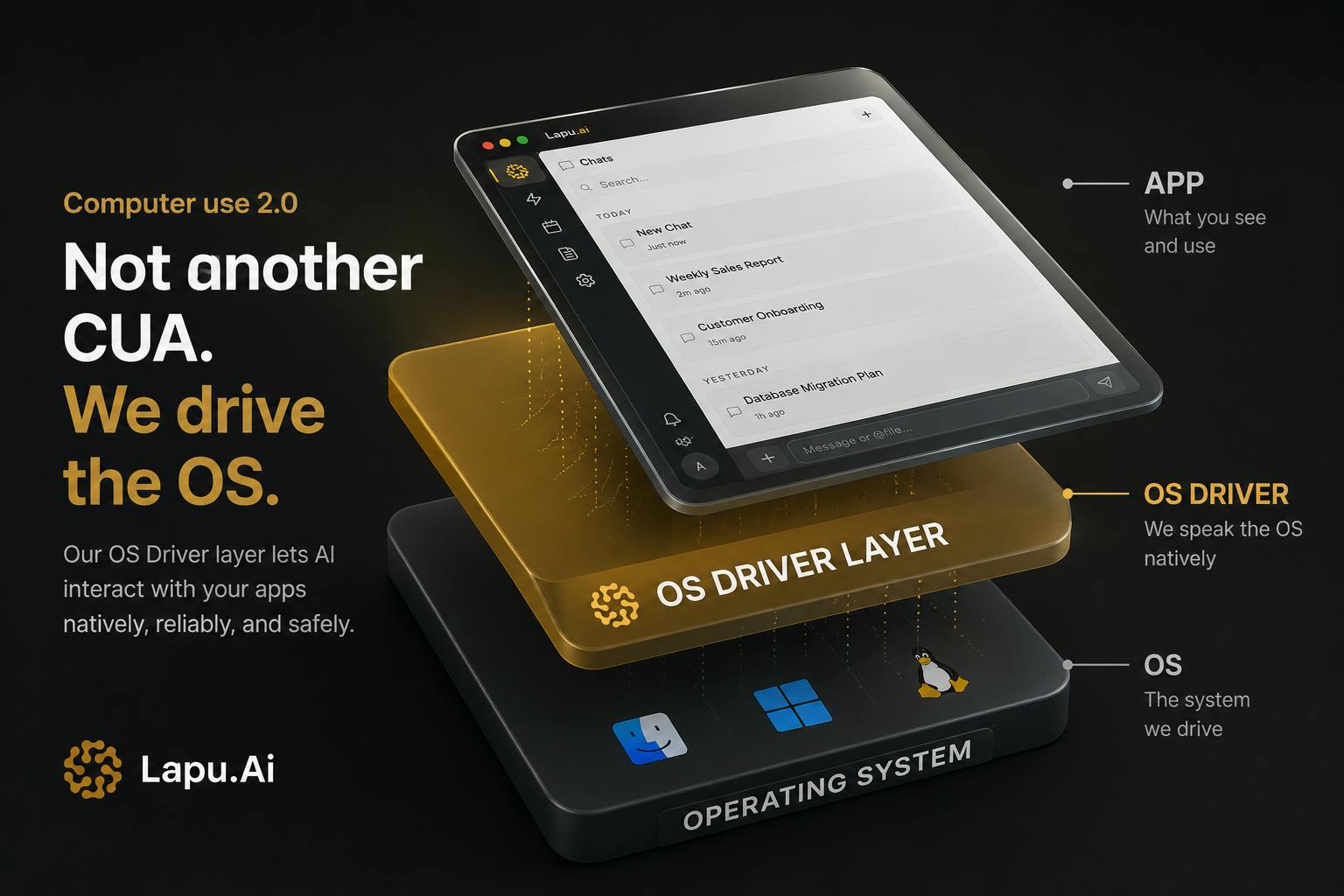
The Vision: AI as an Operating System Driver
LapuAi is positioning itself as a fundamental shift in how artificial intelligence interacts with personal computing. Instead of AI models operating in isolated sandboxes or relying on complex API integrations, LapuAi aims to function as an 'OS Driver for AI.' This concept suggests that AI agents, equipped with LapuAi, could directly control and manipulate computer operating systems, much like a hardware driver allows the OS to communicate with a graphics card or a network interface.
The implications of such a system are vast. Imagine AI agents that can browse the web, manage files, launch applications, and even perform complex multi-step tasks on your behalf, all without requiring explicit, step-by-step programming for each action. This moves beyond current AI assistants that primarily rely on pre-defined commands or simple web interactions. LapuAi envisions a future where AI has the agency to understand and execute tasks within the user's existing computing environment.
Think of it less like a chatbot that can search the internet and more like a digital intern who can actually use your computer. This intern wouldn't just tell you how to do something; they would do it for you, navigating menus, clicking buttons, and typing into fields as if they were a human user. This level of autonomy is the core promise of LapuAi.
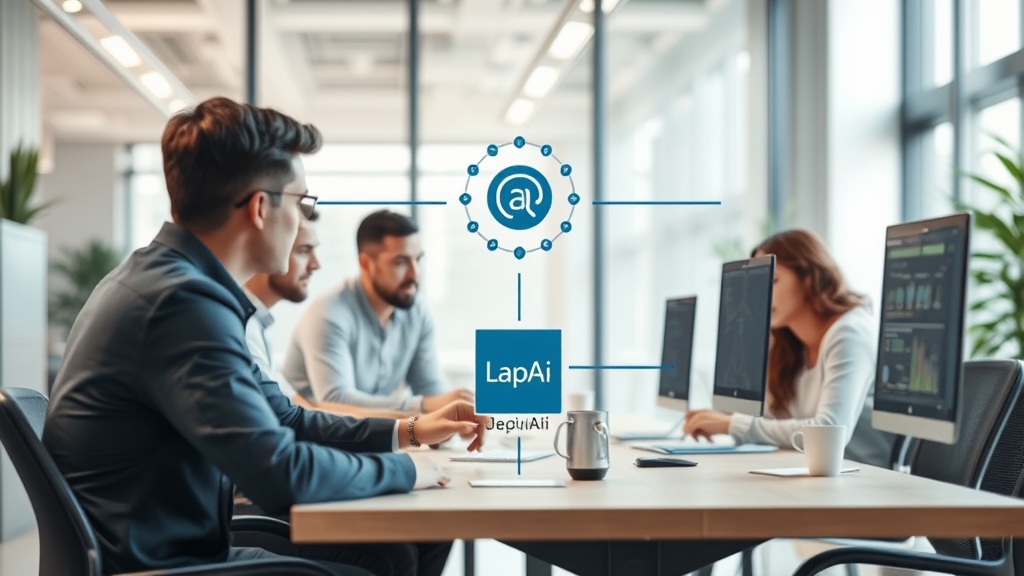
Bridging the AI-Human Interface Gap
Current AI models, particularly large language models (LLMs), excel at understanding and generating human language. However, translating that understanding into concrete actions within a traditional desktop operating system presents a significant challenge. LLMs can generate code or provide instructions, but executing those instructions directly on a user's machine requires a layer of abstraction that can interpret AI outputs and translate them into OS-level commands.
LapuAi seeks to be that interpreter. By acting as an OS driver, it would abstract away the complexities of interacting with Windows, macOS, or Linux. This means AI developers and users could potentially create AI agents that can:
- Browse and interact with any website: Beyond simple scraping, this could involve logging into accounts, filling forms, and performing complex navigation.
- Manage files and folders: Create, move, copy, delete, and organize files based on AI-driven logic.
- Launch and control applications: Open software, input data, and execute functions within those applications.
- Automate multi-step workflows: Combine actions across different applications to complete intricate tasks, such as generating reports from various data sources and then emailing them.
This capability is crucial for advancing the field of AI agents. Without a robust way for AIs to interact with the digital world as we do, their potential remains largely theoretical or confined to specialized, API-driven environments. LapuAi's approach promises to democratize AI agency, allowing it to operate within the familiar confines of a personal computer.
Potential Applications and Future Implications
The potential applications of LapuAi span across numerous domains. For developers, it could mean building more sophisticated AI assistants, automation tools, and even AI-powered software. Imagine AI agents that can manage your development environment, deploy code, or even assist in debugging by interacting with development tools directly.
For end-users, LapuAi could revolutionize productivity. Tasks that currently require significant manual effort, such as organizing large photo libraries, managing complex spreadsheets, or performing repetitive data entry across multiple applications, could be delegated to AI agents. This could free up human users to focus on more creative and strategic work.
In the realm of cybersecurity, AI agents with OS-level control could be used for advanced threat detection and response, proactively identifying and neutralizing threats by interacting with system processes and network traffic. Conversely, malicious actors could leverage similar capabilities for more sophisticated attacks, highlighting the dual-use nature of such powerful technology.
The success of LapuAi hinges on its ability to provide a secure, reliable, and performant bridge between AI models and operating systems. The technical challenges are significant, including ensuring that AI actions are predictable, that sensitive data is protected, and that the system doesn't introduce new vulnerabilities. However, if LapuAi can deliver on its promise, it could represent a significant step towards truly intelligent and autonomous AI agents that can operate effectively in our digital world.
The Unanswered Question: Security and Control
What nobody has addressed yet, and what will be critical for LapuAi's adoption, is the robust security framework required for an AI to have such deep access to a computer's operating system. Granting an AI the ability to execute arbitrary commands carries inherent risks. How will LapuAi ensure that AI agents operate within defined boundaries? What safeguards will be in place to prevent malicious AI from causing system damage, stealing data, or spreading malware? The promise of AI controlling computers is exciting, but the practical implementation demands an equally compelling answer to the question of absolute control and security. Without this, widespread trust and adoption will be a significant hurdle.