The Core Distinction: Engineering vs. Runtime
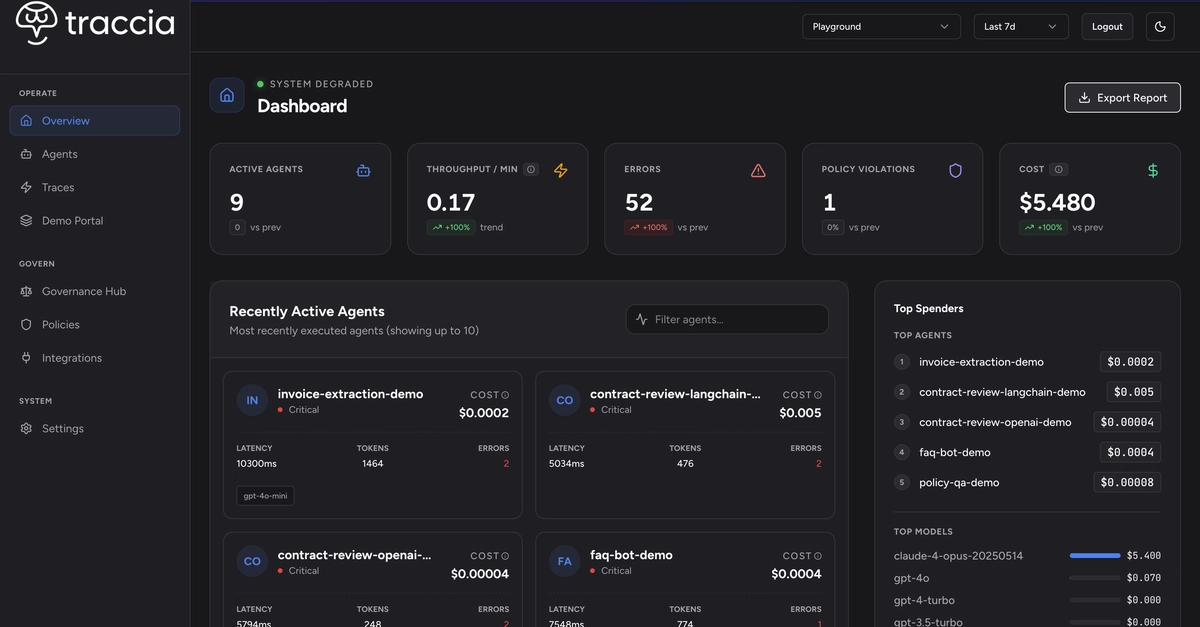
When deploying AI agents, two critical needs emerge: understanding their behavior during development and controlling their actions in production. LangSmith and Traccia address these needs, but from fundamentally different vantage points. LangSmith, deeply integrated with the LangChain ecosystem, excels at the granular debugging and iterative refinement of agent logic. It’s your workbench for understanding why an agent said what it said. Traccia, on the other hand, operates as a runtime control plane. It’s designed for observing agents across different frameworks, enforcing policies at the agent's boundary, and providing auditable proof of its operations in a live environment.
This isn't about one tool being superior. It's about understanding their placement within the AI agent lifecycle. LangSmith is an agent engineering tool, focused on a trace-first debugging experience. Traccia is a runtime observability and control plane, concerned with the agent's behavior once it's live and interacting with the real world.
Consider it this way: LangSmith is like the detailed blueprint and simulation environment for building a complex piece of machinery. You use it to test every gear, every lever, and every possible failure mode in a controlled setting. Traccia is like the sophisticated dashboard and safety interlocks on the actual factory floor. It monitors the machine's performance in real-time, ensures it adheres to operational limits, and logs every significant action for accountability.
LangSmith: Deep Dive into Agent Engineering
LangSmith’s primary strength lies in its ability to provide deep visibility into the execution of LangChain agents. It offers nested tracing, allowing developers to dissect the complex chains of thought, tool calls, and LLM interactions that constitute an agent's decision-making process. This granularity is invaluable for identifying bugs, optimizing prompts, and understanding emergent behaviors. The platform's insights clustering helps developers aggregate similar issues, making it easier to spot recurring problems and prioritize fixes. For developers building with LangChain, LangSmith acts as an indispensable companion, streamlining the path from a nascent agent concept to a robust, debugged application.
Its focus is on the internal workings of the agent. Developers can replay traces, annotate them, and track performance metrics related to latency, cost, and output quality. This iterative feedback loop is crucial for improving the agent's reliability and effectiveness before it ever encounters production traffic. LangSmith helps answer the 'why' behind an agent's output during development.
Traccia: Runtime Observability and Policy Enforcement
Traccia shifts the focus to the production environment. Its core value proposition is the ability to observe agents irrespective of the framework they are built upon, thanks to its adoption of OpenTelemetry (OTel) standards. This means Traccia can bring unified observability to a heterogeneous agent deployment, where different agents might be built with LangChain, LlamaIndex, or custom code. It provides detailed lineage tracking, showing how data flows through the agent and its interactions with external systems.
The critical differentiator for Traccia is its enforcement capability. It allows teams to define and enforce policies at the agent boundary. This could include rules about what kinds of data an agent can access, what actions it is permitted to take, or specific compliance requirements it must meet. By acting as a runtime control plane, Traccia ensures that agents operate within defined guardrails, mitigating risks and ensuring accountability. It provides auditable logs that prove what happened, when, and why, which is essential for compliance and security in production systems.
Traccia answers the 'what happened' and 'did it follow the rules' questions in production. This capability is vital for organizations that need to demonstrate compliance, manage operational risk, and maintain trust in their AI systems. It moves beyond simple logging to active policy enforcement and verifiable operational history.
The Stack Layer Question
The distinction between agent engineering and runtime control is fundamental. Agent engineering tools like LangSmith are essential for the initial build and validation phases. They provide the deep, internal visibility needed to craft effective agent logic. Runtime control planes like Traccia become critical once the agent is deployed. They provide the external, policy-driven oversight necessary to manage risks and ensure reliable operation in the unpredictable environment of production.
Trying to use an agent engineering tool for runtime enforcement is like trying to use a screwdriver to tighten a bolt on a moving assembly line – it’s the wrong tool for the job. Similarly, relying solely on runtime observation without deep development-time debugging can lead to brittle agents that are hard to fix when they inevitably fail. The ideal scenario involves leveraging both types of tools.
For instance, a developer might use LangSmith to perfect an agent's ability to summarize customer support tickets. They would iterate on prompts, test tool integrations, and ensure the agent correctly extracts key information. Once satisfied, they deploy this agent using Traccia. Traccia would then monitor the agent's interactions with the customer database, ensuring it only accesses permitted data fields and logs every summary action. If the agent attempts to access restricted data, Traccia would block the action and flag the event. This layered approach ensures both the agent's efficacy and its safe, compliant operation.
When to Use Which
If you are actively building, debugging, or optimizing the logic of your AI agents, particularly within the LangChain ecosystem, LangSmith should be your primary tool. It provides the introspection necessary to understand and improve agent performance during development.
If your AI agents are already deployed, or you are deploying them into production environments where policy enforcement, auditable logs, and cross-framework observability are critical, Traccia is the tool you need. It provides the guardrails and visibility required for managing AI systems in live operations. The choice isn't mutually exclusive; a mature AI deployment strategy will likely incorporate elements of both. Understanding their distinct roles helps teams build more robust, reliable, and secure AI agents.