The Memory Problem in AI Agents
Building AI agents with LangGraph and other frameworks promises sophisticated conversational abilities. Yet, a common and frustrating issue emerges: agents forget crucial context from previous turns in a conversation. This isn't a minor bug; it cripples the agent's utility, especially for tasks requiring follow-up questions or maintaining a coherent dialogue, like a simple support bot.
You might have meticulously followed documentation for StateGraph, expecting it to manage conversational history. However, the agent still responds as if the user's last input was in a vacuum. This disconnect between expected functionality and actual performance points to a deeper understanding required of the underlying decision-making process.
Understanding the ReAct Loop
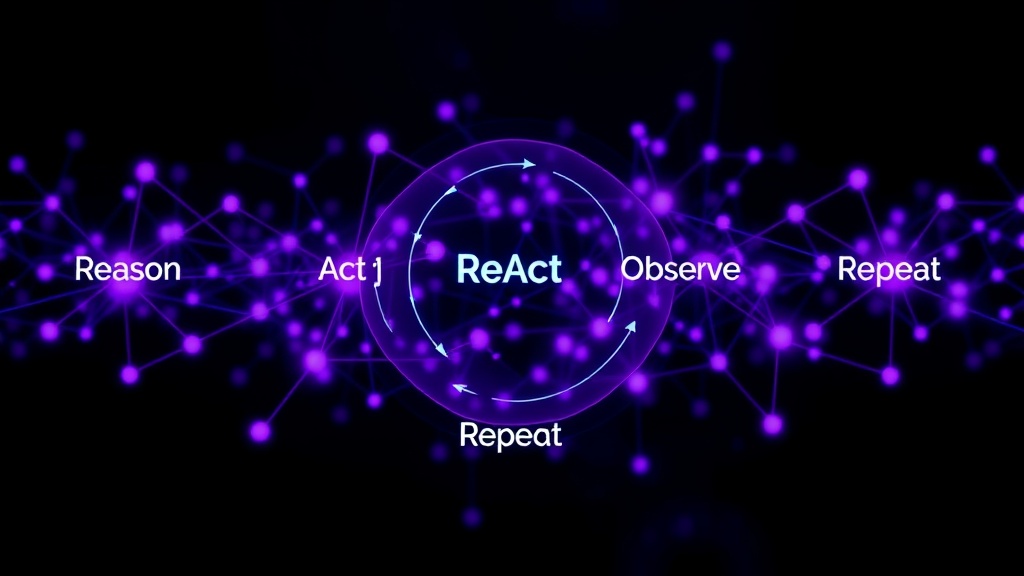
LangGraph's core strength lies in its ability to implement complex agentic behavior through a structured loop. This is the ReAct (Reason, Act, Observe) loop. The fundamental idea is that an agent:
- Reasons about the current state of the world and the user's input.
- Acts based on that reasoning, typically by invoking a tool or generating a response.
- Observes the outcome of its action, which updates the state of the world.
- Repeats the process, using the updated state to inform the next step.
This iterative cycle is the engine that drives an agent's decision-making and allows it to adapt and learn within its operational environment. For a support bot, this loop is essential for handling multi-turn interactions. Without it functioning correctly, the agent cannot build upon prior information.
Implementing ReAct for Contextual Awareness
The challenge of memory loss in LangGraph agents often stems from how the ReAct loop is configured and how state is managed. A typical ReAct loop in a support bot scenario involves the agent processing user input, deciding whether to use a tool (like a knowledge base lookup or a customer database query), executing that tool, and then observing the tool's output to formulate a response. Each step needs to feed into the next, updating the agent's understanding of the conversation's state.
Consider a user asking, "What was the status of my last order?" The agent reasons, identifies the need for a tool to query order status, acts by calling the `getOrderStatus` tool with user-identifying information (perhaps implicitly derived from session context), observes the tool's output (e.g., "Shipped"), and then responds, "Your last order has been shipped." If the user then asks, "When will it arrive?", a correctly implemented ReAct loop should allow the agent to recall the previous `getOrderStatus` action and its result, and then use that information to query a shipping or tracking tool, rather than asking "Which order are you referring to?"
Common Pitfalls and Solutions
Several factors can disrupt the ReAct loop and cause memory loss:
State Management Issues
The agent's internal state must accurately reflect the conversation history and the results of previous actions. If the state isn't updated correctly after each observation, the agent will operate on stale information. This means ensuring that the output of tools and the agent's own thoughts are consistently added to the state that is passed to the next node in the graph.
Tool Invocation Errors
When an agent uses a tool, the tool's output is critical. If the tool returns an error, or if the agent misinterprets the tool's output, the ReAct loop can break. This might involve ensuring that tools are robust, that their return formats are consistent, and that the agent's parsing logic for tool outputs is sound. For example, if a `getUserID` tool fails, the agent shouldn't proceed as if it has the ID.
Reasoning Logic Flaws
The agent's reasoning process, often driven by a Large Language Model (LLM) prompt, must explicitly instruct the agent to consider the current state and past observations. If the prompt doesn't guide the LLM to look at the relevant parts of the state (e.g., previous tool outputs or conversation history), it might generate a response without considering the full context. This is where prompt engineering becomes paramount. Prompts should emphasize referencing the `messages` or `tool_results` within the agent's state.
Graph Structure and Entry Points
The way the StateGraph is defined in LangGraph is crucial. Each node should represent a distinct step in the ReAct process (e.g., `agent`, `tool_executor`, `observation_parser`). Transitions between these nodes must be carefully defined to ensure the state flows correctly. For instance, after an agent node calls a tool, the execution should transition to a tool node, whose output then transitions back to the agent node, allowing it to reason based on the new information.
A common mistake is not correctly defining the `next` state after a tool execution. If the graph doesn't explicitly route back to the agent node after a tool has run and its output has been processed, the agent will not have the opportunity to use that output in its subsequent reasoning step.
The Developer's Role in ReAct
As developers, our job is to architect this loop. This involves:
- Defining the State Schema: Clearly outlining what information the agent needs to maintain (e.g., `messages`, `tool_code`, `tool_results`, `agent_outcome`).
- Crafting LLM Prompts: Engineering prompts that guide the LLM to perform the reasoning step effectively, encouraging it to refer to the current state.
- Implementing Tool Wrappers: Ensuring tools are callable and their outputs are correctly formatted and captured.
- Configuring Graph Transitions: Precisely defining how the state moves between different nodes in the LangGraph.
The ReAct loop is not magic; it's a pattern that must be meticulously implemented. When an agent forgets, it's usually a sign that one of these components is misconfigured or missing a critical piece of information flow.
Beyond Basic ReAct: Advanced Considerations
While the basic ReAct loop addresses immediate memory issues, advanced scenarios might require further enhancements. This could include:
- External Memory Systems: For very long conversations or agents needing to recall information across sessions, integrating vector databases or other persistent memory solutions becomes necessary.
- Hierarchical Agents: Breaking down complex tasks into smaller sub-tasks handled by specialized agents, coordinated by a supervisor agent.
- Self-Correction Mechanisms: Implementing loops where the agent can detect its own errors or suboptimal reasoning and attempt to correct them.
Ultimately, the ReAct loop in LangGraph provides a powerful framework for building intelligent, stateful AI agents. By understanding its components and common failure points, developers can move beyond agents that forget and build systems that truly understand and respond to user needs contextually.