The Unseen Cost of Rapid Development
LangChain, a prominent framework for developing applications powered by large language models, has experienced a significant shift in its internal development velocity over 38 months. An analysis of its commit history, from January 27, 2023, to March 14, 2026, reveals a stark contrast between its early rapid release cycles and its later, more protracted development cadence. This isn't about external metrics or subjective opinions on code quality; it's LangChain measured against itself, tracking the evolution of its own development processes.
In its formative period, LangChain was known for shipping new releases with astonishing speed. At its peak, a new version could be deployed roughly every 30 minutes. This pace is characteristic of agile development, especially in the fast-moving AI landscape. However, the data shows a clear trend of deceleration. By the end of the analyzed period, the time between releases had stretched to approximately six days. This represents a dramatic reduction in release frequency, moving from multiple releases per hour to one release per week.
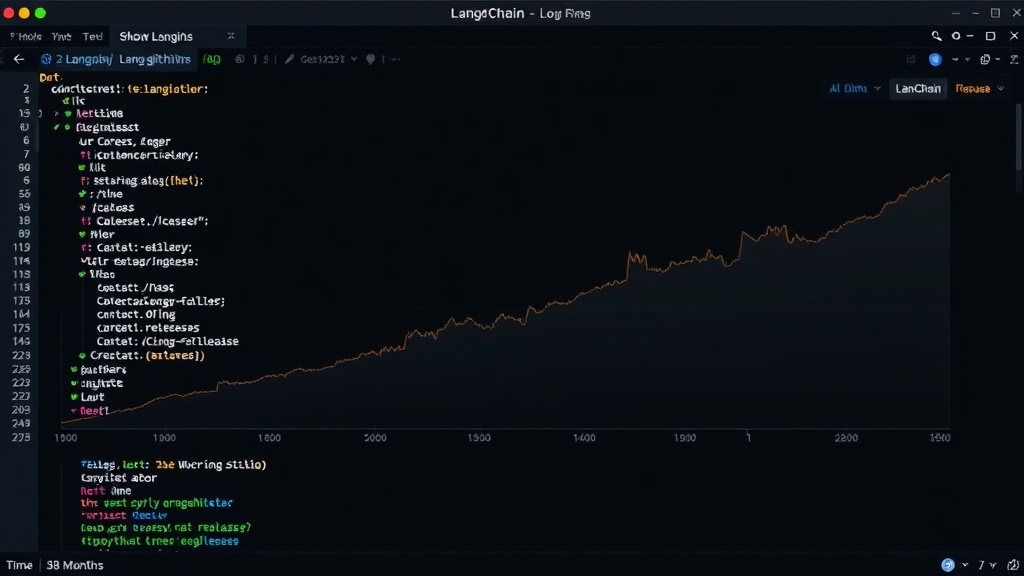
The impact of this slowdown is not confined to release cycles. Continuous Integration (CI) build times, a critical indicator of development efficiency and code health, have also ballooned. A CI build that once took a mere 10 seconds has, at its longest, extended to 55 minutes. This is an 889-fold increase over the repository's own baseline speed. Even when accounting for normal fluctuations, the final measurement stood 27 standard deviations above the historical norm. Such a dramatic increase suggests underlying issues that are impeding the development workflow.
The AI-Assisted Development Paradox
LangChain's entire existence falls within the era of AI-assisted coding. The project was initiated in the same quarter that AI pair-programming tools began entering the mainstream. This raises a complex question: to what extent has AI influenced this architectural drift and performance degradation? The analysis cannot definitively distinguish between human-written and AI-generated code within the commits. However, the observed trends occurred during a period of widespread adoption of AI coding assistants, suggesting a potential, albeit unquantifiable, correlation.
The architecture of a software project is not static. It evolves with every commit, every feature added, and every bug fixed. For a project like LangChain, which aims to abstract complex LLM interactions, the architecture must be both flexible and robust. The data suggests that while flexibility might have been prioritized, robustness and efficiency may have suffered. The increasing complexity and interdependencies within the codebase could be contributing to longer build times and more challenging release processes. This is akin to a city growing rapidly without adequate infrastructure planning; the initial convenience gives way to traffic congestion and strained utilities.
Measuring Internal Drift
The significance of this analysis lies in its self-referential nature. It does not compare LangChain to other frameworks or adhere to external best practices. Instead, it uses LangChain's own historical performance as the benchmark. This approach highlights internal inefficiencies that might otherwise be masked by comparisons to other projects, which have their own unique development histories and challenges. The 38-month window is substantial, encompassing the project's growth from a nascent framework to a widely adopted toolset.
The deceleration in release frequency and the exponential increase in CI build times are not isolated incidents. They are symptoms of a larger architectural evolution. As codebases grow, they naturally become more complex. Without deliberate architectural interventions, refactoring, and optimization, this complexity can lead to a phenomenon known as “technical debt.” This debt accrues in the form of slower development, increased bug rates, and higher maintenance costs. The metrics observed in LangChain's commit history strongly suggest that technical debt has been accumulating.
Implications for Developers and the Ecosystem
For developers building on LangChain, these internal performance degradations have tangible consequences. Longer CI build times translate directly into slower feedback loops. Developers spend more time waiting for tests to run and code to be integrated, reducing overall productivity. Furthermore, a codebase that is becoming harder to build and release might also become harder to contribute to. This could potentially stifle community contributions and slow down the pace at which new features and bug fixes are incorporated, paradoxically negating some of the benefits of the rapid iteration that LangChain was initially known for.
The architectural changes, while not explicitly detailed, can be inferred from the performance metrics. The increasing time to build and release suggests that code is becoming more tightly coupled, dependencies are more complex, or the build system itself is struggling to cope with the scale of the project. This can make it more difficult for developers to understand the codebase, refactor components, or integrate new libraries. The framework, designed to simplify LLM application development, might inadvertently be creating new barriers for its users.
The trend is also a cautionary tale for the broader AI development ecosystem. As AI tools become more integrated into the development lifecycle, it’s crucial to monitor their impact on code quality, build efficiency, and architectural integrity. The assumption that AI assistance automatically leads to faster, better code is not borne out by these metrics alone. Vigilance in code reviews, architectural planning, and performance monitoring remains paramount, regardless of the tools used.
The Unanswered Question of Sustainability
What remains unaddressed is the long-term sustainability of LangChain's development model if these trends continue. While the project has benefited immensely from its initial rapid pace, the current trajectory suggests a potential plateau or even decline in development velocity. The architectural choices made over these 38 months, influenced by both human decisions and the pervasive presence of AI coding tools, have led to a measurable slowdown. The challenge for LangChain and similar projects is to find a balance between rapid innovation and sustainable, efficient development practices. This involves not only writing code but also actively managing the architecture and the development infrastructure to ensure that the project can continue to evolve without succumbing to its own complexity.