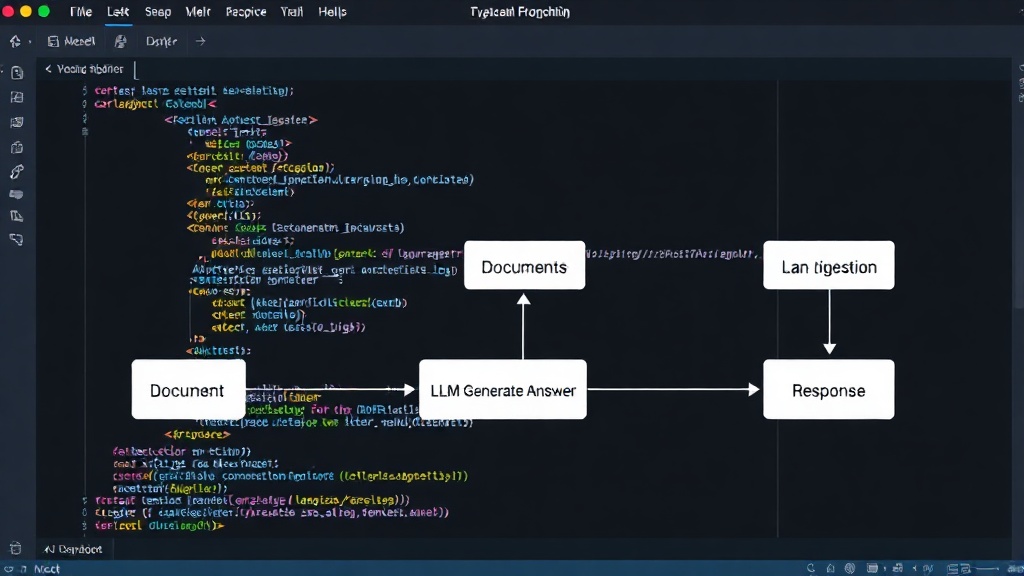
Chains: The AI Workflow Pipeline
At its core, building with large language models often involves orchestrating multiple steps. A chain in LangChain represents a sequence of operations where the output of one step serves as the input for the next. This is fundamental to creating structured AI workflows. Imagine a user asking a question. The process might involve retrieving relevant documents from a knowledge base, feeding those documents and the question to an LLM for an answer, and then formatting that answer into a user-friendly response. This sequential execution is the essence of a chain, acting like a pipeline for AI tasks.
Tools: Empowering LLMs with External Capabilities
Large language models possess vast knowledge derived from their training data, but they are inherently limited to that information. To overcome this, Tools are introduced. Tools grant LLMs the ability to interact with the outside world, extending their capabilities far beyond text generation. These tools can range from performing web searches to query SQL databases, calling external REST APIs, executing Python code for complex computations, reading information from PDFs, or even sending emails. By equipping an LLM with tools, developers can build applications that are not only intelligent but also actionable and data-driven.
Agents: Dynamic Decision-Making for Complex Tasks
While chains provide a linear execution path, Agents introduce a layer of dynamic decision-making. An agent uses an LLM as a reasoning engine to decide which actions to take and in what order. Unlike a chain, which follows a predefined sequence, an agent can select tools, execute them, observe the results, and then decide on the next best action based on the current state of the task. This makes agents incredibly powerful for handling complex, multi-step problems where the path to a solution is not immediately obvious. The agent's loop involves observing the environment, thinking about the best tool to use, using the tool, and repeating until the task is complete.
LangGraph: State Machines for Complex Agents
Building sophisticated agents often requires managing complex states and intricate logic. This is where LangGraph shines. LangGraph is a library built on top of LangChain that enables the creation of stateful, multi-actor applications. It allows developers to define graphs where nodes represent computational steps (like calling an LLM, using a tool, or performing a custom function) and edges represent the transitions between these states. Think of it as defining a finite state machine for your AI agents. This graph-based approach is particularly useful for applications involving collaboration between multiple AI agents, conditional logic, or recurrent processes. For instance, an agent might need to perform a series of checks, branch based on the results, and then loop back to refine its output – a perfect use case for LangGraph's stateful graph capabilities.
Memory: Enabling Context and Conversation
For AI applications to engage in meaningful conversations or maintain context over extended interactions, Memory is crucial. Memory components allow chains and agents to retain information from previous turns in a conversation or from past interactions. This could involve storing conversation history, summarizing key points, or recalling specific details. Without memory, each interaction would be treated in isolation, severely limiting the AI's ability to understand and respond contextually. LangChain offers various memory types, from simple conversation buffers to more advanced summarization or knowledge graph-based memory, enabling AI systems to build a coherent understanding over time.
Putting It All Together
Understanding these core concepts—Chains for sequential processing, Tools for external interaction, Agents for dynamic decision-making, LangGraph for stateful agent orchestration, and Memory for contextual awareness—provides a robust foundation for any AI engineer looking to build advanced applications. Whether you are constructing a simple question-answering system or a complex, multi-agent collaborative platform, these building blocks are essential for harnessing the full potential of LLMs.