
The Limits of Large Language Models and the Rise of RAG
Large Language Models (LLMs) have transformed natural language processing, but they aren't without their limitations. Two primary issues plague their standalone use: hallucination and knowledge staleness. LLMs can confidently present incorrect information when they lack the relevant data, and their knowledge is inherently frozen at the time of their last training update. Retrieval-Augmented Generation (RAG) offers a powerful solution to both problems. RAG enhances LLM output by integrating external, up-to-date information, ensuring greater accuracy and relevance.
This article details how to construct a functional RAG pipeline using two leading tools: LangChain, a framework for developing LLM-powered applications, and Pinecone, a managed vector database optimized for high-speed similarity search at scale. By combining these technologies, developers can build systems that leverage the generative power of LLMs while mitigating their inherent weaknesses.
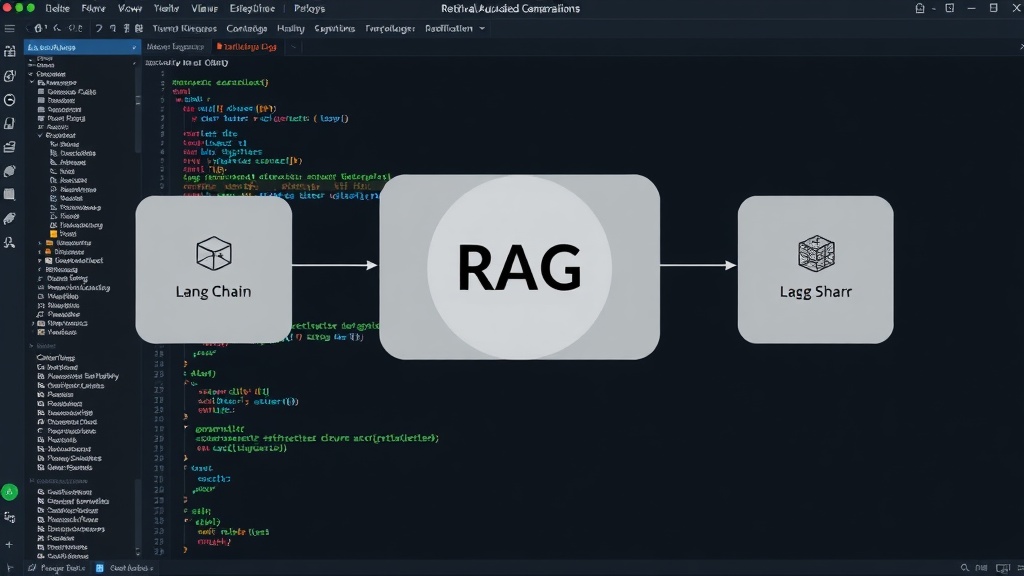
The Three Pillars of a RAG Pipeline
A standard RAG pipeline operates through three fundamental steps: Retrieve, Augment, and Generate. Each step plays a critical role in transforming a raw query into an informed, contextually relevant response.
1. Retrieve: Finding Relevant Information
The process begins when a user submits a query. The RAG system doesn't immediately pass this query to the LLM. Instead, it first queries an external data source, typically a vector database. This database stores information, often documents or text chunks, that have been converted into numerical vector embeddings. The system searches these embeddings to find those most semantically similar to the user's query vector. The goal is to identify and retrieve the pieces of information that are most likely to contain the answer or relevant context for the query. This step is crucial for grounding the LLM's response in factual data.
2. Augment: Enriching the Prompt
Once the relevant documents or text chunks are retrieved, they are used to augment the original user query. This doesn't mean simply appending the retrieved text. Instead, the system constructs a new, more comprehensive prompt for the LLM. This augmented prompt typically includes the original user query alongside the retrieved context. For example, the prompt might be structured as: "Based on the following information: [retrieved context], answer the question: [original query]." This provides the LLM with specific, relevant data points to draw upon, guiding its generation process.
3. Generate: Crafting the Final Response
With the augmented prompt in hand, the LLM can now generate a response. Because the prompt includes specific, relevant context retrieved from an external source, the LLM is far less likely to hallucinate or provide outdated information. The generated output is therefore more accurate, factual, and aligned with the user's intent. The LLM acts as a sophisticated reader and synthesizer, processing the provided context and formulating a coherent answer.
Leveraging LangChain for RAG Orchestration
LangChain provides a robust framework for building and orchestrating LLM applications, making it an ideal choice for implementing RAG pipelines. Its modular design allows developers to easily connect different components, including LLMs, document loaders, text splitters, embedding models, and vector stores.
Document Loading and Splitting
Before data can be indexed, it needs to be loaded and processed. LangChain offers integrations with various data sources (e.g., PDFs, websites, databases) via its Document Loaders. Once loaded, these documents are often too large to be efficiently embedded and searched. LangChain's Text Splitters break down large documents into smaller, manageable chunks. The choice of chunk size and overlap is critical; too small and context is lost, too large and retrieval becomes less precise.
Embedding and Indexing with Pinecone
The next step involves converting these text chunks into numerical vector embeddings. LangChain integrates with various embedding models (e.g., OpenAIEmbeddings, HuggingFaceEmbeddings). These embeddings capture the semantic meaning of the text. These vectors are then indexed into a vector database for efficient similarity search. Pinecone is a highly scalable, managed vector database that excels at this. LangChain's integration with Pinecone allows for seamless upserting of embeddings and querying for similarity.
Querying and Retrieval Logic
When a user query is received, LangChain handles the process of embedding the query using the same embedding model used for the documents. This query vector is then sent to Pinecone to find the most similar document embeddings. LangChain's retrieval chains manage this interaction, fetching the top-k relevant documents from Pinecone.
Chaining Components for Generation
Finally, LangChain facilitates the creation of chains that combine the retrieved context with the LLM. A common pattern is the `RetrievalQA` chain, which takes the user's question and the retrieved documents, formats them into a prompt, and sends it to an LLM for a final answer. This entire process, from query to response, is orchestrated by LangChain, abstracting away much of the complexity.
Why Pinecone for Vector Storage?
Pinecone is purpose-built for managing and searching large collections of vector embeddings at scale. Its managed service abstracts away the complexities of infrastructure management, allowing developers to focus on their RAG application logic.
Scalability and Performance
Unlike traditional databases, Pinecone is designed from the ground up for high-throughput, low-latency vector similarity search. It can handle billions of vectors, making it suitable for even the most demanding applications. Its distributed architecture ensures consistent performance as data volume grows.
Ease of Use and Management
As a fully managed service, Pinecone eliminates the need for developers to provision, configure, or maintain their own vector database infrastructure. This significantly reduces operational overhead and accelerates development time. The API is straightforward, and integrations with frameworks like LangChain are well-supported.
Real-time Indexing
Pinecone supports real-time indexing, meaning that new data can be added to the index and become searchable almost immediately. This is crucial for RAG systems that need to incorporate the latest information without significant delays.
Building Your First RAG System
To build a basic RAG system, you will need to:
- Set up accounts: Obtain API keys for both LangChain (if using specific integrations) and Pinecone.
- Prepare your data: Load your documents (e.g., text files, PDFs) into a format LangChain can process.
- Choose an embedding model: Select an embedding model (e.g., from OpenAI or HuggingFace).
- Initialize Pinecone: Create an index in your Pinecone account.
- Embed and index documents: Use LangChain to split documents, generate embeddings, and upsert them into your Pinecone index.
- Create a retriever: Configure LangChain to use your Pinecone index as a retriever.
- Build the Q&A chain: Use LangChain's `RetrievalQA` chain or a similar structure, connecting the retriever to an LLM.
- Query the system: Send your questions to the chain and receive grounded responses.
This process, while detailed, is made significantly simpler by the abstractions provided by LangChain and the managed nature of Pinecone. The result is an LLM application that can access and utilize external knowledge, making it more reliable and trustworthy.
The Future of Grounded AI
RAG is not just a technique; it's a paradigm shift in how we build and deploy AI applications. By enabling LLMs to access and reason over external, dynamic knowledge bases, RAG systems unlock new possibilities for accuracy, relevance, and trustworthiness. As LLMs continue to evolve, the importance of grounding their outputs in verifiable data will only increase. LangChain and Pinecone stand out as key enablers for developers looking to build the next generation of intelligent, reliable AI applications.