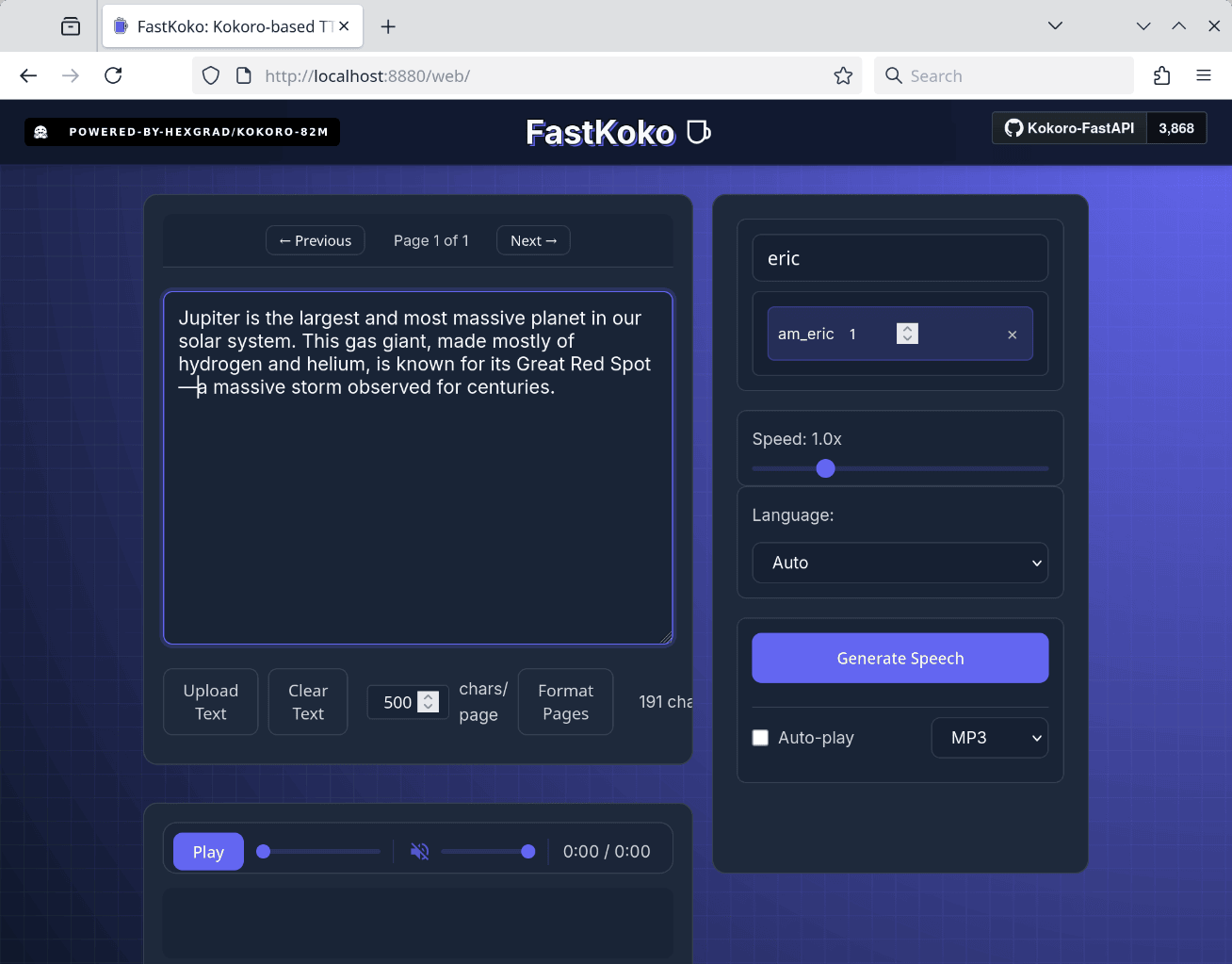
Introducing Kokoro: Local TTS Redefined
Generating natural-sounding speech from text has long been dominated by cloud-based services, offering convenience but at the cost of privacy, latency, and ongoing expenses. For developers and creators, this often meant a trade-off between quality and accessibility. Now, the open-source project Kokoro emerges, promising to democratize high-quality text-to-speech (TTS) by enabling it to run efficiently on local, consumer-grade CPUs. This development is significant for anyone building applications requiring voice output, from virtual assistants and accessibility tools to content creation workflows, without the need for expensive cloud infrastructure or constant internet connectivity.
Kokoro's core innovation lies in its architecture, which is designed for performance on standard hardware. Unlike many existing TTS engines that rely on massive neural networks requiring powerful GPUs or cloud scaling, Kokoro leverages optimized models and inference techniques to deliver impressive results using only the CPU. This makes it a viable option for a much broader range of devices and use cases, including edge computing scenarios and applications where offline functionality is paramount.
Technical Underpinnings and Performance
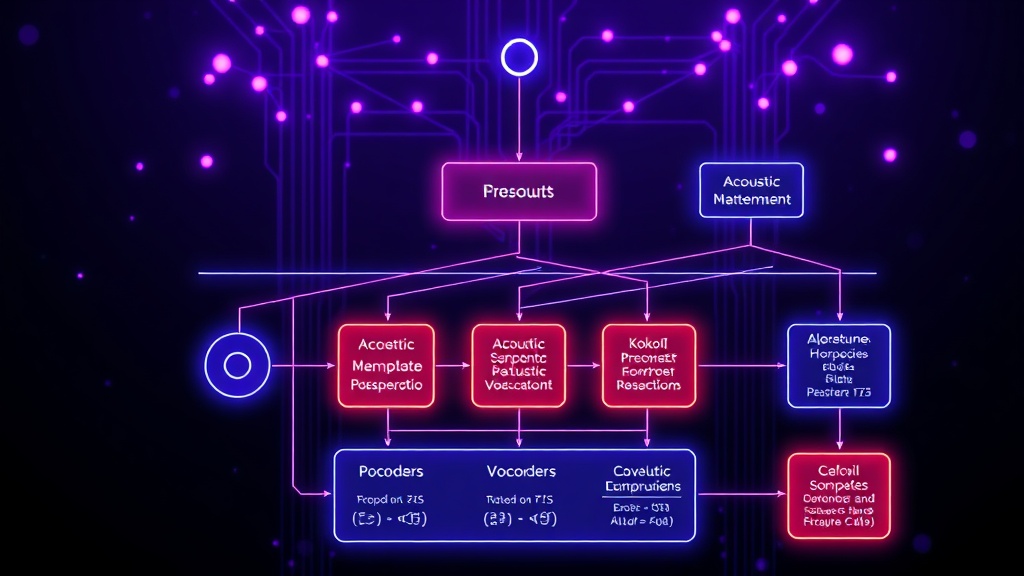
At its heart, Kokoro is built upon a foundation of efficient deep learning models specifically trained for speech synthesis. The project emphasizes a modular design, allowing for different acoustic models and vocoders to be swapped in and out, catering to various languages and voice characteristics. The key to its CPU-friendliness is a combination of model quantization, knowledge distillation, and optimized inference kernels. Quantization reduces the precision of model weights, shrinking model size and speeding up computations, while knowledge distillation transfers the performance of larger, more complex models into smaller, more efficient ones. Specialized inference engines further accelerate the process on typical CPU architectures.
The project's approach moves away from monolithic, resource-intensive models towards a more distributed and accessible paradigm. This is akin to how modern web development has shifted from heavy client-side applications to more efficient, progressive web apps that perform well across a variety of devices. Kokoro aims to achieve a similar level of accessibility for speech synthesis. Early benchmarks shared by the project's maintainers indicate that Kokoro can achieve near real-time speech generation on modern multi-core CPUs, delivering output quality that rivals, and in some cases surpasses, established cloud-based solutions. The latency is drastically reduced compared to network round-trips, making interactive applications feel much more responsive.
A notable aspect of Kokoro's design is its focus on ease of integration. The project provides well-documented APIs and SDKs, making it straightforward for developers to incorporate its TTS capabilities into their existing applications. This lowers the barrier to entry for implementing sophisticated voice features, allowing developers to focus on the unique aspects of their applications rather than wrestling with complex audio processing pipelines.
Quality and Voice Diversity
High-quality TTS is characterized by natural prosody, accurate pronunciation, and the absence of robotic artifacts. Kokoro addresses this by employing advanced neural network architectures that capture the nuances of human speech. The project is actively developing and integrating various acoustic models, each trained on diverse datasets to produce different vocal styles and emotional tones. This commitment to voice diversity means users can select voices that best fit their application's persona, whether it's a friendly assistant, a professional narrator, or an informative guide.
The emphasis on local processing also means that users retain full control over their data. Unlike cloud TTS services that send audio data to external servers for processing, Kokoro handles all synthesis on the user's machine. This is a critical advantage for applications dealing with sensitive information or requiring strict data privacy compliance. The ability to generate speech offline further enhances its utility in environments with unreliable internet access, such as remote locations or during network outages.
The Unanswered Question: Long-Term Model Maintenance and Evolution
While Kokoro presents a compelling solution for local TTS, a key question remains: how will the project ensure the continuous evolution and maintenance of its acoustic models and inference engines? Building and refining high-quality TTS models is an ongoing process, requiring significant data curation, training, and expert linguistic input. As the field of AI speech synthesis advances rapidly, keeping Kokoro's models competitive and its inference efficient will require sustained community effort and clear development roadmaps. The success of this open-source initiative will hinge on its ability to foster a vibrant community that contributes to model development, bug fixes, and feature enhancements, ensuring it doesn't become a static technology in a rapidly evolving landscape.
Implications for Developers and the TTS Landscape
Kokoro's emergence has several immediate implications. For developers, it offers a powerful, cost-effective, and privacy-preserving alternative to cloud-based TTS. This is particularly impactful for startups and independent developers who may have limited budgets for cloud services. The ability to deploy high-quality speech synthesis on edge devices opens up new possibilities for smart home devices, wearables, and embedded systems where computational resources are constrained. Furthermore, the reduced latency can significantly improve user experience in real-time interactive applications, such as gaming or live translation services.
For the broader TTS market, Kokoro represents a significant step towards decentralization and open-source innovation. It challenges the dominance of large cloud providers by demonstrating that high-fidelity speech can be achieved without proprietary, resource-intensive infrastructure. This could spur further innovation in local AI processing and encourage other projects to focus on optimizing complex AI tasks for consumer hardware. The project's success could also lead to a more diverse ecosystem of TTS voices and capabilities, tailored to specific niches and user needs, moving beyond the one-size-fits-all approach often seen in commercial offerings.
The project's commitment to being CPU-friendly is its most significant differentiator. Think of it less like a massive data center humming away, and more like a highly efficient, finely tuned engine running on your existing laptop. This accessibility means that sophisticated voice generation is no longer a luxury reserved for those with deep pockets or access to specialized hardware. It democratizes a powerful communication tool, putting it directly into the hands of creators and developers worldwide.