Kogvio: On-Page Understanding Without Context Switching
In the digital age, information overload is a constant challenge. Developers, researchers, and even casual web surfers frequently encounter jargon, complex concepts, or unfamiliar terms that necessitate leaving the current page to perform a search. This context-switching is a notorious productivity killer. Kogvio, a new browser extension, aims to solve this by bringing understanding directly to the user, on the page itself.
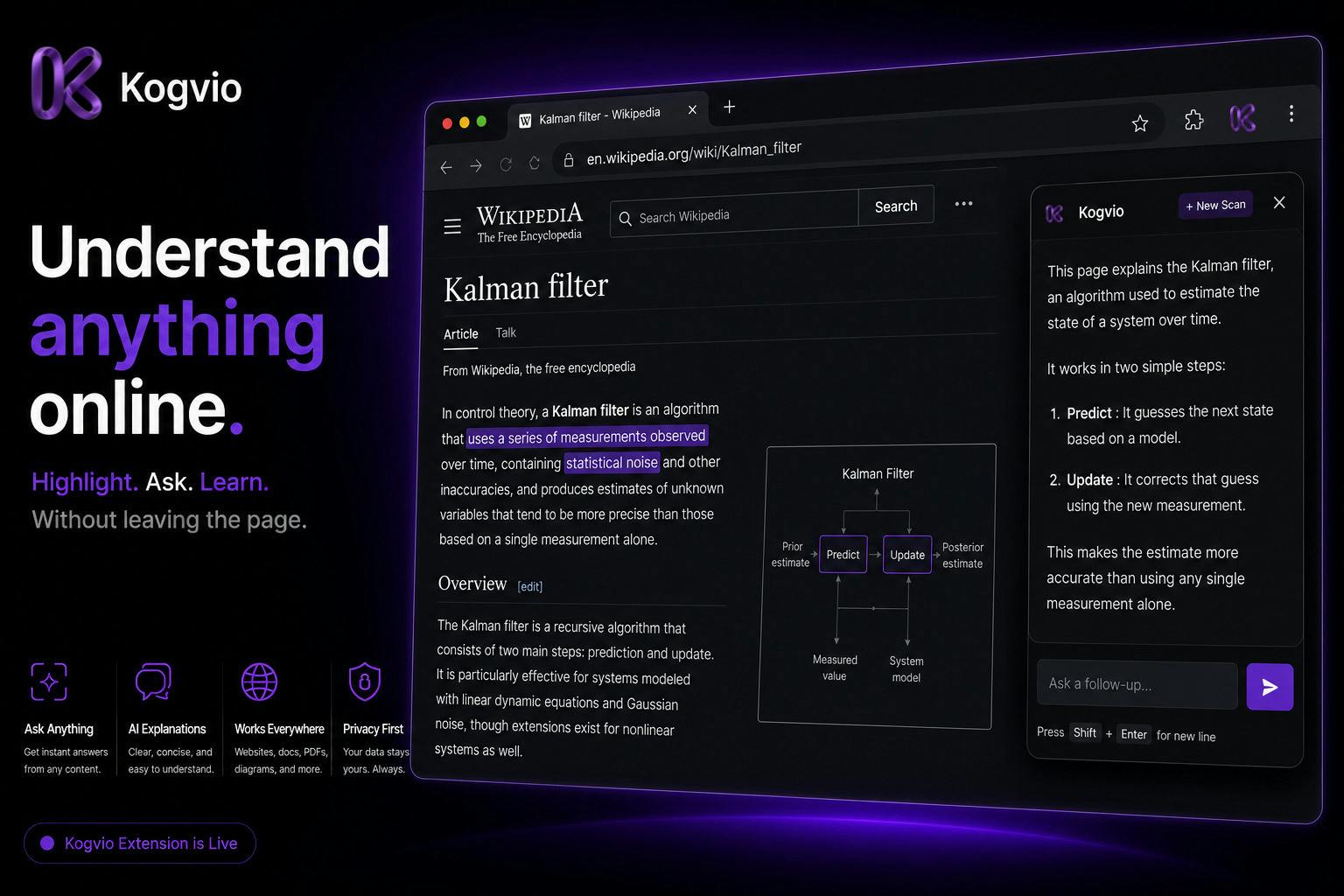
The core promise of Kogvio is simple yet ambitious: understand anything online without leaving the page. This means that when a user encounters a word, phrase, or concept they don't fully grasp, Kogvio can provide an explanation or summary in situ. This is achieved through a combination of natural language processing and intelligent information retrieval, designed to work across a wide range of online content.
The extension functions by analyzing the content of the webpage the user is currently viewing. When a user highlights text or hovers over a specific term, Kogvio can trigger an overlay or a side panel that displays relevant information. This information could range from a simple dictionary definition to a more comprehensive summary of a complex topic, generated dynamically based on the surrounding text and the user's query.
For developers, this could mean instantly understanding a new API endpoint or a piece of technical documentation without having to open multiple tabs for Stack Overflow, official docs, or Wikipedia. Researchers might find it invaluable for quickly grasping the meaning of specialized terminology in academic papers or industry reports. Even for everyday browsing, understanding a news article's complex political or economic references becomes more seamless.
The underlying technology likely involves sophisticated AI models capable of semantic analysis. When a user requests information about a specific term, Kogvio doesn't just perform a keyword search. Instead, it attempts to understand the context in which the term appears on the page. This allows it to provide more relevant and nuanced explanations than a simple search engine lookup might offer. For instance, if a developer highlights the term "RESTful API" within a discussion about microservices, Kogvio might provide a definition tailored to that specific architectural pattern, rather than a generic explanation of APIs.
Beyond Simple Definitions: Contextual Summaries and Deeper Insights
Kogvio's functionality extends beyond mere word definitions. The tool is designed to offer contextual summaries, which can be particularly useful for lengthy articles or complex discussions. Instead of reading through several paragraphs to grasp the main point, users can potentially get a concise summary generated from the relevant section of text. This is akin to having an intelligent assistant that can distill complex information on demand.
Consider a long-form article detailing a new machine learning algorithm. A reader might highlight a paragraph describing the model's architecture. Kogvio could then provide a summary explaining the core components and their interactions, allowing the reader to quickly assess its relevance or understand its novelty without a deep dive into the entire article's technical details. This capability is a significant step beyond traditional "lookup" tools, which primarily focus on single terms.
The success of such a tool hinges on its accuracy and speed. If the explanations are often incorrect or the retrieval process is slow, users will quickly revert to their old habits of opening new tabs. The challenge for Kogvio is to provide explanations that are not only accurate but also contextually appropriate and delivered with minimal latency. This requires efficient natural language understanding models and robust data sources that can be queried rapidly.
One of the key differentiators Kogvio appears to offer is its integration directly into the browsing experience. Unlike standalone tools or bookmarklets that might require copying and pasting text, Kogvio works by interacting with the DOM of the webpage. This seamless integration is crucial for maintaining user flow and minimizing friction. The developers have focused on making the interaction as intuitive as possible, likely through simple mouse gestures or keyboard shortcuts.
The Broader Implications for Online Learning and Productivity
The ability to understand complex information instantly while browsing has profound implications for how we consume and process digital content. For professionals in rapidly evolving fields like AI, software development, and cybersecurity, staying current requires continuous learning. Tools that can accelerate this learning process by removing barriers to understanding are invaluable.
Kogvio taps into a growing trend of AI-powered tools designed to augment human capabilities. Similar to how code completion tools assist developers or grammar checkers refine writing, Kogvio aims to enhance comprehension. If it delivers on its promise, it could become an essential utility for anyone who regularly engages with technical documentation, academic research, or complex online discussions.
The surprise here is not the concept of an on-page lookup tool, which has existed in simpler forms for years (think browser dictionaries). The genuine advancement is the integration of sophisticated AI for *contextual summarization and explanation*, moving beyond simple definitions to a deeper, more nuanced understanding of the content presented. This shift from mere lookup to genuine comprehension is what sets Kogvio apart.
What remains to be seen is how Kogvio handles the nuances of highly specialized domains or rapidly changing information. Can it keep up with the latest research in fields like quantum computing or the fast-moving world of crypto-economics? Furthermore, the ethical considerations of AI-generated summaries, particularly in sensitive contexts like news or legal documents, will undoubtedly become a point of discussion as the tool gains traction.
For now, Kogvio presents a compelling vision for a more efficient and accessible online information landscape. By bringing understanding directly to the user, it promises to reduce cognitive load and empower individuals to learn and work more effectively, all without ever leaving the page.