The LLM Landscape: A Shifting Battleground
The pace of large language model development shows no signs of slowing. New models emerge with increasing frequency, each promising enhanced capabilities, larger context windows, and more competitive pricing. Developers and businesses looking to integrate these powerful AI tools face a complex decision matrix, often requiring cross-referencing scattered documentation from multiple vendors. Recently, Kimi K3 entered the arena, prompting a re-evaluation of the current top contenders. This analysis breaks down the key specifications and, crucially, the real API pricing for Kimi K3, Kimi K2.6, Fable 5, and OpenAI's GPT models, aiming to provide clarity for informed build decisions.
Kimi K3: A New Contender with a Massive Context Window
Moonshot AI’s Kimi K3 has generated significant buzz, largely due to its headline-grabbing 1 million token context window. This represents a substantial leap forward, potentially enabling more complex reasoning, deeper analysis of lengthy documents, and more sophisticated conversational AI applications that retain a much longer memory of interactions. However, this expanded capability comes with a corresponding price tag for API access. The published pricing indicates an input token cost of $3.00 per 1 million tokens. This is significantly higher than its predecessor, Kimi K2.6. The output token cost for Kimi K3 is set at $15.00 per 1 million tokens, which is also a considerable increase. A noteworthy detail, however, is the tiered pricing for cached input. When Kimi K3 hits its cache, the input cost drops dramatically to $0.30 per 1 million tokens. This suggests that applications designed to efficiently leverage caching mechanisms could see substantial cost savings, making the effective cost much lower for certain use cases.
Kimi K2.6: The Established Predecessor
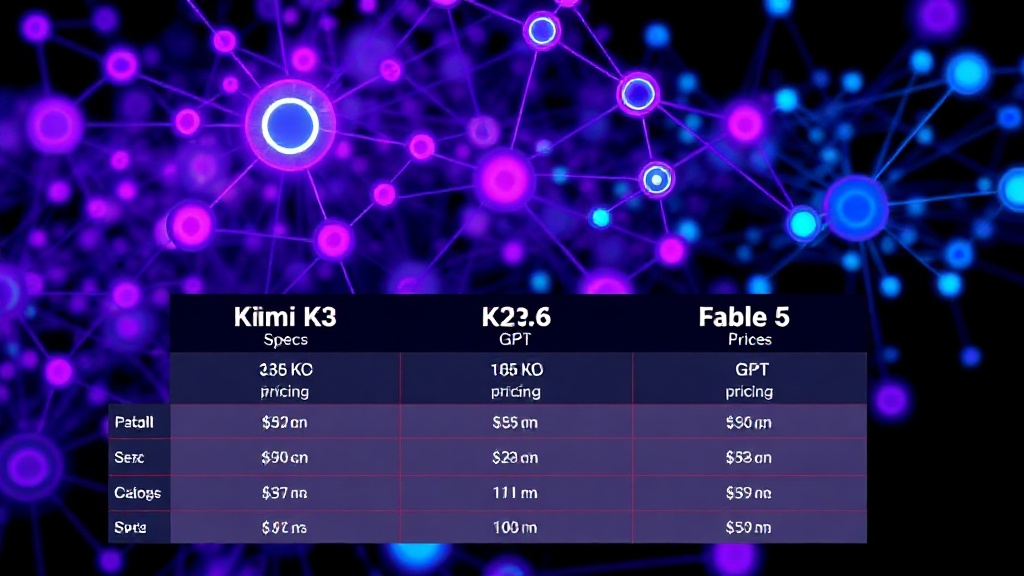
Before the arrival of K3, Kimi K2.6 was a strong offering, particularly for its balance of performance and cost. It boasts a context window of 256,000 tokens, which is still substantial and sufficient for many advanced applications. The API pricing for K2.6 is considerably more affordable than K3. Input tokens are priced at $0.95 per 1 million tokens, and output tokens at $4.00 per 1 million tokens. This makes K2.6 a more economical choice for applications that do not require the extreme context length of K3. The model also features open weights, a key differentiator for developers who require greater control, customization, and the ability to run models on-premises for security or cost reasons. The significant price difference between K2.6 and K3 for both input and output tokens highlights the trade-offs involved in accessing the latest, most powerful models.
Fable 5: A Premium, Closed-Source Option
Fable 5, from an unspecified vendor (likely referring to models like Anthropic's Claude or Google's Gemini, which are often positioned as premium, closed-source alternatives), operates in a different segment of the market. While specific token pricing is not detailed in the same granular format as Kimi’s offerings, it is characterized as a 'premium' service. This typically implies a higher cost structure, often bundled with advanced features, enterprise-grade support, and potentially dedicated infrastructure. The lack of open weights means that developers cannot inspect, modify, or self-host the model. This choice is often made by organizations prioritizing ease of use, managed services, and cutting-edge performance without the overhead of managing model infrastructure or fine-tuning. The decision to use Fable 5 hinges on whether the 'premium' features and performance justify the likely higher cost and lack of transparency compared to open-weight models.
GPT Models: The Industry Benchmark
OpenAI's GPT models, particularly the GPT-4 series, have long served as a benchmark in the LLM space. Like Fable 5, GPT models are generally considered 'premium' offerings, with pricing structures that reflect their advanced capabilities and widespread adoption. While the exact pricing can vary depending on the specific model version (e.g., GPT-4 Turbo, GPT-4o) and the context window utilized, they are positioned at the higher end of the market. OpenAI does not offer open weights for its flagship models, adhering to a closed-source, API-access model. This strategy has fostered a massive ecosystem but also means that developers are reliant on OpenAI's platform and pricing. The decision to use GPT often comes down to its proven performance, extensive tooling, and the vast developer community it supports, balanced against its premium cost and closed nature.
API Pricing: The Real Cost of Doing Business
The most critical factor for many developers and businesses is the actual cost of API calls. While context window size and benchmark performance are important, the token-per-million pricing directly impacts operational budgets. Kimi K3's $3.00 input and $15.00 output per 1 million tokens present a significant cost increase over K2.6 ($0.95 input, $4.00 output). This substantial difference means that migrating applications from K2.6 to K3 will likely require a re-evaluation of cost-effectiveness, unless the 1 million token context window is absolutely essential and the cache-hit pricing can be effectively leveraged. For applications that can optimize their use of K3's caching, the effective input cost can be reduced to $0.30 per 1 million tokens, making it highly competitive for specific workloads.
Both Fable 5 and GPT models fall into the 'premium' category, implying costs that are generally higher than K2.6 but potentially competitive with K3, depending on the specific model variant and usage patterns. Without explicit per-token pricing for Fable 5, direct comparison is difficult, but the 'premium' label suggests a higher cost threshold. GPT pricing, especially for GPT-4 variants, can also be substantial, with input tokens often costing several dollars per million and output tokens even more. The surprising detail here is not the raw cost of K3's output tokens, which is high, but the dramatic drop to $0.30/1M for cached input. This specific pricing strategy suggests a deliberate effort to make the 1M context window viable for a broader range of applications, provided they can be architected to benefit from caching.
Open Weights: A Key Differentiator
The distinction between open-weight and closed-source models is a fundamental consideration. Kimi K3 and K2.6 offer open weights, granting developers the freedom to download, inspect, modify, and deploy the models on their own infrastructure. This is invaluable for companies with strict data privacy requirements, those needing deep customization, or those aiming to optimize inference costs by managing their own hardware. In contrast, Fable 5 and GPT are closed-source. Users interact with them solely through APIs provided by the vendors. This simplifies deployment and management but introduces vendor lock-in and limits customization possibilities. The choice between open and closed models often boils down to a balance between flexibility, control, and cost versus convenience, managed services, and potentially leading-edge performance.
Conclusion: Navigating the LLM Choices
The introduction of Kimi K3 with its massive context window and tiered pricing model adds another layer of complexity to the LLM selection process. Developers must weigh the benefits of an unparalleled context length against the higher base API costs, while also considering the potential for significant savings through efficient caching. Kimi K2.6 remains a strong, cost-effective option with open weights. Fable 5 and GPT represent the premium, closed-source segment, offering ease of use and potentially leading performance at a higher cost. The decision ultimately depends on specific project requirements, budget constraints, and the strategic importance of factors like model transparency and customization. What remains unaddressed by these specifications alone is the real-world latency and the nuanced performance differences across various tasks, which often require practical testing beyond benchmark scores and pricing sheets.