
Kimi K3 Emerges as a Top Contender
The landscape of large language models (LLMs) is rapidly evolving, and Kimi K3 has just thrown its hat into the ring, positioning itself as a serious challenger to established giants like Anthropic's Claude Opus 4.8. Kimi K3, developed by Moonshot AI, is notable as the first open-weight model to seriously contend with top-tier proprietary models. Its performance on the Artificial Analysis Intelligence Index places it fourth among 189 models, achieving a statistical tie with Claude Opus 4.8 and GPT-5.5. This benchmark performance is significant, especially considering Kimi K3's expected release of its weights by July 27th, a move that will empower the open-source community.
The question of whether Kimi K3 or Claude Opus 4.8 is superior doesn't have a simple answer. The choice hinges on specific use cases and optimization goals. While both models demonstrate exceptional capabilities, Kimi K3 offers a compelling cost advantage, priced 40% lower per token than Opus 4.8. This economic factor, combined with its impressive performance, makes Kimi K3 an attractive option for developers and organizations looking to scale their AI deployments cost-effectively.
Benchmark Showdown: Kimi K3 vs. Claude Opus 4.8
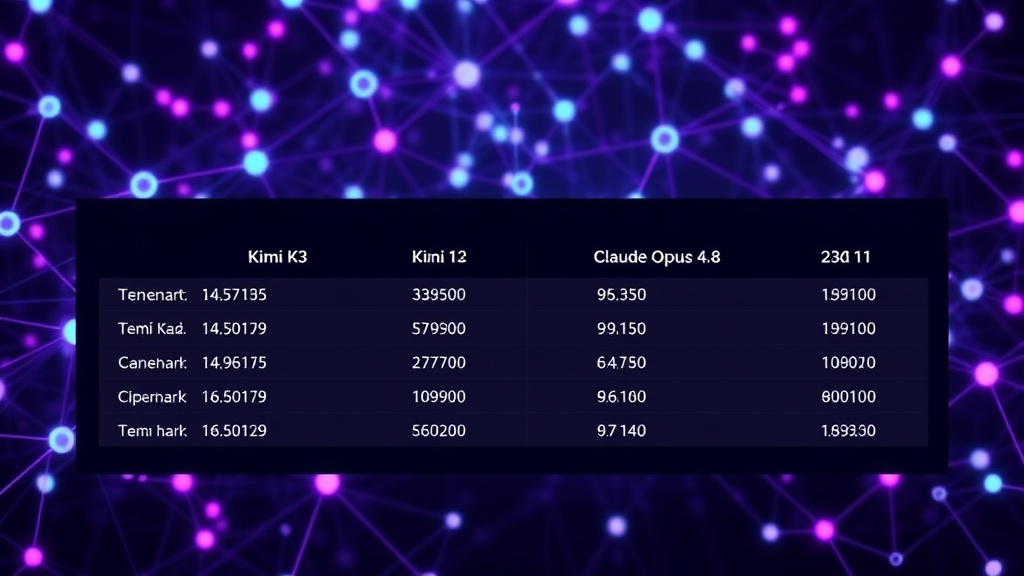
A closer look at the benchmarks reveals a highly competitive performance between Kimi K3 and Claude Opus 4.8. On the Artificial Analysis Intelligence Index, both models are rated at 57, securing them the 4th position out of 189 evaluated models. This indicates a near-parity in their overall reasoning and analytical capabilities. However, Kimi K3 demonstrates a significant lead in specific areas. In the GPQA Diamond benchmark, Kimi K3 achieved 93.5%, narrowly trailing Claude Opus 4.8's 93.6%, showing almost identical performance in complex graduate-level reasoning tasks.
The divergence becomes more apparent in specialized benchmarks. Kimi K3 scored an impressive 88.3% on the Terminal-Bench 2.1, a benchmark focused on command-line interface tasks and system interaction, significantly outperforming Claude Opus 4.8's 74.6%. This suggests Kimi K3 possesses a more refined understanding and execution capability for tasks involving code interpretation and system commands. While Kimi K3's performance on the SWE-bench Verified benchmark is not yet published, its strong showing in other coding-related tasks hints at its potential in this domain. Claude Opus 4.8, while a strong all-rounder, appears to lag in these specific technical execution benchmarks.
Context Windows and Integration Challenges
Beyond raw benchmark scores, context window size and integration ease are critical factors. Kimi K3 boasts a massive 1 million token context window, enabling it to process and retain information from extremely long documents or conversations. This is a significant advantage for tasks requiring deep comprehension of extensive data, such as analyzing lengthy legal documents, codebases, or historical logs. In contrast, while Claude Opus 4.8 has a substantial context window, specific details on its current maximum token limit are less prominently advertised compared to Kimi K3's headline-grabbing 1 million tokens.
However, leveraging these advanced models within existing developer workflows presents its own set of challenges. Tools like Claude Code, Cursor, and Cline are often locked to their respective proprietary APIs or backends. Claude Code, for instance, defaults to Anthropic's API. Cursor integrates with its own backend, and Cline requires manual key configuration. This fragmentation makes it difficult to seamlessly switch between or utilize different models without significant configuration overhead.
LLM Gateway: Bridging the Integration Gap
To address these integration hurdles, solutions like LLM Gateway are emerging. LLM Gateway acts as a universal adapter, speaking both Anthropic and OpenAI API formats. This allows existing tools to run Kimi K3, or any of the over 200 models supported by the gateway, simply by changing the base URL. For developers using Claude Code, LLM Gateway enables it to connect to any endpoint using the Anthropic /v1/messages format.
Setting up Kimi K3 with Claude Code via LLM Gateway involves configuring three environment variables: ANTHROPIC_BASE_URL, OPENAI_API_KEY, and OPENAI_BASE_URL. By pointing ANTHROPIC_BASE_URL to the LLM Gateway endpoint and setting a dummy OPENAI_API_KEY (as it's not strictly needed for this specific integration but often required by the tool's initialization), users can effectively route Claude Code's requests through Kimi K3. This flexibility extends to other tools like Cursor, which can be configured to use Kimi K3 by setting its API endpoint to the LLM Gateway URL.
The Verdict: Optimization is Key
The comparison between Kimi K3 and Claude Opus 4.8 is not about a definitive winner but about identifying the optimal tool for a given task. Claude Opus 4.8 remains a robust, general-purpose LLM with strong performance across a wide array of tasks. Its established presence and Anthropic's continued development offer reliability and a mature ecosystem.
Kimi K3, however, presents a compelling case for specific applications. Its near-parity performance with Opus 4.8 on high-level benchmarks, coupled with a 40% cost reduction and a massive 1 million token context window, makes it an extremely attractive option for cost-sensitive projects and those requiring the processing of vast amounts of information. The forthcoming release of its open weights is a significant development for the AI community, promising to accelerate innovation and customization. For developers focused on coding tasks, Kimi K3's superior performance on benchmarks like Terminal-Bench 2.1 is a clear indicator of its specialized strengths. If you are building applications that require extensive context or are sensitive to operational costs, Kimi K3 is a model to watch very closely. If you are already invested in the Anthropic ecosystem and require seamless integration, Opus 4.8 is the path of least resistance, but Kimi K3 via tools like LLM Gateway offers a viable, more economical alternative.