KiCad Goes Web: Anywhere PCB Design Becomes Reality
The open-source Electronic Design Automation (EDA) tool KiCad, a favorite among hobbyists and professionals alike for its powerful features and zero cost, has taken a significant leap towards accessibility. A new project, dubbed "KiCad in the Browser," demonstrates a fully functional KiCad environment running directly within a web browser. This development bypasses the need for local installation, opening up PCB design to a wider audience and offering unprecedented flexibility for existing users.
The project, showcased on Hacker News as a "Show HN," is not an official KiCad Foundation release but a testament to the platform's adaptability and the ingenuity of its community. It leverages WebAssembly (WASM) to compile the C++ codebase of KiCad into a format executable by web browsers. This allows the complex logic and graphical interfaces of the desktop application to run client-side, offering a near-native experience without requiring users to download and install hefty software packages. The implications are far-reaching for education, rapid prototyping, and collaborative design efforts.
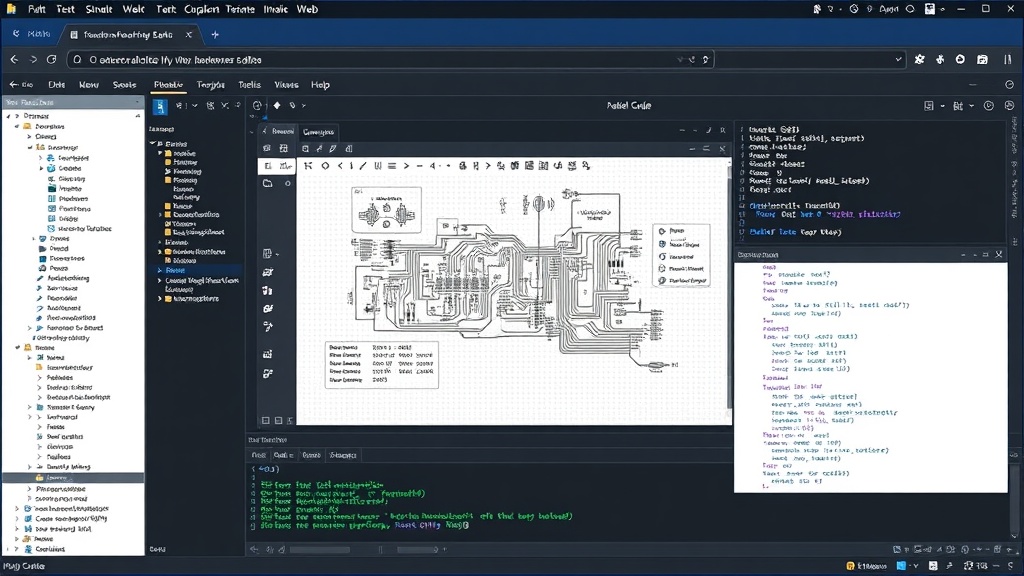
This isn't a stripped-down version or a viewer. Early demonstrations show the ability to create schematics, lay out printed circuit boards, and even generate manufacturing files. The core components of KiCad, including the schematic editor (Eeschema) and the PCB layout editor (Pcbnew), appear to be fully integrated and operational. Users can expect to perform tasks such as drawing components, routing traces, placing vias, and managing design rules, all within the familiar browser tab. This transforms the accessibility of professional-grade PCB design from a desktop-bound activity to one that can be done from a Chromebook, a tablet, or any machine with a modern web browser and an internet connection.
Technical Underpinnings: WebAssembly and Emscripten
The magic behind "KiCad in the Browser" lies in the sophisticated compilation techniques that bridge the gap between desktop C++ code and web technologies. The project primarily relies on Emscripten, a powerful compiler toolchain that targets WebAssembly. Emscripten translates C and C++ code into JavaScript and WebAssembly, enabling native performance for computationally intensive applications within the browser sandbox. This is the same technology that has brought complex applications like AutoCAD, Adobe Photoshop, and even video games to the web.
For KiCad, this means its extensive libraries, intricate rendering engines, and complex algorithms for routing and design rule checking can all be compiled and executed efficiently. The browser acts as the runtime environment, managing the graphical output and user input. While performance can vary based on the complexity of the design and the user's hardware, the ability to run such a sophisticated application entirely client-side is a significant technical achievement. The project likely involves careful management of memory, graphics rendering (potentially using WebGL), and input handling to provide a responsive user experience.
Democratizing PCB Design: Who Benefits?
The impact of making KiCad accessible via a browser is profound, particularly for several key demographics:
- Students and Educators: Educational institutions can now offer powerful PCB design tools without the overhead of managing software licenses or complex installations on lab computers. Students can access design tools from any device, fostering a more flexible and accessible learning environment. This lowers the barrier to entry for aspiring electrical engineers and makers.
- Hobbyists and Makers: The maker community, often working with a variety of hardware and limited setup time, gains a significant advantage. Prototypes can be designed and iterated upon from anywhere, whether at home, at a hackerspace, or on the go. The need for a powerful desktop workstation is reduced, making advanced design more attainable.
- Collaborative Teams: While not explicitly a collaborative platform yet, the web-based nature opens doors for future integration of cloud-based collaboration features. Imagine multiple engineers simultaneously reviewing or even editing a PCB design in real-time, similar to modern document editors. This could significantly streamline team workflows.
- Users of Less Powerful Hardware: Individuals with older laptops or less powerful machines can now leverage KiCad's capabilities without performance degradation. The heavy lifting is done by the browser's compiled WebAssembly code, which often leverages hardware acceleration, rather than solely relying on the CPU and RAM of the host machine.
Limitations and Future Potential
While the "KiCad in the Browser" project is an impressive feat, it's important to acknowledge its current limitations. As it's a community-driven effort and not an official release, it may lag behind the latest features and bug fixes of the desktop version. Performance, especially on very large and complex boards with thousands of components and intricate routing, could still be a bottleneck compared to native desktop applications. Furthermore, full integration with external tools, such as advanced 3D viewers or specific CAM processors, might require further development.
However, the potential is immense. The project demonstrates the viability of running complex desktop EDA software in the browser. Future iterations could see tighter integration with cloud storage for project management, real-time collaborative editing, and even direct integration with PCB manufacturing services. The core achievement here is proving that professional-grade PCB design software doesn't need to be confined to a desktop installation. It’s a significant step towards making sophisticated design tools universally accessible.
What remains to be seen is how the KiCad Foundation and the broader community will embrace and potentially integrate such web-based initiatives. Will this project evolve into an official offering, or will it remain a powerful demonstration of what's possible with WebAssembly? Regardless, for anyone interested in designing PCBs, the ability to fire up a powerful EDA tool in a browser tab is a compelling proposition.