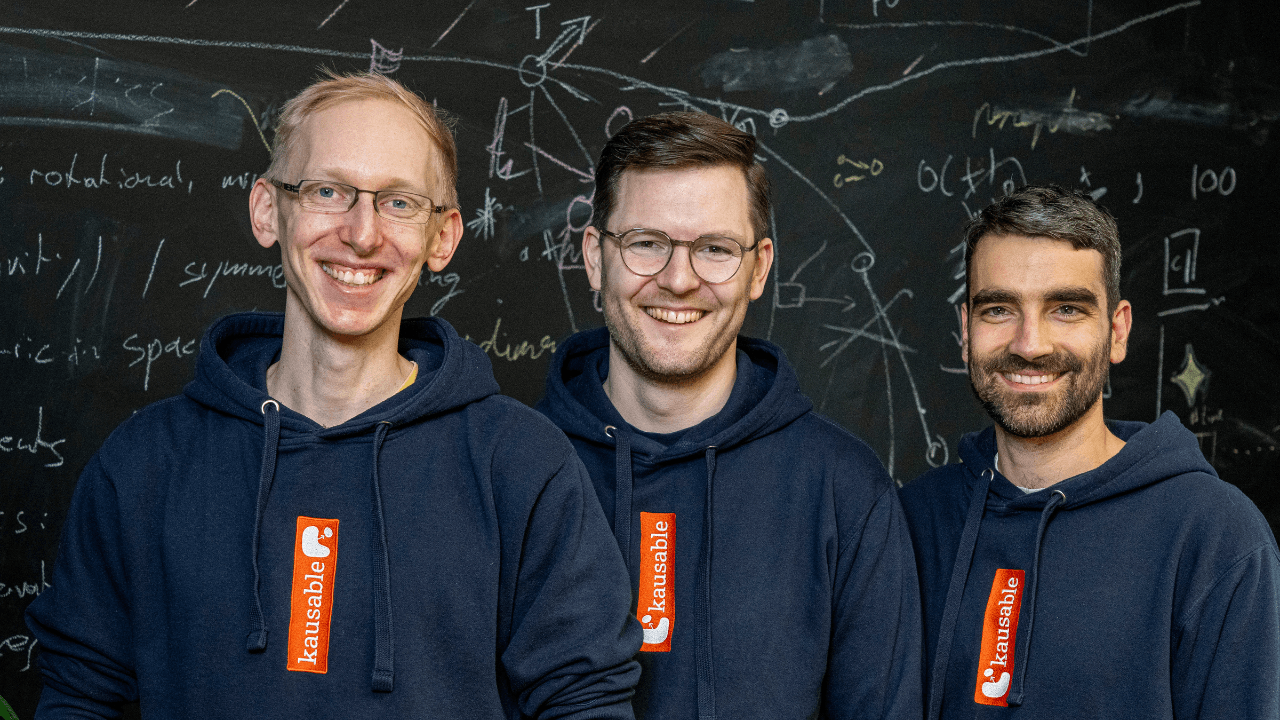
Rethinking AI's Learning Curve
The prevailing paradigm in artificial intelligence demands continuous, resource-intensive retraining. As AI models grow more complex and are deployed in dynamic environments, the cost and time associated with updating their knowledge bases become prohibitive. This cycle of constant re-training hinders the agility and scalability of AI systems, particularly for frontier applications that require real-time adaptation. European AI startup Kausable is challenging this status quo with a novel approach centered on reasoning-first AI.
Kausable announced today it has secured €12 million in seed funding to accelerate the development of its proprietary AI architecture. The company's mission is to build AI systems that learn and adapt continuously, mirroring human cognitive processes more closely, without the need for expensive and time-consuming full-scale retraining. This funding round, led by [Investor Name - if available, otherwise omit], with participation from [Other Investor Name - if available, otherwise omit], signals strong market confidence in Kausable's vision to create more efficient and adaptable AI.
Traditional AI models, especially large language models (LLMs) and deep learning systems, operate on a principle of learning from vast datasets. Once trained, their knowledge is largely static until a new, extensive training phase is initiated. This is akin to a student cramming for an exam and then forgetting much of it unless constantly reviewing the entire textbook. For applications in rapidly changing fields like finance, cybersecurity, or autonomous systems, this lag in knowledge updates can lead to outdated decision-making and performance degradation. Kausable aims to break this cycle by embedding reasoning capabilities at the core of its AI, enabling it to infer, adapt, and learn from new information incrementally.
The company's approach focuses on what it terms "reasoning-first frontier AI." This implies a shift from purely pattern-matching or statistical correlation to a more robust form of artificial general intelligence (AGI) that can understand context, causality, and abstract concepts. By prioritizing reasoning, Kausable's AI is designed to be more efficient, requiring less data for adaptation and generating more reliable, interpretable outputs. This could unlock new possibilities for AI in domains where explainability and continuous learning are paramount.
The Core Problem: AI's Costly Memory
The necessity for constant retraining stems from the inherent architecture of most current AI models. When new data emerges, or the environment shifts, these models can quickly become outdated. Updating them involves feeding new data through the entire training pipeline, which can take days or weeks and require significant computational power. This process is not only expensive in terms of compute costs but also in terms of human engineering effort to manage and execute these updates.
For instance, a fraud detection AI trained on historical data might miss novel fraudulent patterns if not retrained frequently. Similarly, an AI assisting in medical diagnosis could fall behind on the latest research findings. Kausable's proposed solution is to build AI that can integrate new knowledge like a human would—by understanding its implications and updating its internal models without discarding its existing knowledge base. This is a significant departure from current practices, where updating often means a partial or complete re-initialization of the model's parameters.
The company's technical roadmap, while not fully disclosed, is understood to involve novel neural network architectures and learning algorithms that prioritize symbolic reasoning and knowledge representation alongside traditional deep learning techniques. This hybrid approach aims to leverage the strengths of both methodologies: the data-processing power of deep learning and the logical inference capabilities of symbolic AI. The goal is an AI that not only recognizes patterns but also understands the underlying logic, making its learning process more efficient and its conclusions more trustworthy.
Funding and Future Trajectory
The €12 million seed funding will be instrumental in scaling Kausable's engineering team, further developing its core technology, and initiating pilot programs with early-adopter clients. The company plans to focus its initial efforts on specific enterprise use cases where continuous learning and adaptability are critical differentiators. This includes areas such as real-time risk assessment, dynamic resource optimization, and personalized customer engagement platforms.
Kausable's strategy to focus on reasoning-first AI positions it within a growing but still nascent segment of the AI research and development landscape. While many companies are focused on scaling existing LLM architectures, Kausable is betting on a fundamental architectural shift. This is a higher-risk, higher-reward approach that, if successful, could establish a new standard for AI development. The company's European roots also place it within a region that has been increasingly vocal about ethical AI development and regulatory compliance, suggesting that Kausable's focus on explainable and adaptable AI may also align with future regulatory frameworks.
The competitive landscape for AI startups is fierce, with significant investment flowing into companies focused on generative AI, specialized AI models, and AI infrastructure. Kausable's differentiation lies in its foundational research and its commitment to creating AI that can evolve autonomously. This is less about building a single, powerful model and more about creating a framework for AI that remains relevant and effective over time, a critical challenge as the pace of change accelerates across industries. The success of this approach will hinge on its ability to demonstrate tangible improvements in efficiency, adaptability, and reliability compared to existing methods.