
The Problem with Overloaded RAG Context
Retrieval Augmented Generation (RAG) systems promise to ground Large Language Models (LLMs) in factual data, significantly improving their ability to answer complex questions. The core idea is simple: before an LLM generates a response, a retrieval system fetches relevant documents or passages from a knowledge base. This retrieved information is then fed to the LLM as context, alongside the user's prompt. However, a critical flaw emerges when the retrieval system returns too much information. LLMs, despite their power, can struggle to sift through extensive, noisy, or irrelevant context. This often leads to diluted answers, increased hallucination, or simply nonsensical outputs. The sheer volume of tokens can also drive up inference costs and latency. Kapa.ai, a company focused on improving LLM accuracy for engineering teams, has developed a technique to tackle this precisely: pruning RAG context down to what the answer actually needs.
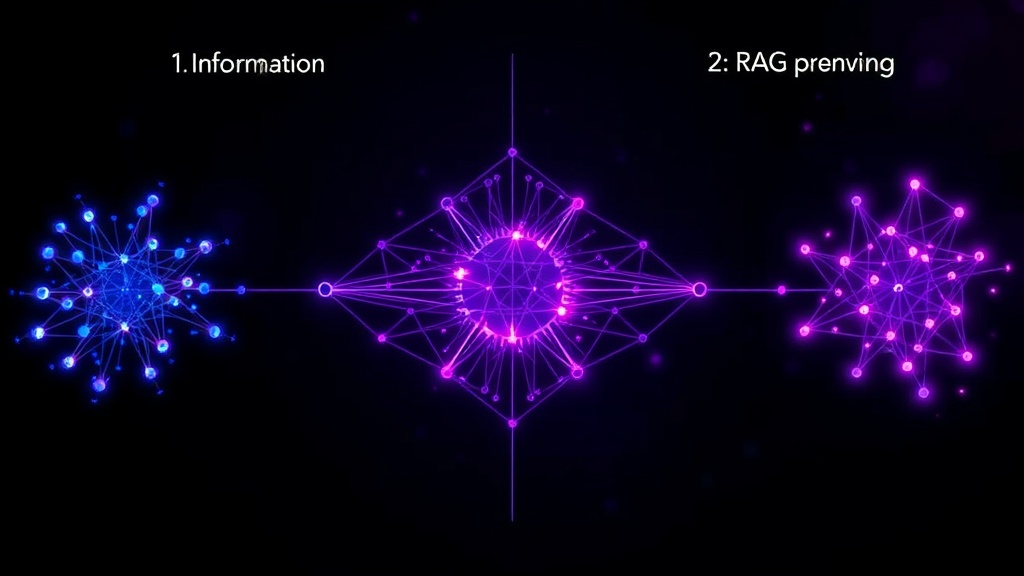
Introducing Kapa.ai's Context Pruning Method
The new approach, detailed in a recent blog post, focuses on refining the context provided to the LLM *after* the initial retrieval phase. Instead of passing all retrieved documents directly, Kapa.ai's method acts as an intelligent filter. The core innovation lies in using the LLM itself, or a smaller, specialized model, to identify which parts of the retrieved context are actually necessary for answering the specific user query. This is not about improving the initial retrieval accuracy (though that is also crucial), but about making the *most* of the retrieved context. Think of it less like a search engine finding more documents, and more like a meticulous research assistant who reads through all the found documents and highlights only the sentences directly relevant to your specific question, discarding the rest.
How the Pruning Works: A Deeper Dive
Kapa.ai’s technique involves a multi-step process. First, a standard retrieval system fetches a candidate set of documents or chunks based on the user’s query. This initial retrieval might be broad, aiming to cast a wide net. The crucial step follows: a “pruning” model analyzes each retrieved chunk. This model is trained or prompted to assess the relevance of each piece of text to the specific question. It doesn't just look for keyword overlap; it tries to understand the semantic relationship between the retrieved text and the query. The model then assigns a score or a binary decision (keep/discard) to each chunk. Only the chunks deemed highly relevant are passed to the final LLM for answer generation. This selective approach ensures that the LLM receives a concentrated, high-signal context, minimizing noise and maximizing the chances of a precise, factual answer. This is particularly important for complex queries that might touch upon multiple documents, where only a few specific sentences across those documents are truly pertinent.
Benefits of Context Pruning
The advantages of this method are manifold:
- Improved Answer Accuracy: By removing irrelevant or contradictory information, the LLM is less likely to hallucinate or produce off-topic responses. The focused context guides the LLM more effectively.
- Reduced Inference Costs: LLM APIs often charge based on the number of tokens processed. Sending fewer tokens (the pruned context) directly translates to lower operational costs.
- Lower Latency: Processing a smaller context window means the LLM can generate responses faster, leading to a better user experience.
- Enhanced Focus: For developers building on RAG, this means less time spent wrestling with noisy outputs and more time iterating on core application logic.
Kapa.ai highlights that this pruning can be done efficiently, even with smaller, specialized models, making it a practical addition to existing RAG pipelines. The ability to dynamically filter context based on the specific query is a significant step beyond static document retrieval.
The Future of RAG Context Management
The development by Kapa.ai underscores a critical shift in RAG system design. The focus is moving from simply retrieving *more* information to retrieving *better* information, and then intelligently processing it. As LLMs become more capable, the ability to manage and distill context will become a key differentiator for AI applications. This context pruning technique is a significant step toward making RAG systems more robust, cost-effective, and reliable, especially in enterprise environments where factual accuracy and efficiency are paramount. The challenge for other RAG developers will be to implement similar filtering mechanisms, moving beyond basic keyword matching to semantic understanding of context relevance.