The Allure of Exactly-Once
The phrase "exactly-once semantics" often conjures an image of perfect data pipelines, where every message is processed precisely one time, eliminating the need for complex deduplication logic downstream. This understanding is prevalent in architecture reviews, design documents, and even postmortems. However, this perception frequently represents a misunderstanding of what Kafka's exactly-once guarantee truly covers. The gap between this promise and the reality has, in numerous instances, led to significant production incidents.
Kafka's journey towards providing exactly-once semantics (EOS) is a complex one, primarily introduced and enhanced in version 0.11.0 and subsequent releases. It's crucial to dissect what this guarantee entails and where its boundaries lie to avoid costly errors.
What Kafka's Exactly-Once Actually Covers
Kafka's EOS operates at two distinct levels, each addressing different failure scenarios:
Producer Idempotence
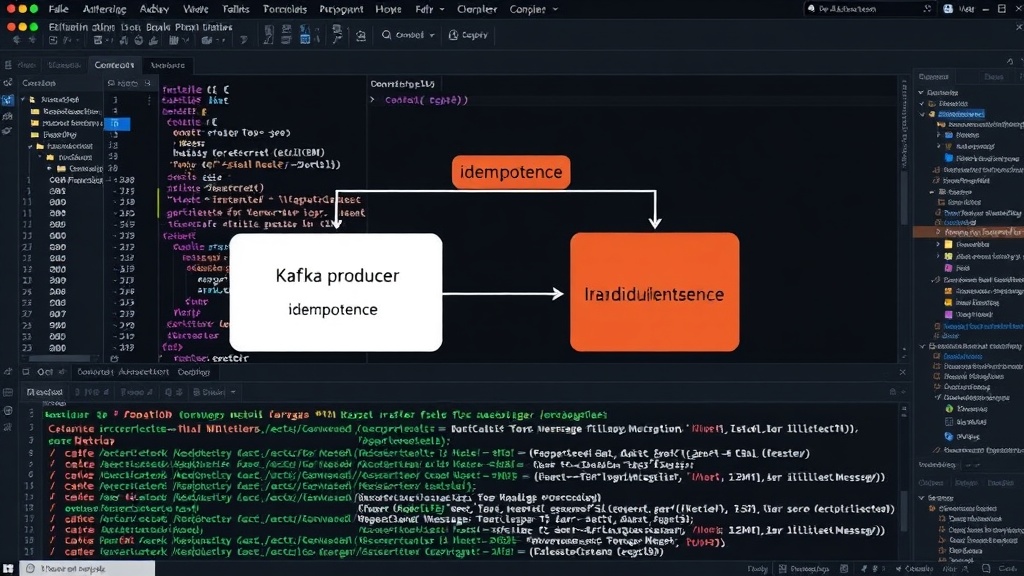
The first layer is producer idempotence, enabled by setting enable.idempotence=true. This feature ensures that a producer assigns a unique sequence number to each message it sends to a specific partition. The Kafka broker then uses this sequence number, along with the producer ID, to deduplicate messages. If a producer retries sending a message due to a network glitch or a temporary broker unavailability, the broker will recognize the duplicate based on the producer ID and sequence number and discard it. This guarantees that a message lands in a Kafka partition exactly once, irrespective of how many times the producer attempts to send it. This is a powerful mechanism for preventing duplicate messages originating from producer-side failures.
Transactions
The second, more comprehensive layer of EOS involves Kafka transactions. This feature, enabled through the use of a transactional.id, extends the exactly-once guarantee beyond a single partition. Transactions allow a producer to perform atomic writes to multiple partitions across different topics. If a producer fails mid-transaction, all messages sent within that transaction will be aborted and will not be visible to consumers. Conversely, if the transaction commits successfully, all messages within it are guaranteed to be written atomically and will become visible to consumers. This is critical for scenarios where a single logical operation involves writing to multiple Kafka topics or partitions, ensuring data consistency across these destinations.
When both producer idempotence and transactional capabilities are correctly implemented, Kafka can provide an end-to-end exactly-once guarantee from the producer to the consumer, provided the consumer also adheres to EOS principles. This involves consumers reading messages, processing them, and then committing their offsets atomically with their processing. The Kafka Streams API, for instance, is designed to leverage these transactional capabilities to achieve end-to-end exactly-once processing.
The Critical Gap: Producer to Broker vs. End-to-End
The common misconception arises from conflating the guarantee provided by producer idempotence and transactions with a true end-to-end exactly-once processing guarantee for the entire application flow. Kafka's EOS primarily guarantees that messages are written to its internal logs exactly once. It does not, by itself, guarantee that a downstream consumer will process each message exactly once in the context of its own operations.
Consider a typical producer-consumer flow:
- Producer sends message with idempotence enabled.
- Broker receives and stores the message exactly once.
- Consumer reads the message.
- Consumer processes the message (e.g., updates a database).
- Consumer commits its Kafka offset.
The failure point often lies between steps 3 and 5. If the consumer reads a message (step 3), begins processing it (step 4), but crashes *before* committing its offset (step 5), Kafka will consider that message uncommitted. Upon restart, the consumer will re-read the same message. If the processing in step 4 is not idempotent, this will result in duplicate processing. While Kafka's transactional producer ensures the message hit the broker exactly once, the consumer's processing and offset commit logic must also be transactional or idempotent to achieve true end-to-end exactly-once processing.
Many systems incorrectly assume that enabling enable.idempotence=true and using transactional.id on the producer automatically absolves them from implementing deduplication or transactional logic in their consumers. This is a dangerous assumption. The producer-consumer interaction is where the true complexity of end-to-end EOS lies, and it requires careful design on both sides.
Real-World Incidents and Lessons Learned
Production incidents stemming from this misunderstanding are not uncommon. Teams may rely on Kafka's EOS to avoid building custom deduplication mechanisms, only to discover later that their critical data processing jobs are producing duplicate records. This often happens during failover events, network partitions, or application restarts where the consumer's state (processing completion and offset commit) becomes desynchronized.
The key takeaway is that while Kafka provides robust tools to ensure messages enter its system exactly once and can be written atomically across partitions, achieving true end-to-end exactly-once processing requires a holistic approach. This means implementing idempotent consumers or using transactional consumers that coordinate their processing with their offset commits. Without this, the promise of exactly-once semantics remains incomplete, leaving systems vulnerable to data duplication under failure conditions.
What Nobody Has Addressed Yet: The Cost of Complexity
While the technical intricacies of Kafka's EOS are well-documented, what often goes unaddressed is the significant operational and development overhead associated with implementing and managing true end-to-end exactly-once processing. The complexity of coordinating transactions between producers, brokers, and consumers, especially in distributed systems with potential network latency and failure modes, can be substantial. Developers must grapple with the nuances of transactional IDs, isolation levels, and the careful design of idempotent consumer logic. This complexity can slow down development cycles and increase the potential for subtle bugs. The industry is still seeking simpler, more developer-friendly patterns that achieve the desired data integrity without imposing an overwhelming burden on engineering teams. The current solutions are powerful but require a deep understanding and meticulous implementation, a bar that many teams struggle to clear in practice.