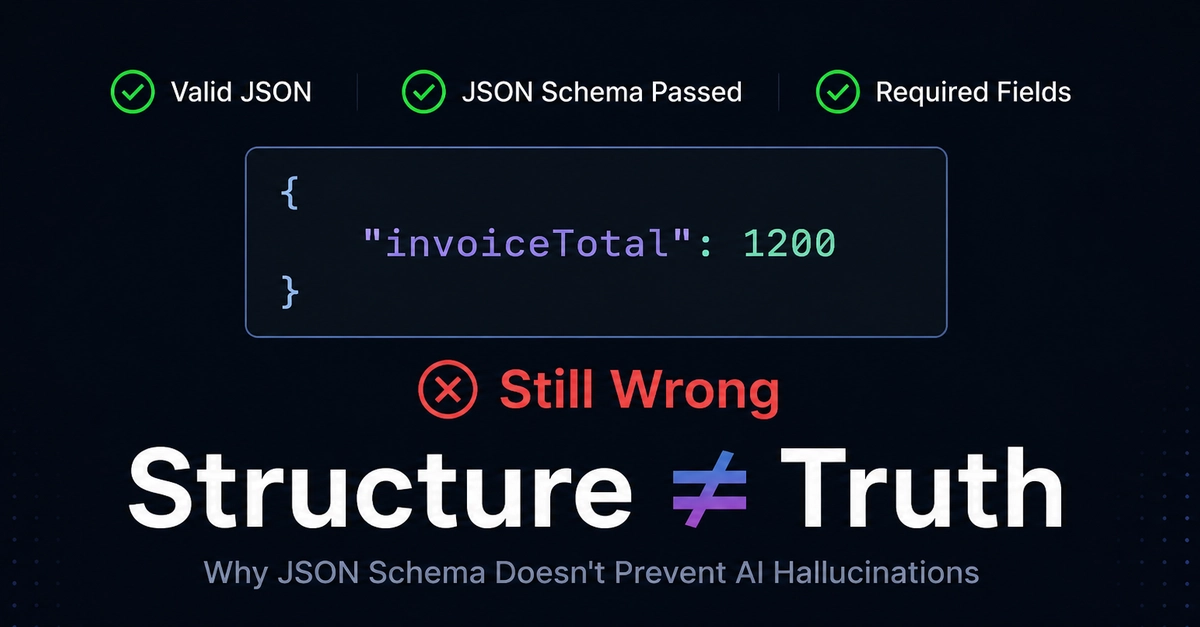
The Misconception: Structure Equals Correctness
For a time, many in the AI development community believed that using structured outputs, like JSON Schema, would effectively eliminate AI hallucinations. This seemed logical: if you define a strict format for the AI to adhere to, it shouldn't be able to deviate into nonsensical or factually incorrect responses. However, experience and recent developments reveal a more nuanced reality. Structured outputs guarantee that the AI's response conforms to a predefined schema—it ensures the data is in the right shape—but they do not guarantee that the data within that shape is factually correct or logically sound. This distinction is critical for anyone deploying AI in production environments.
Consider an example of extracting data from an invoice. If an invoice clearly states 'Invoice Total: $900', a well-trained AI model, even when asked to output this information in a JSON format like {"invoice_total": 900}, might still hallucinate. It could, for instance, output {"invoice_total": 9000} or even {"invoice_total": "nine hundred dollars"} if it misinterprets the input or suffers from internal model noise. The JSON schema would ensure the output is a valid JSON object with a key named 'invoice_total' and a value of a specific type (e.g., a number). However, it wouldn't catch the error if the AI generated '9000' instead of '900', or if it incorrectly formatted the value as a string when a number was expected. The schema enforces the rules of the game, but it doesn't judge the player's accuracy within those rules.

The Real Problem Solved by Structured Outputs
Structured outputs are powerful tools, but their strength lies in ensuring consistency and predictability of format, not factual accuracy. When building applications that rely on AI, developers often need predictable output structures for downstream processing. This is where structured outputs shine. Libraries and frameworks supporting structured outputs allow developers to define the desired format—whether it's JSON, XML, or another structured data type—and the AI model is guided to produce output that adheres to this schema. This is invaluable for tasks like data extraction, where the AI needs to return specific fields in a consistent manner, or for generating configuration files, API requests, or database entries.
For instance, if you're building a system to parse customer feedback, you might want to extract sentiment, key topics, and suggested actions. A JSON schema can define an output like:
{
  "sentiment": "positive",
  "topics": ["feature request"],
  "suggestions": ["add dark mode"]
}
A structured output library ensures the AI returns data in this exact shape, with 'sentiment' as a string, 'topics' as an array of strings, and 'suggestions' as an array of strings. This predictability is crucial. It means your application code doesn't need to defensively parse wildly different output formats; it can reliably access response.sentiment, response.topics, and so on. This is analogous to a chef meticulously following a recipe. The recipe ensures all ingredients are present in the correct proportions and cooked in the right order, leading to a predictable dish. However, the recipe doesn't guarantee the chef used fresh, high-quality ingredients, nor does it guarantee the chef's skill in execution—the dish might still be bland or burnt, even if perfectly assembled according to the recipe.
The Nature of AI Hallucinations
Hallucinations in AI, particularly in Large Language Models (LLMs), stem from the probabilistic nature of their underlying architecture. LLMs generate text by predicting the most likely next word or token based on their training data and the input prompt. While this process is remarkably effective for generating coherent and contextually relevant text, it's not inherently tied to factual truth or logical consistency. The model doesn't 'know' facts in the human sense; it has learned patterns and correlations from vast amounts of text.
When an LLM hallucinates, it's essentially generating text that is plausible within its learned patterns but is factually incorrect, nonsensical, or not grounded in the provided context. This can happen for several reasons:
- Data Gaps: The model may lack specific knowledge about a topic.
- Conflicting Information: Training data might contain contradictions.
- Prompt Ambiguity: Vague or misleading prompts can lead the model astray.
- Over-Confidence: The model may generate confident-sounding but false information.
- Internal Noise: The probabilistic generation process can sometimes lead to unexpected deviations.
These are fundamental challenges inherent to how current LLMs operate. Imposing a JSON schema doesn't alter the model's internal reasoning or its probabilistic generation process. It merely acts as a validator on the output. If the model generates a plausible-sounding but incorrect piece of data (e.g., a false date, an invented statistic), the JSON schema will likely accept it as long as it matches the expected data type and structure. The schema is like a spell-checker for grammar; it ensures the words are correctly spelled and arranged, but it can't verify if the sentences convey factual truth.
Moving Forward: A Hybrid Approach
Given that structured outputs alone do not prevent hallucinations, the path forward for reliable production AI involves a hybrid approach. Developers must combine the benefits of structured outputs with other techniques designed to improve factual accuracy and reduce hallucinations.
These techniques include:
- Retrieval-Augmented Generation (RAG): Grounding LLM responses in specific, verifiable external knowledge bases. RAG systems fetch relevant information before generating a response, significantly reducing the likelihood of fabricating facts.
- Prompt Engineering: Crafting precise and unambiguous prompts that guide the model towards accurate and relevant outputs. This includes providing clear instructions, context, and constraints.
- Fact-Checking Layers: Implementing post-processing steps that verify the generated information against trusted sources. This can involve external APIs or dedicated fact-checking models.
- Model Fine-Tuning: Training models on curated datasets that emphasize factual accuracy and reduce the propensity for hallucination.
- Confidence Scoring: Developing mechanisms for the AI to express its confidence level in its generated output, allowing downstream systems to flag low-confidence responses for human review.
The realization that JSON Schema and similar structuring tools solve a different problem than hallucination prevention is not a cause for despair. Instead, it's an invitation to build more robust AI systems. By understanding the strengths and limitations of each tool, developers can architect solutions that are both predictable in their output format and reliable in their factual accuracy. ShapeCraft, an open-source library supporting structured outputs for various LLM providers, exemplifies the need for such tools to ensure consistent data formatting, a vital component of any production AI pipeline, even as other methods are employed to tackle the hallucination problem.
The Unanswered Question: How to Quantify Hallucination Reduction?
While we have identified various techniques to mitigate AI hallucinations, a significant unanswered question remains: how do we effectively and consistently quantify the reduction in hallucinations across different models, prompts, and RAG implementations? Establishing standardized benchmarks and methodologies for measuring hallucination rates is crucial for comparing the effectiveness of different strategies and for building trust in AI systems. Without such metrics, it is challenging to objectively assess progress and to make informed decisions about which mitigation techniques to prioritize in production environments.