NVIDIA CEO Jensen Huang declared at GTC 2025 that the future of Software-as-a-Service (SaaS) is agent-first. This isn't a distant prediction; it's a description of a paradigm shift already underway. Huang’s vision posits a move from humans interacting directly with software to AI agents performing tasks on behalf of users. This evolution promises to redefine how we build, deploy, and consume software, enabling unprecedented automation and efficiency.
One founder, operating outside the typical VC-backed cloud behemoths, is already demonstrating this future. By leveraging a modest Virtual Private Server (VPS) costing $45 per month, he has built and operates two distinct SaaS products: ConnectEngine OS, which automates lead generation, content creation, and uptime monitoring, and ProductShot, an AI tool for generating product photography. This approach bypasses traditional cloud markups and venture capital, showcasing a lean, self-sufficient model for agent-based software delivery.
What Does Jensen Mean by Agent-First Software?
Huang's assertion is rooted in a fundamental structural change. Traditional SaaS models require human users to log in, navigate interfaces, and manually execute tasks. The agent-first model flips this dynamic. Instead of a human commanding software, an AI agent receives a goal or instruction and then autonomously uses software tools to achieve it. Think of it less like using a spreadsheet and more like delegating a complex research project to a highly capable assistant who knows how to find, process, and present information using various digital tools.
This shift implies that the core value proposition of SaaS will move from providing a user interface for tasks to providing a robust agent that can execute those tasks. The software itself becomes the agent's toolkit. This requires a re-architecture of applications, moving from monolithic UIs to modular services that agents can interact with programmatically. The success of this model hinges on the agent's ability to understand complex instructions, break them down into discrete steps, and reliably execute them using available software components.
Building an Agent-First SaaS on a Budget
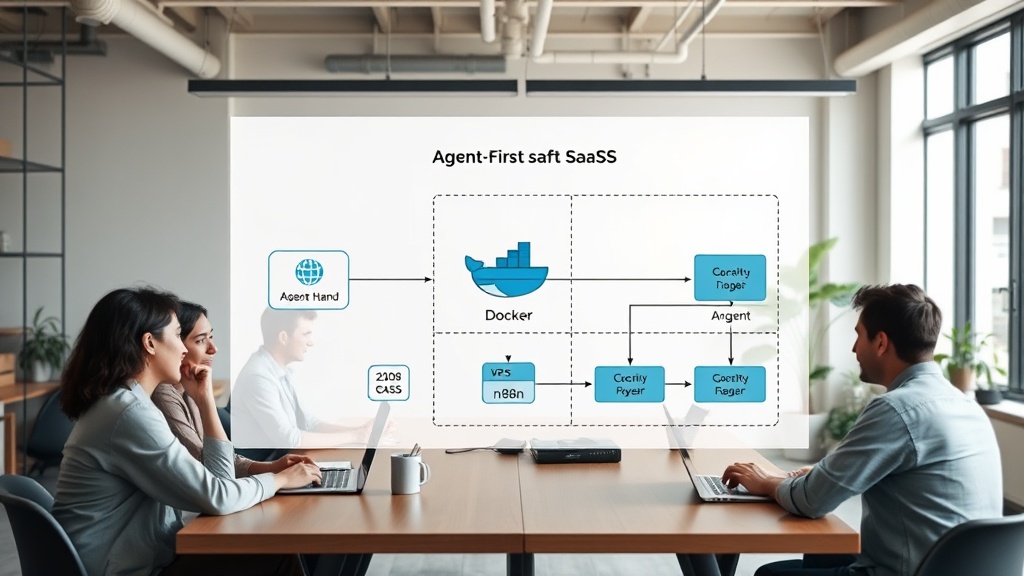
The practical implementation of an agent-first strategy doesn't necessitate massive infrastructure or deep VC funding. The founder behind ConnectEngine OS and ProductShot proves this point. His operational costs—a mere $45 per month—are achieved through a combination of self-hosted infrastructure and open-source tooling. The backbone of this operation is a VPS, which provides the necessary compute and storage resources without the overhead of managed cloud services.
Docker containers are used to package and isolate the applications, ensuring consistency and simplifying deployment across the server. The critical component for agent orchestration is n8n.io, an open-source workflow automation tool. n8n allows users to visually design complex workflows, which in this context, serve as the 'brains' for the AI agents. These workflows can chain together various operations, integrate with external APIs, and execute multi-step processes autonomously. For example, a lead generation agent might use n8n to scrape websites, extract contact information, draft personalized emails, and schedule follow-ups, all without human intervention after the initial goal is set.
The Products:
- ConnectEngine OS: Automates lead generation by identifying potential customers, content creation for marketing campaigns, and continuous uptime monitoring for other digital assets. Its agents work around the clock, identifying opportunities and ensuring services remain available.
- ProductShot: Generates AI-powered product photography. Users provide product details, and the agent creates professional-quality images suitable for e-commerce listings or marketing materials, a task that traditionally requires expensive photography equipment and skilled professionals.
This $45/month infrastructure cost covers the VPS and potentially other minimal services, demonstrating that the barrier to entry for building sophisticated agent-based applications is significantly lower than often perceived. The key is leveraging open-source software and a lean, self-managed infrastructure.
The Implication: Democratizing Agent-First Software
Huang's prediction, coupled with this practical demonstration, has profound implications. It suggests that the future of SaaS is not exclusively for large corporations with vast cloud budgets. Instead, the agent-first paradigm could empower smaller teams and individual developers to build powerful, automated solutions. By abstracting away the complexities of AI agent management and orchestration into accessible tools like n8n, and by providing cost-effective hosting options like VPS, the development and deployment of agent-driven software become far more democratized.
This model challenges the conventional wisdom that scaling requires massive cloud spend. It implies that innovation in agent-based software can flourish in leaner, more agile environments. Founders can focus on the agent's intelligence and workflow design rather than the complexities of managing distributed cloud infrastructure. This could lead to a Cambrian explosion of specialized agents, each performing specific tasks with greater efficiency and lower cost than human-operated software.
The surprising detail here is not the low cost, but the explicit decoupling of agent capability from massive cloud infrastructure. It suggests that the true moat for an agent-first company will be the intelligence and effectiveness of its agents, not the scale of its server farms. This is a significant reframing for the industry. What remains to be seen is how these lean, agent-first SaaS companies will scale their support and reliability as their user base grows, and whether the underlying VPS infrastructure can sustain enterprise-level demands.
The Road Ahead: Agents as the New UI
The transition to agent-first SaaS means the primary user interface will no longer be a graphical screen but a conversational or goal-oriented interaction with an AI agent. Developers will need to shift their focus from building intricate UIs to designing robust agent logic and ensuring reliable integration with various software tools. This involves defining agent capabilities, training them on relevant data, and establishing clear communication protocols for task delegation and feedback.
For users, this means a future where software works for them proactively. Instead of managing multiple subscriptions and logging into numerous platforms, users will delegate tasks to a suite of agents that handle the digital heavy lifting. This could free up significant human bandwidth, allowing individuals and businesses to focus on higher-level strategy, creativity, and decision-making.
The implications for the software industry are vast. Companies that fail to adapt to an agent-first mindset risk becoming obsolete. The focus will shift from feature lists to agent performance, reliability, and the intelligence embedded within. The $45/month VPS model serves as a powerful proof of concept, illustrating that building the future of software doesn't necessarily require the traditional, capital-intensive approach.