Understanding JavaScript Scope
In JavaScript, scope answers the fundamental question: “Where can I access a variable?” The language employs lexical scope, also known as static scope. This means a variable's accessibility is determined by its physical location in the source code, not by where the function is called at runtime. This contrasts with dynamic scope, where scope can change based on the execution context. Lexical scope provides a predictable environment for variable access, making code easier to reason about and debug.
Consider a simple example: a variable declared inside a function is only accessible within that function and any nested functions. When an inner function is defined, it inherits the scope of its outer function. This creates a chain of scopes, often visualized as nested blocks or environments.
The Power of Closures
A closure is a function that remembers the environment in which it was created, even after that environment has closed. More precisely, a closure is the combination of a function and the lexical environment within which that function was declared. This environment consists of any local variables that were in scope at the time the closure was created.
Think of a closure like a backpack that a function carries with it. This backpack contains all the variables and parameters that were available when the function was defined. When the function is later executed, it can access and use the items in its backpack, regardless of the current execution context. This allows functions to maintain state between calls, enabling powerful patterns like data privacy and factory functions.
How Closures Work: An Example
Let's illustrate with a common pattern: a counter function.
function createCounter() {
  let count = 0; // This variable is part of the closure's environment

  return function() {
    count++;
    return count;
  };
}

const counter = createCounter();
console.log(counter()); // Output: 1
console.log(counter()); // Output: 2
In this example, createCounter is an outer function that declares a variable count. It then returns an inner anonymous function. This inner function, when called, increments and returns the count variable. Crucially, the inner function maintains a reference to the count variable from its parent scope, even after createCounter has finished executing. Each call to counter() accesses and modifies the *same* count variable, demonstrating state preservation through closure.
This ability to retain access to variables from its enclosing scope is what makes closures so powerful. They are fundamental to implementing private variables and methods in JavaScript, preventing external code from directly manipulating internal state.
Immediately Invoked Function Expressions (IIFE)
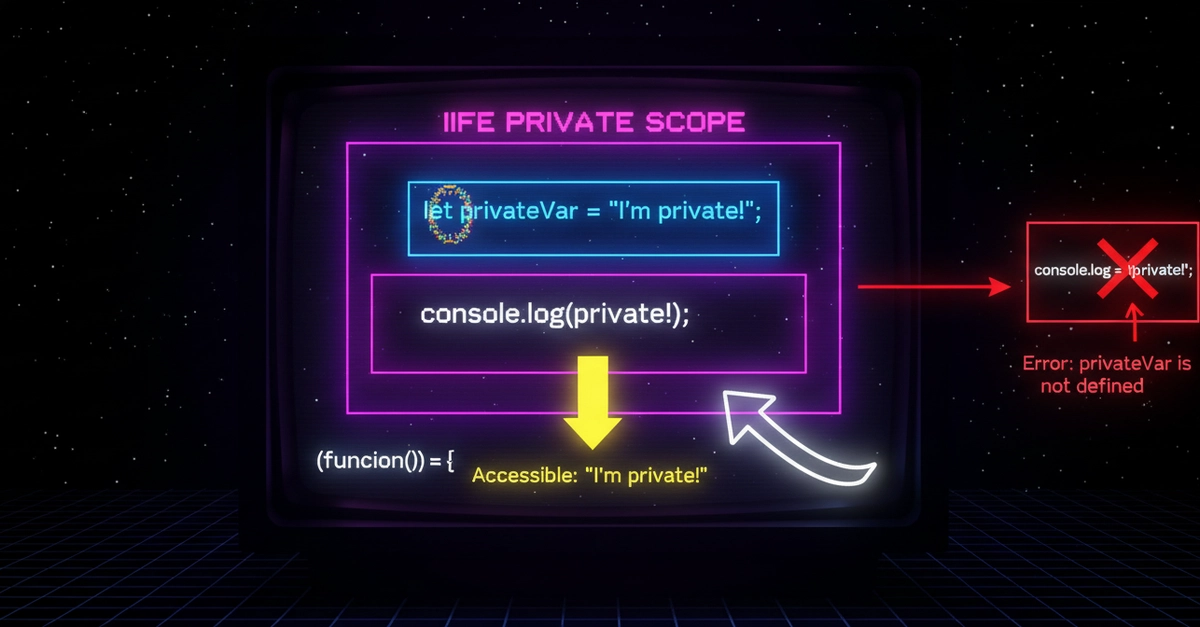
An Immediately Invoked Function Expression (IIFE) is a JavaScript function that is executed as soon as it is declared. It's a pattern used to create a local scope, preventing variables from polluting the global scope. IIFEs are often used to encapsulate code, manage dependencies, or create private variables.
The syntax typically involves wrapping a function declaration in parentheses, followed immediately by another set of parentheses to invoke it.
(function() {
  // Code inside this scope is private
  var privateVar = "I am private";
  console.log(privateVar);
})();

// privateVar is not accessible here
// console.log(privateVar); // This would cause an error
The outer parentheses (function() { ... }) cause the JavaScript engine to interpret the function declaration as an expression. The final set of parentheses () then executes that function expression immediately. This pattern is particularly useful for modules or libraries that need to run immediately upon script load but want to avoid creating global variables.
IIFEs leverage lexical scope to create isolated environments. Any variables declared within the IIFE are local to that scope and are not accessible from the outside. This is a foundational technique for writing modular and maintainable JavaScript, especially in older codebases before the advent of ES Modules.
Scope, Closures, and IIFE in Practice
Understanding how lexical scope, closures, and IIFEs interact is key to writing robust JavaScript. Lexical scope dictates where variables can be accessed. Closures allow functions to retain access to their lexical environment, enabling stateful behavior and data encapsulation. IIFEs provide a mechanism to create self-contained execution scopes, often utilizing closures to manage private state.
Together, these concepts form the bedrock of many advanced JavaScript patterns. Developers use them to create:
- Private state: As seen in the counter example, closures can protect variables from external modification.
- Module patterns: IIFEs were historically crucial for creating modules, defining private scope for internal variables and exposing only a public API.
- Callback functions: Closures are implicitly used when callback functions need access to variables from their creation context.
- Currying and partial application: These functional programming techniques rely heavily on functions retaining access to their outer scope.
The interplay between scope and closures is not merely an academic exercise; it directly impacts code quality, maintainability, and the avoidance of subtle bugs. By mastering these concepts, developers can write more predictable, modular, and efficient JavaScript applications.
The surprising detail here is how fundamental these concepts are, yet how easily they can be misunderstood. Many developers, especially those new to JavaScript, find the idea of a function