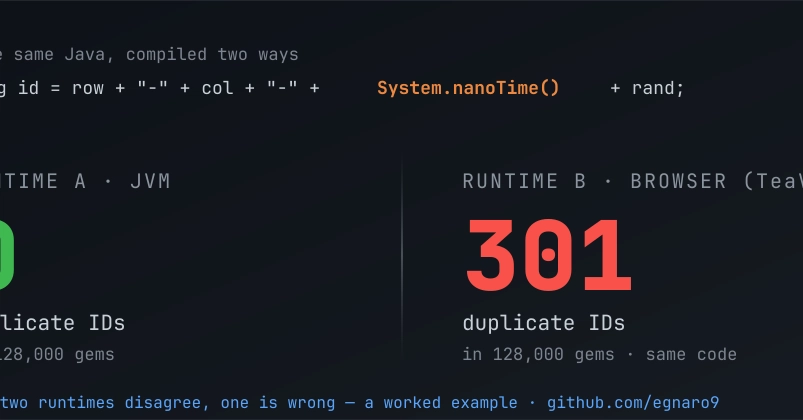
A reader's pointed feedback on a previous post pushed for a deep dive into a single, real-world bug. The request was clear: eschew jargon, avoid pitch-deck language, and instead, meticulously trace one task from inception to resolution, detailing what changed, what caught the problem, and what proof was needed. This article delivers exactly that, walking through a bug found in a match-3 game's Java rules engine, which runs on both a standard JVM and, compiled via TeaVM, in the browser.
The Setup: Dual Runtimes for Free Validation
The game's core logic resides in a plain-Java rules engine. This engine serves a dual purpose: it powers the game's backend and testing infrastructure on a Java Virtual Machine (JVM), and it's compiled to JavaScript using TeaVM to drive the playable board in a web browser. This isn't just for show; running the same Java code in two fundamentally different environments—the JVM and a JavaScript engine—provides an invaluable, built-in validation mechanism. Discrepancies between these two runtimes immediately signal a problem, acting as an early warning system for subtle bugs that might otherwise go unnoticed.
The critical insight here is that the browser runtime isn't merely a web-based demo. It's a full-fledged execution environment for the game's logic. By compiling the Java code to JavaScript with TeaVM, the developer ensures that the exact same Java code dictates gameplay on both the server (JVM) and the client (browser). This dual-runtime approach offers a free cross-validation layer. When behavior diverges between the JVM and the browser, it’s a strong indicator of a bug, not in the game's logic itself, but in how that logic is interpreted or translated across different execution environments.
Identifying the Discrepancy: Duplicate IDs Emerge
The issue surfaced during a routine development cycle. While testing new features, a peculiar pattern emerged: the browser version of the game was generating duplicate IDs for game elements, while the JVM version remained clean. This wasn't a minor cosmetic flaw; duplicate IDs can wreak havoc on application state, event handling, and data consistency. The immediate concern was understanding why this divergence was happening and how it was being missed by standard JVM tests.
The problem manifested as a persistent generation of identical identifiers for distinct game objects within the browser environment. For instance, if the game needed to create three 'gem' objects, the browser might erroneously assign the same ID to all three, or to two of them, while the JVM would correctly assign unique IDs. This discrepancy was particularly concerning because the underlying Java code was identical. The implication was that the compilation process via TeaVM, or the JavaScript runtime itself, was introducing a subtle error in the ID generation mechanism.
The numbers were stark: 301 duplicate IDs were detected in the browser runtime, while the JVM reported a clean slate with zero duplicates. This quantitative difference underscored the severity and specificity of the bug. It wasn't a general failure but a precise failure in a particular execution context. The immediate question became: what part of the ID generation process was sensitive to the JVM vs. JavaScript environment?
The Root Cause: A Race Condition in `System.currentTimeMillis()`
The investigation traced the problem to the seemingly innocuous use of `System.currentTimeMillis()` for generating unique IDs. In a single-threaded JVM environment, calls to `System.currentTimeMillis()` are typically spaced far enough apart, or the system clock moves fast enough, that collisions are exceedingly rare. However, when the Java code is compiled to JavaScript and run in a browser, especially in a highly optimized or concurrent context that TeaVM might facilitate, the granularity and timing of these calls can become problematic.
JavaScript's execution model, even with its single-threaded event loop, can lead to unexpected timing behaviors when dealing with high-frequency operations or during the compilation and optimization phases. TeaVM, in its effort to translate Java's concurrency primitives and system calls into efficient JavaScript, might alter the precise timing or execution order of `System.currentTimeMillis()` calls. If multiple ID generation requests happen in extremely rapid succession, within the same millisecond, `System.currentTimeMillis()` will return the same value. In the JVM, the inherent delays between operations, even small ones, usually prevent this. In the compiled JavaScript, these delays might be compressed, leading to multiple calls returning the identical millisecond timestamp.
The surprising detail here is not the sheer number of duplicates (301), but the absolute absence of the issue on the JVM. This highlights how environment-specific optimizations and execution models can mask or introduce bugs. What works perfectly in one runtime can fail silently or spectacularly in another, especially when dealing with time-sensitive operations that are susceptible to micro-optimizations or subtle timing differences. The race condition wasn't in the Java code's explicit logic but in the implicit timing assumptions it made about its execution environment.
The Fix: A More Robust ID Generation Strategy
The solution involved replacing the unreliable `System.currentTimeMillis()` approach with a more robust ID generation strategy. The developer opted for a method that ensures uniqueness even under rapid, high-frequency calls. One common and effective pattern is to use a combination of a counter and a seed value, or a UUID generator. For this specific game, a simple incrementing counter, managed within the scope of the object or component needing an ID, proved sufficient.
Instead of relying on an external, system-wide timestamp that could be subject to timing race conditions, the new approach involves maintaining a local counter. Each time a new ID is needed for an object of a specific type (e.g., a 'gem' or a 'player'), the counter for that type is incremented, and the new value is assigned. This guarantees that within a single execution context and for a specific object type, all generated IDs will be unique. While this might still produce duplicate IDs across different game sessions or if the counter state isn't persisted correctly, it eliminates the millisecond-level race condition that plagued the browser runtime.
The essential change is moving from a time-based, externally synchronized mechanism to a state-based, internally managed sequence. This makes the ID generation deterministic and immune to the subtle timing variations introduced by the TeaVM compilation and JavaScript execution. The fix is simple and effective, addressing the core vulnerability without introducing significant complexity or performance overhead.
Proof and Validation: Re-testing the End-to-End Flow
With the fix implemented, the critical step was re-validating the entire process. The developer ran the game logic through both the JVM and the TeaVM-compiled browser version. The expected outcome was zero duplicate IDs reported by the browser runtime, matching the clean output from the JVM. This end-to-end re-testing confirmed that the new ID generation strategy resolved the discrepancy.
The proof was in the numbers: after the change, the browser reported 0 duplicate IDs, aligning perfectly with the JVM's output. This demonstrated that the fix had successfully eliminated the race condition and ensured consistent behavior across both runtimes. The process served as a powerful reminder of the importance of cross-runtime testing and the potential pitfalls of relying on system-level primitives that may behave differently under varying execution conditions.
This exercise highlights a key challenge in cross-platform development: assumptions about execution environments. While `System.currentTimeMillis()` is a standard Java API, its performance characteristics and the implicit timing guarantees it offers can vary significantly when translated to different platforms like JavaScript. The dual-runtime strategy, though initially designed for convenience, proved invaluable in surfacing this deep-seated, environment-specific bug.