
Java 27: A Leap Forward in Concurrency and Performance
Oracle has officially released Java 27, marking another significant milestone in the evolution of the venerable programming language. This release continues the rapid six-month cadence, bringing a host of improvements and new features, with a particular focus on enhancing Project Loom and delivering substantial performance gains.
For developers, the most impactful changes often lie in how Java handles concurrency. Java 27 builds upon the foundation laid by Project Loom, further refining the capabilities of virtual threads. These lightweight threads, which are multiplexed onto a smaller pool of operating system threads, have been a game-changer for building highly concurrent, I/O-bound applications. The enhancements in Java 27 aim to make virtual threads even more robust and performant, simplifying the development of scalable applications without the complexities of traditional thread management.
The core idea behind virtual threads is to abstract away the underlying operating system threads. Instead of a one-to-one mapping between application threads and OS threads, a large number of virtual threads can be managed by a small number of OS threads. When a virtual thread performs a blocking I/O operation, it is unmounted from its OS thread, allowing that OS thread to be used by another virtual thread. This dramatically increases the number of concurrent operations an application can handle, akin to having an unlimited supply of workers for a factory floor, each only needing a small desk to operate from.
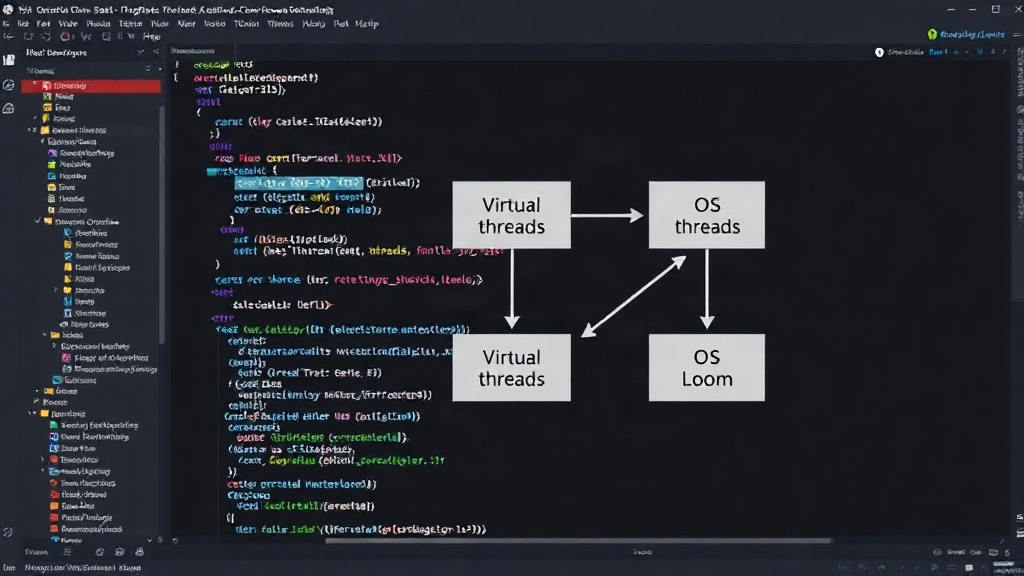
Key Enhancements in Project Loom
Java 27 introduces several key improvements to Project Loom. While specific details will emerge as the community dives deeper, early indications point to better scheduling algorithms for virtual threads, leading to reduced latency and increased throughput. This means applications can respond faster and handle more requests simultaneously. The runtime has been optimized to manage the lifecycle of virtual threads more efficiently, reducing overhead associated with their creation and termination. Furthermore, improvements to the ForkJoinPool, which underlies the execution of many concurrent tasks in Java, are expected to provide a more predictable and performant experience when using structured concurrency patterns with virtual threads.
One of the subtle but critical advancements is the improved handling of thread-local storage with virtual threads. Previously, managing thread-local variables across the lifecycle of a virtual thread could present challenges. Java 27 offers more predictable and robust mechanisms for managing these variables, ensuring that shared state is correctly managed when applications transition between different virtual threads or when threads are mounted and unmounted from OS threads.
Performance Improvements Across the JVM
Beyond Project Loom, Java 27 delivers a suite of performance optimizations across the Java Virtual Machine (JVM). These include enhancements to the garbage collector, JIT compiler, and the string processing APIs. The garbage collector, responsible for reclaiming memory, has seen tuning that aims to reduce pause times and improve overall memory management efficiency. This is crucial for applications that require low latency and high availability.
The Just-In-Time (JIT) compiler, which translates Java bytecode into native machine code at runtime, has also received attention. Optimizations here can lead to faster execution of frequently used code paths, resulting in a tangible performance boost for CPU-bound applications. Early benchmarks suggest noticeable improvements in startup times and peak performance for certain workloads. The string manipulation APIs, a common area for optimization in many programming languages, have also been refined to offer better performance and reduced memory consumption for typical string operations.
Other Notable Changes
While Project Loom and performance are the headline features, Java 27 also includes a range of other improvements. These typically encompass updates to the standard library, security enhancements, and deprecation of older APIs. Developers should consult the release notes for a comprehensive list of all changes, including any potential API deprecations or removals that might affect existing codebases. The ongoing effort to modernize the Java platform is evident, with each release bringing the language closer to contemporary development needs while maintaining its stability and backward compatibility.
The rapid release cycle means that keeping up with every new Java version requires continuous learning. However, the predictable nature of these releases, coupled with the significant value delivered in each, makes it increasingly beneficial for organizations to adopt newer versions of Java. The long-term support (LTS) releases still serve as stable anchors, but the feature releases like Java 27 offer compelling reasons to upgrade sooner for those who can leverage the latest advancements in concurrency and performance.
What This Means for Developers
For developers, Java 27 represents an opportunity to build more scalable and performant applications with less effort. The continued maturation of virtual threads simplifies concurrent programming, allowing teams to focus on business logic rather than complex thread synchronization. The performance enhancements mean that applications can achieve higher throughput and lower latency with existing code, or potentially require fewer resources to achieve the same performance targets. If you manage a fleet of microservices or any application that deals with significant I/O, exploring Java 27's virtual thread improvements should be a high priority.
The surprising detail here is not the introduction of new features, but the *incremental yet substantial* refinement of existing ones, particularly Project Loom. Instead of a single, massive overhaul, we see Java evolving through steady, impactful improvements that address core developer pain points. This approach makes adoption smoother and the benefits more immediately tangible.
As you plan your next development cycle or consider upgrading existing applications, Java 27 warrants serious consideration. The advancements in concurrency and performance are not merely theoretical; they translate directly into more efficient, responsive, and scalable software. The platform continues to assert its relevance in the modern cloud-native landscape, proving that Java is far from a legacy technology.