The Challenge of Modern Project Management Tools
The landscape of project management and issue tracking tools is dominated by platforms like Jira, Linear, and Trello. While these tools offer robust features, they often impose specific workflows that don't align with all development methodologies. Source 2 highlights a critical mismatch when trying to adapt methodologies like 'Shape Up' into tools inherently built for Scrum. Jira, for instance, structures work around backlogs, estimates, and sprints, making it difficult to accommodate Shape Up's focus on shaped bets and discovered tasks. The 'pitch' document in Shape Up, a core artifact, has no direct equivalent in Jira, leading to its displacement into disconnected Confluence pages. This process mismatch forces teams to contort their preferred methods to fit the tool, rather than the tool supporting their method.
This fundamental disconnect means that even when teams adopt new processes, the underlying tools can quietly revert them to older, less suitable paradigms. The estimation fields, designed for sprint velocity, become filled out despite Shape Up's emphasis on fixed scope and time. Tasks, conceived as outputs of a larger shaped piece of work, are treated as inputs to be sized and prioritized in a traditional backlog. This rigidity can stifle innovation and lead to inefficient workflows, as teams spend more time managing the tool than executing their work.
Introducing It's a Plan
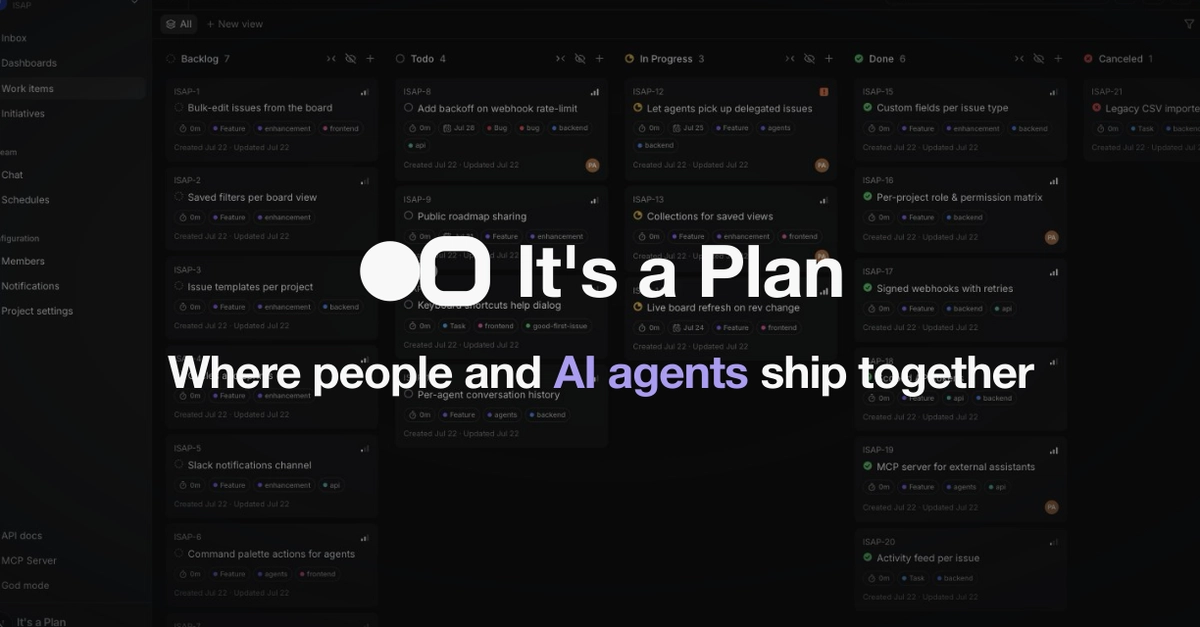
Enter 'It's a Plan,' an open-source, self-hosted alternative aiming to bridge this gap. Developed by croffasia, this project positions itself as a direct competitor to Linear, Jira, and Trello, but with a distinct philosophy. The core premise is to create a unified board where both human team members and AI agents can collaborate seamlessly. This approach directly addresses the need for more flexible and intelligent project management tools.
The self-hosted nature of 'It's a Plan' is a significant differentiator. It means users control their own server, their database, and their model keys. This offers greater data privacy, security, and freedom from vendor lock-in. The project is released under the AGPL-3.0 license, emphasizing its commitment to open-source principles. Crucially, it operates without seat limitations or proprietary constraints, aiming to be accessible and adaptable for teams of any size.
AI Agents as First-Class Citizens
One of the most compelling aspects of 'It's a Plan' is its integration of AI agents. Unlike other tools where AI might be an add-on or a separate feature, 'It's a Plan' is designed from the ground up for co-creation between humans and AI. This suggests a future where AI agents can actively participate in planning, task management, and even execution, working alongside developers, designers, and product managers on the same board. This could accelerate development cycles, automate repetitive tasks, and provide intelligent insights directly within the workflow.
The implications of this AI integration are vast. Imagine AI agents helping to break down complex tasks, suggest solutions, identify potential roadblocks, or even draft code snippets, all within the context of the project board. This moves beyond simple AI assistance to a more collaborative partnership. The control over model keys further empowers users to select and manage the AI models they prefer, maintaining flexibility and control over their AI stack.
Addressing the Process Mismatch
By offering a self-hosted, open-source solution, 'It's a Plan' inherently provides the flexibility needed to implement various methodologies. Without the rigid Scrum-centric structure of tools like Jira, teams can mold 'It's a Plan' to fit their preferred workflows, whether it's Shape Up, Kanban, or a custom hybrid. The absence of seat-based pricing removes a common barrier for startups and smaller teams, fostering wider adoption.
The project's stated goal is to enable 'humans and AI agents share one board.' This unified view is key. Instead of separate tools for documentation, task tracking, and AI interaction, 'It's a Plan' aims to consolidate these into a single, cohesive environment. This reduces context switching and ensures that all project-related information, including AI-generated contributions, is readily accessible and integrated.
The Future of Project Management?
The emergence of 'It's a Plan' signals a potential shift in the project management software market. As teams increasingly explore AI integration and seek greater control over their tools and data, open-source, self-hosted solutions become more attractive. The challenge for 'It's a Plan' will be to demonstrate its robustness, scalability, and user-friendliness compared to the mature offerings from established players. However, its foundational design, emphasizing AI collaboration and user autonomy, positions it as a compelling alternative for forward-thinking development teams.
What nobody has addressed yet is how effectively AI agents can truly collaborate on complex software projects without human oversight, and what the long-term implications are for team dynamics and skill development as AI becomes a more integrated part of the development process. The technical hurdles of integrating diverse AI models into a cohesive workflow are significant, and 'It's a Plan' is one of the first to tackle this head-on with an open-source, self-hostable solution.