The Open Source Discovery Problem
Thousands of developers annually express a desire to contribute to open source projects. The motivation is high, the projects are abundant, and the issues are plentiful. However, the path to a first contribution is often obscured by a frustrating discovery process. Developers typically resort to searching GitHub for terms like good first issue, leading to an overwhelming experience. They open dozens of repositories, sift through potentially outdated or inactive issues, decipher confusing descriptions, and frequently abandon the effort, closing the tab in frustration. This friction point discourages many aspiring contributors and hinders the growth of open source communities.
The core of the problem lies in the sheer volume and disorganization of available issues. Developers face too many repositories to explore effectively. Issues might be stale, already resolved, or inactive, wasting valuable developer time. Beginners often lack a clear starting point, unsure of their skill alignment with specific tasks. The constant switching between numerous GitHub tabs creates a cognitively taxing workflow. Critically, there's a lack of personalized recommendations that could guide developers to issues best suited for their skill set and interests.
Introducing IssueSwipe
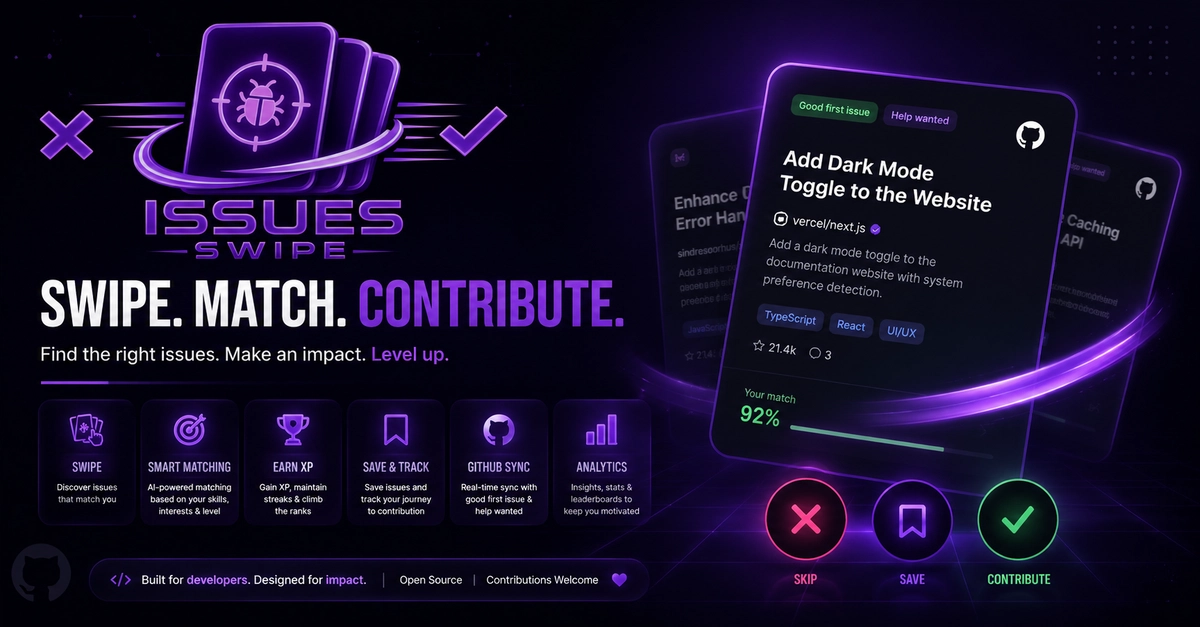
To address this significant friction, Rishi Byte has developed IssueSwipe, a platform designed to streamline the open source contribution discovery process. IssueSwipe adopts a familiar, intuitive interface inspired by popular dating applications, where users can swipe left or right on issues presented to them. This gamified approach aims to make the often-tedious task of finding a suitable open source task more engaging and efficient. The platform aggregates open source issues and presents them to users in a digestible format, allowing them to quickly indicate their interest or disinterest.
The core functionality of IssueSwipe involves presenting developers with individual open source issues. Each issue is displayed with essential information, such as the project name, a brief description, and relevant tags. Users can then 'swipe right' on issues they find appealing or suitable for their skills, effectively bookmarking them for later. Swiping left signifies disinterest or unsuitability. This simple, binary interaction allows users to curate a personalized list of potential contributions without the need to navigate complex project pages or manage numerous browser tabs. The goal is to reduce the cognitive load associated with issue discovery and accelerate the path from interest to contribution.

How IssueSwipe Works
IssueSwipe aggregates issues from various open source repositories, primarily focusing on those tagged with indicators of beginner-friendliness, such as good first issue, help wanted, or easy. The platform's backend processes these issues, extracting key details and preparing them for presentation. When a user signs up or logs in, they are presented with a stream of these issues, one at a time. The user's interaction—swiping right or left—is recorded and used to refine future recommendations. This continuous feedback loop allows IssueSwipe to learn the user's preferences, project interests, and skill levels, thereby improving the relevance of the issues presented over time.
Users can create an account, which allows them to save the issues they've swiped right on. This saved list functions as a personalized dashboard of potential contributions. From this dashboard, developers can access direct links to the original issue on platforms like GitHub, facilitating the transition from discovery to actual contribution. The platform aims to be a central hub for aspiring open source contributors, simplifying the initial hurdle of finding a project and an issue that aligns with their capabilities and learning goals. By providing a curated and interactive experience, IssueSwipe seeks to lower the barrier to entry for new contributors and foster a more vibrant open source ecosystem.
The Broader Impact on Open Source
IssueSwipe’s innovative approach has the potential to significantly impact the open source landscape. By simplifying the discovery process, it can onboard a new wave of developers who might have been intimidated by the traditional methods of finding contributions. This influx of new talent can benefit existing open source projects by increasing the pool of potential contributors, accelerating development, and improving code quality through broader community involvement. For maintainers, IssueSwipe could mean a more consistent stream of well-suited contributions, reducing their burden in triaging and assigning simple tasks.
The model itself, leveraging a gamified, swipe-based interface, could inspire similar tools for other complex discovery problems in technology. It demonstrates that familiar user experience patterns from consumer applications can be effectively applied to developer tooling, making sophisticated tasks more accessible. The success of IssueSwipe might encourage further innovation in developer onboarding and community engagement platforms, ultimately strengthening the open source movement by making participation more inviting and rewarding for a wider audience. The surprising element here is how a simple, consumer-centric UX pattern can unlock a significant bottleneck in a professional developer workflow.
Future Directions and Potential
While IssueSwipe currently focuses on issue discovery, its future potential is substantial. The platform could evolve to incorporate more sophisticated matching algorithms, considering not just issue tags but also the specific programming languages, frameworks, and project types a user prefers. Integration with developer profiles, perhaps via GitHub, could offer even more personalized recommendations. Furthermore, IssueSwipe could expand to include features that support the entire contribution lifecycle, such as tools for tracking progress on swiped issues, facilitating communication between contributors and maintainers, or even providing mentorship resources.
The platform could also explore features for project maintainers, allowing them to more effectively tag and promote issues that are ideal for new contributors. Building a community around IssueSwipe itself, where users can share their successful contributions or discuss challenges, could further enhance its value. The ultimate vision is to create a comprehensive ecosystem that not only helps developers find their first open source contribution but also supports their continued growth as active members of the open source community. What remains to be seen is how IssueSwipe will scale its issue aggregation and curation as the number of open source projects and issues continues to grow exponentially.