
The Problem with Manual Internal Linking
For most websites, internal linking is an afterthought, a manual process driven by an editor's memory. A content creator remembers a related article and manually adds a hyperlink, often at the end of a post. This ad-hoc approach is manageable for small sites, perhaps a few dozen pages. However, as a website grows past a few hundred URLs, this system breaks down. Nobody can recall every connection. Pages become discoverable only by chance, and critical content can effectively disappear into the digital ether, unlinked and forgotten. This isn't just a content discovery problem; it's a fundamental issue of site architecture and information retrieval.
The core of the issue lies in how we perceive and manage these links. We treat them as a part of the content itself, a stylistic choice or a helpful hint. But this perspective fundamentally limits our ability to understand and optimize the site's overall structure. When a site scales, relying on human memory for complex relational data is unsustainable and error-prone. The result is a site that is less accessible to users and less understandable to search engines, impacting SEO, user experience, and overall content effectiveness.
Shifting to a Graph-Based Model
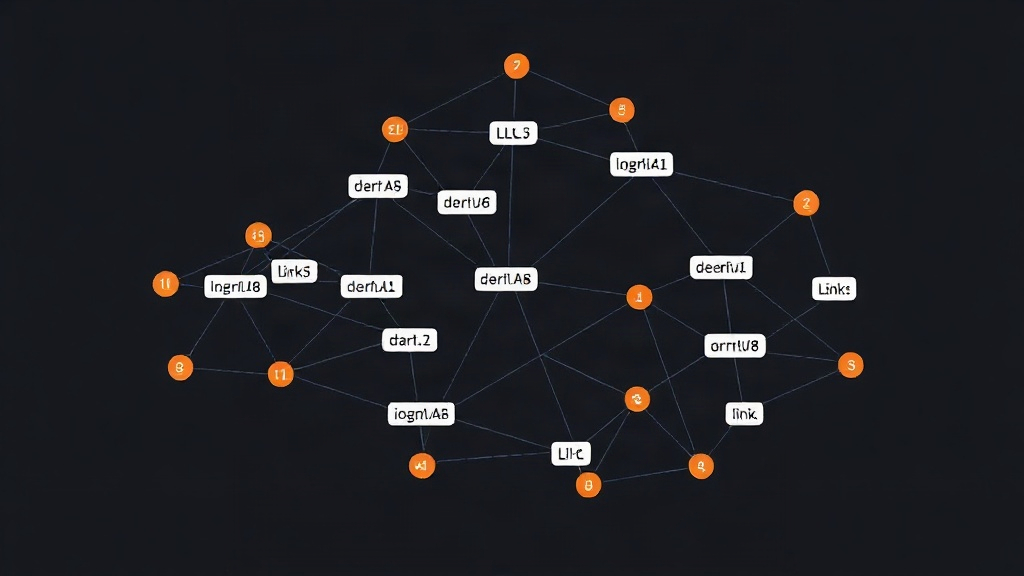
The solution is to reframe internal linking. Instead of viewing each link as a piece of content, we must treat the entire internal linking structure as a data structure: specifically, a directed graph. In this model, every unique URL on a domain becomes a node. Each <a href> tag that points to another URL within the same domain represents a directed edge connecting two nodes. This shift in perspective transforms a chaotic jumble of hyperlinks into a structured, computable entity.
Once a website's internal linking is represented as a graph, previously intractable problems become solvable. Orphan pages—those with no incoming links from other pages on the site—can be identified algorithmically. Link depth, a measure of how many clicks it takes to reach a page from the homepage, becomes a quantifiable metric. Missing connections, or areas where the graph is sparse or poorly connected, can be mapped. These are no longer subjective editorial decisions but objective properties of the site's architecture that can be analyzed, optimized, and maintained programmatically.
Constructing the Node List from the Sitemap
The first step in building this graph representation is to establish the set of all nodes. The most efficient way to get a comprehensive list of all URLs a website claims to exist is by parsing its sitemap. Sitemaps, typically in XML format, are designed to inform search engines about all available pages. By processing the sitemap, we can generate the complete set of nodes for our graph. This provides an authoritative inventory of the site's URLs.
However, a sitemap alone does not reveal the connections between these nodes. To build the edges of our graph, we must then crawl the HTML content of each URL identified from the sitemap. During this crawl, we extract all <a href> tags that point to internal domains. Each extracted link represents a directed edge, connecting the current page (source node) to the linked page (target node). This process systematically maps out the relationships between all pages, forming the complete internal linking graph.
Analyzing Graph Properties for Site Health
With the internal linking structure modeled as a graph, a wealth of analytical possibilities opens up. Beyond simply identifying orphan pages, we can analyze the graph for other critical properties that impact user experience and SEO performance.
Link Depth Analysis
Link depth measures the shortest path from the homepage (or a designated starting node) to any given page. Pages with excessive link depth can be difficult for users and search engine crawlers to find. A deep graph indicates that a user would need to click through many pages to reach certain content, which is often detrimental to engagement and discoverability. Analyzing link depth allows editors and developers to strategically add more direct links to important, deeply nested pages, effectively shortening their paths within the graph.
Connectivity and Reachability
A robust internal linking strategy ensures that most pages are reachable from most other pages, directly or indirectly. Graph algorithms can identify clusters of pages that are poorly connected to the main body of the site, or pages that have very few incoming links (low in-degree). These metrics highlight areas of content that might be overlooked. Conversely, pages with an extremely high in-degree might be central hubs, and ensuring their quality and relevance is paramount.
Identifying Broken Links and Redirect Chains
While not strictly a graph property in its raw form, the process of crawling to build the graph inevitably reveals broken links (404 errors) and problematic redirect chains. If a node (URL) in the sitemap points to another URL that returns an error, or if an edge leads to a page that immediately redirects elsewhere multiple times, these issues can be flagged. This transforms link maintenance from a reactive chore to a proactive analysis of the site's structural integrity.
Tools and Implementation
Implementing this graph-based approach requires tooling that can parse sitemaps, crawl websites, extract links, and then process this data as a graph. Several open-source libraries for graph manipulation exist in languages like Python (e.g., NetworkX) or JavaScript (e.g., Cytoscape.js). These can be used to build custom scripts or applications that analyze a site's internal linking structure.
For developers, this means writing scripts that:
- Fetch and parse the
sitemap.xmlfile to get the list of all URLs (nodes). - Crawl each of these URLs, parsing the HTML to find all internal
<a href>tags. - Store these relationships (source URL, target URL) as directed edges.
- Use a graph library to compute properties like path length, connected components, and node degrees.
- Generate reports or visualizations of the graph structure, highlighting areas for improvement.
The surprising detail here is not the technical complexity of graph theory, but how profoundly it simplifies what was once a purely subjective and error-prone editorial task. By treating internal links as a computable graph, we move from guesswork to data-driven optimization.
Broader Implications for Site Management
Adopting a graph-based approach to internal linking offers significant advantages for site management, SEO, and user experience. It provides a clear, quantitative understanding of a website's architecture, enabling proactive maintenance and strategic growth. For SEO professionals, this means a more crawlable and indexable site, with better distribution of