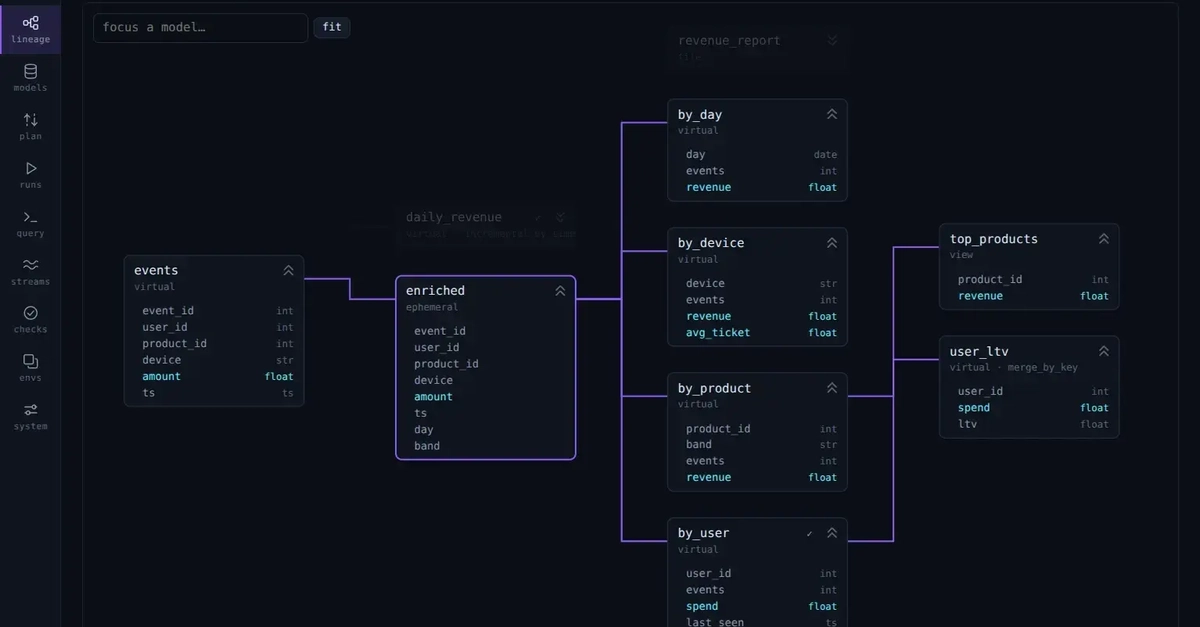
The modern data stack is a sprawling collection of specialized tools, each excelling at its given task. Data engineers in 2026 face a steep learning curve: dbt for SQL transformations, Airflow or Dagster for orchestration, dlt, Airbyte, or Fivetran for ingestion, and Python for anything beyond SQL. Add to this the YAML configurations and the necessary glue code to connect these disparate systems, and the result is a complex, brittle ecosystem.
This is the problem Interlace.sh set out to solve. The company's new platform introduces a unified abstraction layer, aiming to eliminate the friction points – the 'seams' – that plague contemporary data engineering workflows. The core thesis is that while individual tools are powerful, their integration is often manual, error-prone, and difficult to manage.
The Problem with Seams
Interlace.sh identifies the critical issue not with the tools themselves, but with how they interact. Consider a typical data pipeline: an ingestion tool writes data to a landing zone, and a transformation tool reads from it. This handoff is not managed by either tool; it's a convention, relying on agreed-upon table names and timing assumptions. This lack of inherent connection means that failures often occur at these boundaries. A change in a table name, a slight delay in ingestion, or an unexpected schema drift can break the entire pipeline, with neither the ingestion nor the transformation tool being aware of the failure's root cause in the other's domain.
This fragmented approach leads to several challenges:
- Increased Complexity: Engineers must understand the intricacies of multiple tools and their specific integration patterns.
- Brittleness: Pipelines are prone to breaking due to minor changes in one component, requiring extensive debugging across systems.
- Manual Handoffs: The 'glue code' and configurations needed to connect tools consume significant engineering time and introduce potential errors.
- Lack of Observability: Pinpointing failures becomes difficult when issues span across multiple, disconnected services.
Interlace.sh argues that by providing a unified abstraction, these seams can be smoothed over, leading to more robust and manageable data pipelines. The platform acts as a central nervous system, understanding the relationships between different stages of the data lifecycle and providing a consistent interface for developers.
How Interlace.sh Unifies the Stack
The Interlace.sh platform introduces a universal interface that abstracts away the underlying tools. Instead of configuring dbt, Airflow, and Fivetran separately, engineers interact with Interlace.sh's model. This abstraction layer manages the execution, scheduling, and dependency mapping across different data processing engines and orchestration frameworks.
Key aspects of Interlace.sh's approach include:
- Unified Configuration: A single configuration language or interface replaces the need for multiple YAML files and tool-specific settings. This allows engineers to define their entire data pipeline—from ingestion to transformation to testing—in one place.
- Intelligent Orchestration: Interlace.sh understands the dependencies between different tasks, regardless of the underlying tool executing them. It can schedule jobs, manage retries, and propagate failures more effectively than fragmented orchestration tools. Think of it less like a conductor leading separate orchestras, and more like a single composer writing a symphony where every instrument plays in perfect harmony, managed by one score.
- Cross-Tool Compatibility: The platform is designed to integrate with existing popular data tools. It doesn't aim to replace dbt or Airflow entirely, but rather to provide a meta-layer that orchestrates them. This means organizations can leverage their existing investments while gaining the benefits of a unified system.
- Enhanced Observability: By centralizing pipeline management, Interlace.sh provides a single pane of glass for monitoring pipeline health, performance, and failures. This unified view simplifies debugging and operational oversight.
The initial focus of Interlace.sh appears to be on streamlining the common pain points encountered by data engineers. By abstracting the operational complexities, the platform frees up engineers to focus on the actual logic of data transformation and analysis, rather than the mechanics of tool integration.
The Future of Data Engineering Abstraction
Interlace.sh's ambition is significant: to become the de facto standard for managing complex data pipelines. By tackling the 'seam problem,' they are addressing a fundamental challenge in data engineering that has persisted despite the proliferation of powerful, specialized tools. The success of such a platform hinges on its ability to truly abstract complexity without introducing its own set of limitations or becoming another tool that requires significant integration effort.
The company's approach suggests a future where data engineers can define their desired outcomes – what data needs to be ingested, how it should be transformed, and what quality checks are required – and have a unified system manage the execution across a diverse set of underlying technologies. This vision aligns with the broader trend in software development towards higher levels of abstraction, enabling faster iteration and reducing cognitive load on development teams.
What remains to be seen is how Interlace.sh will scale its abstraction to accommodate the rapidly evolving data landscape. As new tools and paradigms emerge, the platform will need to demonstrate its flexibility and extensibility. Furthermore, the performance implications of routing operations through an abstraction layer will be a critical factor for adoption in performance-sensitive environments.