The Latency Bottleneck in Real-Time LLM Interaction
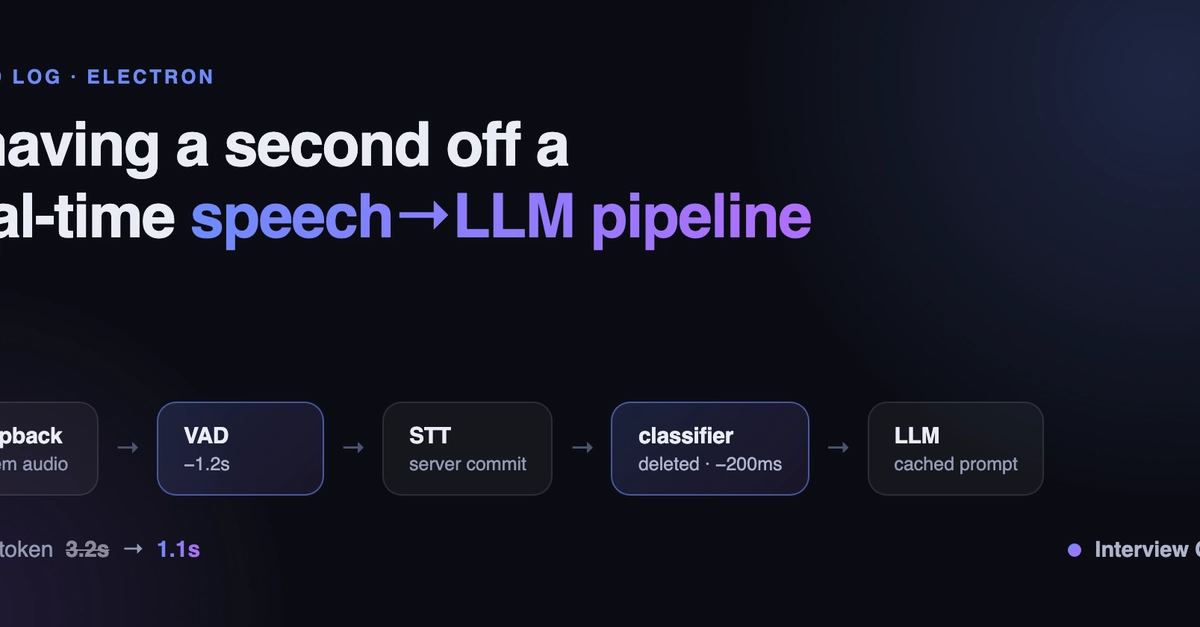
Building interactive applications that leverage Large Language Models (LLMs) often involves real-time audio processing. A common use case is a desktop overlay that listens to one side of a video call, transcribes the speech, and then streams an LLM-generated answer. While individual components of such a pipeline—speech-to-text (STT), classification, and LLM inference—might be fast enough on their own, chaining them together can introduce significant latency. In one such implementation, the time from a speaker finishing a sentence to the first LLM token appearing on screen was a sluggish 3.2 seconds. This delay is unacceptable when a human is actively waiting for a response.
The naive pipeline looks something like this:
mic/loopback → PCM → WebSocket STT → final transcript → "is this a question?" classifier → LLM → stream
This initial setup resulted in approximately 3.2 seconds of end-to-end latency. To improve this, developers identified four potential areas for optimization, but only two proved to be impactful. The key to shaving off critical milliseconds lies in understanding how audio data is processed and how STT services interpret speech segments.
Optimizing Audio Chunking and Endpoint Detection
The most significant improvement came from addressing how silence is handled and how audio is segmented before being sent to the STT service. The initial approach likely involved streaming continuous audio, which presented a problem for the STT server's endpointing mechanism. STT services often rely on detecting pauses or silence to determine the end of a spoken segment, commit to a transcription, and send it for further processing. When continuous audio is streamed without clear pauses, the server may delay its segment commit, effectively adding latency. This is not primarily a bandwidth issue but a protocol and processing one within the STT service itself.
The solution implemented was to run a Voice Activity Detection (VAD) algorithm on the client-side. VAD analyzes the audio stream and identifies segments containing speech versus silence. By using client-side VAD, the application can intelligently decide when to send audio chunks to the STT server. Crucially, it can also suppress sending prolonged periods of silence. This allows the STT server to receive more distinct, speech-filled segments. When the VAD detects a pause that is sufficiently long to be considered the end of an utterance, the application can then send that final chunk to the STT service. This signals to the STT server that a complete utterance has been received, prompting it to commit the transcription faster.
This client-side VAD not only helps the STT server with its endpointing but also allows the application to control the size and timing of audio chunks more precisely. Instead of sending continuous, potentially fragmented audio, the application can buffer speech until a natural pause occurs, then send a well-defined segment. This reduces the overhead associated with managing continuous streams and allows the STT service to process discrete, meaningful units of speech more efficiently.
The Impact of Segment Commit and Classifier Latency
While optimizing audio chunking and VAD was the primary driver of latency reduction, another area that contributed to the overall improvement was the STT service's segment commit time and the subsequent classification step. Even with optimized audio input, the STT service itself introduces a small delay as it processes the audio and commits to a final transcript for a given segment. This commit time is inherent to the STT model and its architecture.
Following the STT, the transcript is fed into a classifier. This classifier determines if the spoken utterance is a question. If it is a question, the application proceeds to query the LLM. The latency introduced by this classifier, though typically low, adds to the total pipeline delay. In the optimized pipeline, the focus shifted to ensuring that the time between the STT committing a transcript and the classifier making its decision, and subsequently triggering the LLM, was minimized. This involves efficient data transfer between these components and fast execution of the classification logic.
The crucial insight is that the STT server's decision to commit a segment is a key latency point. By providing cleaner, more defined speech segments via client-side VAD, the STT server is prompted to commit earlier. This earlier commit means the transcript is available sooner for the downstream classifier and LLM, directly reducing the end-to-end time. The four initial areas of attack were identified as:
- Stopping the sending of silence (addressed by client-side VAD).
- Reducing the STT server's segment commit time (indirectly addressed by VAD).
- Optimizing the "is this a question?" classifier.
- Minimizing LLM inference and streaming time.
The surprising detail here is not the specific time saved, but how much of the 3.2-second delay was directly attributable to the STT endpointing mechanism failing to recognize natural pauses in continuous audio streams. The other two optimization paths—the classifier and the LLM itself—while important for overall responsiveness, did not offer the same magnitude of improvement in this specific bottleneck scenario.
Achieving Sub-Second Latency
By implementing client-side VAD to intelligently manage audio chunking and suppress silence, the pipeline's performance saw a dramatic improvement. The time from the speaker finishing a sentence to the first LLM token appearing on screen was reduced from 3.2 seconds to approximately 1.7 seconds. This nearly halves the latency, making the real-time interaction significantly more fluid and responsive. This is achieved by ensuring the STT service receives well-defined utterances, allowing it to commit transcripts faster, which in turn allows the subsequent classification and LLM steps to begin their work sooner.
This optimization is particularly relevant for developers building real-time conversational AI agents, dictation software, or any application where immediate feedback based on spoken input is critical. The Electron framework, while offering cross-platform desktop capabilities, introduces its own set of considerations for performance-critical pipelines. Managing audio streams and inter-process communication efficiently within Electron is paramount for achieving low latency.
What nobody has addressed yet is the long-term impact of such aggressive latency optimization on the STT models themselves. As developers push for faster commits by providing cleaner data, it might inadvertently train these models to be more sensitive to short pauses, potentially leading to premature segmentation of naturally flowing speech in other applications or contexts.