Intel Starfire: A New Frontier in Space-Grade Computing
Intel has officially unveiled Starfire, a new system-on-chip (SoC) specifically engineered for the rigorous demands of space-based applications and designed with the U.S. government as its primary customer. This advanced chip, based on the Panther Lake architecture, represents a significant step forward in high-performance computing for the final frontier. Starfire integrates cutting-edge manufacturing processes and architectural designs, aiming to provide unprecedented reliability and performance in an environment where failure is not an option.
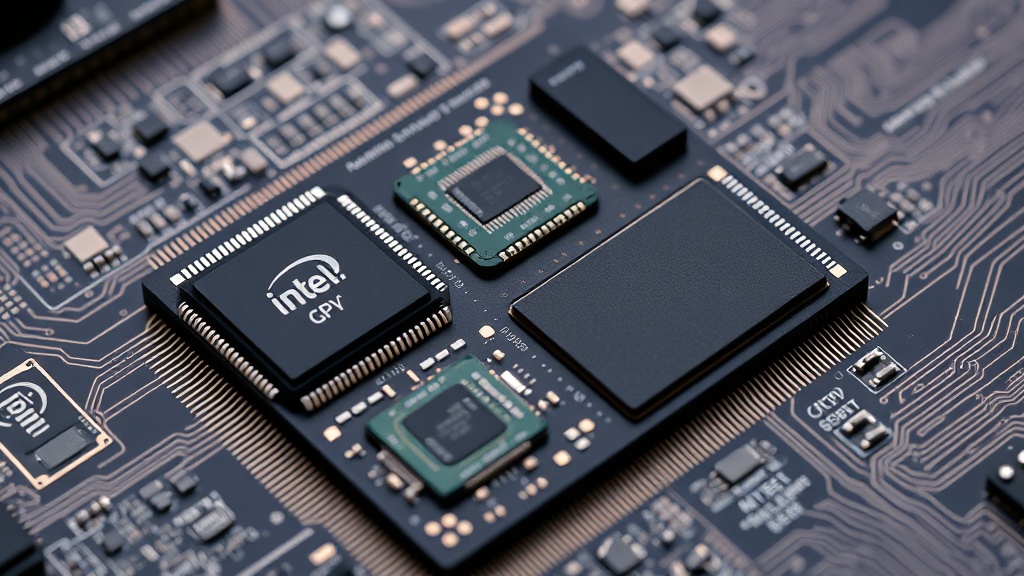
The development of Starfire underscores Intel's ongoing commitment to specialized markets that require extreme resilience and tailored solutions. Unlike consumer-grade or even standard enterprise silicon, components destined for space must withstand harsh conditions, including extreme temperature fluctuations, radiation bombardment, and the vacuum of space. Intel's approach with Starfire involves leveraging its most advanced process nodes and robust design methodologies to meet these stringent requirements. The chip's architecture is a hybrid, combining a powerful CPU built on Intel's cutting-edge 18A process node with a GPU manufactured using the mature and reliable Intel 3 process.
This dual-node strategy is particularly noteworthy. The 18A process, Intel's most advanced node to date, offers superior transistor density and power efficiency, making it ideal for the core processing unit where raw computational power is paramount. Conversely, the Intel 3 process, while not the absolute bleeding edge, provides a well-established, high-performance, and radiation-hardened platform suitable for the GPU. This judicious selection of process technologies allows Starfire to balance state-of-the-art performance with the proven reliability essential for space missions.
Architectural Innovations and Manufacturing Prowess
At the heart of the Starfire SoC is its 18A CPU. This designation signifies that the processor cores are fabricated using Intel's 1.8nm process technology (Angstrom era). This node is characterized by its use of advanced gate-all-around (GAA) transistors, specifically RibbonFETs, and backside power delivery via PowerVia. These innovations are designed to push the boundaries of transistor performance, enabling higher clock speeds and improved power efficiency compared to previous generations. For a space-grade chip, this translates to more processing power available within strict thermal and power envelopes, crucial for satellite and deep-space probe operations.
Complementing the CPU is the GPU, which is built on the Intel 3 process. Intel 3 is a refined 3nm-class process node that offers significant improvements over Intel 4, delivering higher performance and improved power efficiency. While not as advanced as 18A, Intel 3 is a proven and robust node. For space applications, this maturity is a key advantage. GPUs are often exposed to higher levels of radiation, and a more established process node can offer better inherent radiation tolerance and a more predictable performance profile under such conditions. The choice of Intel 3 for the GPU suggests a deliberate trade-off, prioritizing long-term stability and radiation resistance for graphics and parallel processing tasks over the absolute latest performance gains offered by 18A.
The Panther Lake architecture itself is designed for high integration, combining multiple functional blocks onto a single piece of silicon. This includes not only the CPU and GPU but potentially other essential components like memory controllers, I/O interfaces, and specialized accelerators. Such integration reduces the need for discrete components, leading to a smaller, lighter, and more power-efficient system – all critical factors for space deployments where every gram and watt counts. The system-on-chip approach also minimizes interconnects, which can be points of failure in harsh environments.
Addressing the Unique Challenges of Space Computing
Designing chips for space is a vastly different endeavor than for terrestrial applications. Components must be rigorously tested and qualified to ensure they can operate reliably for years, often decades, without physical access for repairs. Radiation is a primary concern. High-energy particles, such as cosmic rays and solar flares, can flip bits in memory (single-event upsets or SEUs) or even cause permanent damage to transistors (single-event gate rupture or SEGR). Intel employs several strategies to mitigate these effects, including:
- Radiation Hardening by Design (RHBD): Incorporating specific circuit designs and layouts that are inherently more resistant to radiation effects.
- Error Detection and Correction (EDAC): Implementing robust ECC memory and internal data path checks to detect and correct errors caused by radiation.
- Process Node Selection: As seen with Starfire, choosing mature and well-understood process nodes like Intel 3 for critical components that are more susceptible to radiation.
- Extensive Testing and Qualification: Subjecting the chips to extreme radiation doses and thermal cycling in specialized facilities to verify their resilience.
The U.S. government's requirement for Starfire highlights the growing need for secure, high-performance computing capabilities in space for national security, scientific research, and communication. Satellites, deep-space probes, and even potential future space stations require processors that can handle complex data analysis, real-time command and control, and advanced sensor processing. Starfire aims to meet these needs by offering a solution that combines Intel's latest architectural advancements with proven space-grade engineering principles.
Implications for the Space Technology Landscape
Intel's entry into this specialized market with a chip as advanced as Starfire has broad implications. It signals a heightened level of competition and innovation in the space-grade semiconductor sector. For decades, this market has been dominated by a few specialized suppliers focusing on radiation-hardened components. Intel's ability to leverage its high-volume manufacturing infrastructure and advanced process nodes, even for niche applications, could lead to more powerful and cost-effective solutions for space missions. This could accelerate the pace of scientific discovery and enhance the capabilities of national security assets operating in orbit and beyond.
What remains to be seen is the extent to which Starfire's architecture and performance can be extended to other high-reliability markets, such as avionics or industrial automation, where similar demands for robustness exist, albeit typically less extreme than in deep space. Furthermore, the dual-node strategy employed for Starfire could become a blueprint for future high-performance, high-reliability chips across various demanding sectors, demonstrating a pragmatic approach to balancing innovation with resilience.
The development of Starfire also speaks to the broader trend of