The Limitations of Memory Encryption Alone
While encrypting data as it leaves the System-on-Chip (SoC) provides essential confidentiality, it's only half the battle for mission-critical applications. Systems in aerospace, defense, and high-assurance computing environments face complex threats that extend beyond mere eavesdropping. Simply scrambling data in transit to external memory doesn't address the need for authentication or the resilience required to withstand sophisticated attacks. This leaves a critical gap in protecting sensitive information stored off-chip.
Consider a scenario in a military drone's flight control system. The core processing happens within the SoC, but flight parameters, sensor readings, and navigation data might be temporarily stored in external DRAM for capacity. If this data is only encrypted, an attacker could potentially tamper with it without the system detecting the modification. Imagine corrupting altitude readings or GPS coordinates; the consequences could be catastrophic, leading to mission failure or even loss of the asset. This highlights why confidentiality, the primary goal of encryption, is insufficient on its own. Authentication and integrity are equally vital for ensuring that the data is not only secret but also trustworthy and unaltered.

The Necessity of Data Integrity and Authentication
Mission-critical systems operate under stringent requirements where data integrity—ensuring data has not been altered, accidentally or maliciously—is paramount. Authentication, the process of verifying the source and validity of data, is the mechanism by which integrity is often enforced. Without these, encrypted data can still be subverted. An attacker might not be able to read the data, but they could potentially flip bits, insert malicious commands, or replay old, valid data packets. This is known as a bit-flip attack or a replay attack, and they can bypass standard encryption schemes.
For instance, in a secure government communication system, command-and-control messages are sent from a central server (SoC) to remote terminals (external memory). If these messages are merely encrypted, an adversary could intercept a valid, encrypted command (e.g., 'deploy countermeasures') and replay it later, or even modify it to something else if the integrity checks are weak. The system would decrypt the message and execute it, unaware of the tampering. This underscores the need for robust integrity mechanisms that go hand-in-hand with encryption. The system must not only ensure the message is secret but also confirm that it originated from the correct source and has not been modified since it was sent.
Implementing Inline Memory Encryption with Integrity
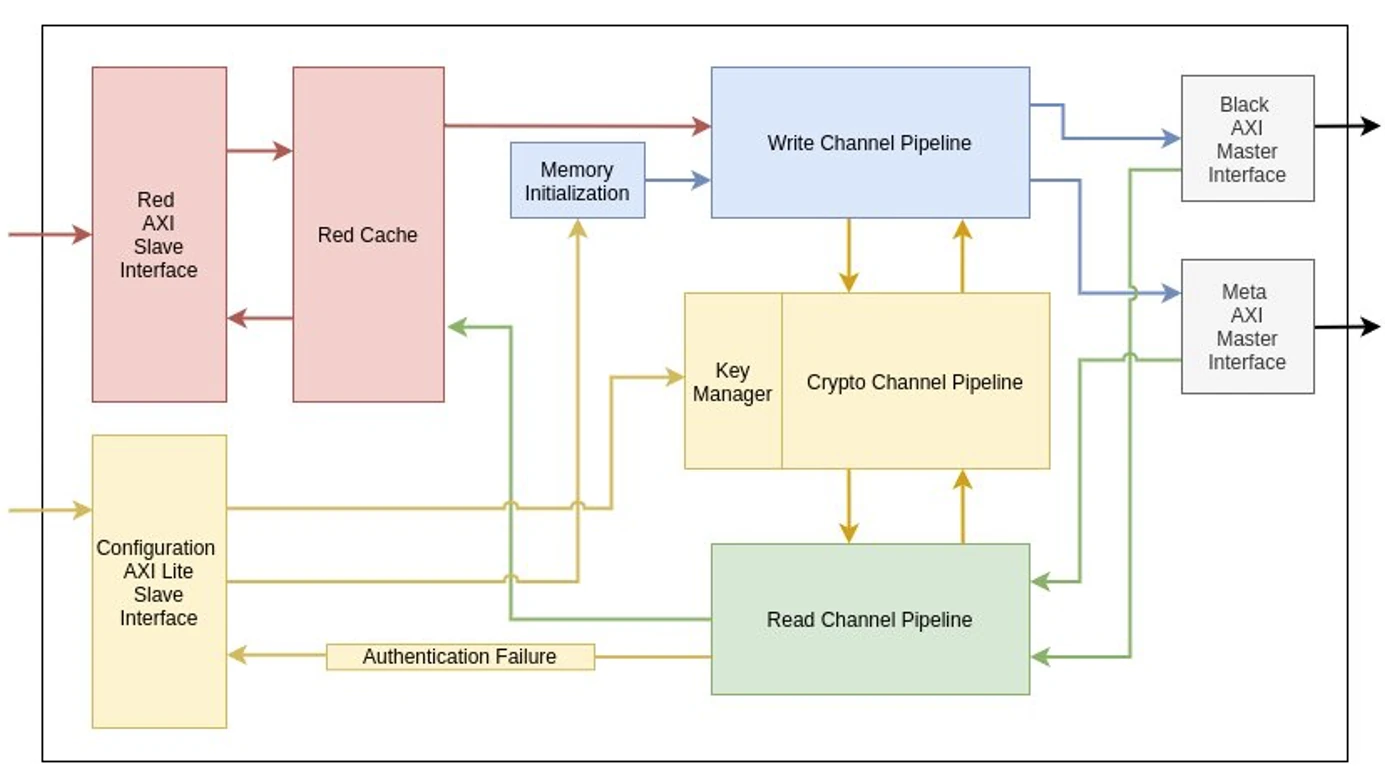
Addressing these challenges requires a layered approach, integrating integrity checks directly into the memory subsystem. This means moving beyond simple encryption and adopting solutions that provide authenticated encryption with associated data (AEAD) or similar cryptographic primitives at the point of memory access. Such solutions typically involve generating Message Authentication Codes (MACs) or employing authenticated ciphers that bind the data to a secret key, ensuring both confidentiality and integrity. When data is written to external memory, it is encrypted, and a tag (the MAC) is generated based on the data and a shared secret. When the data is read back, the system recomputes the tag and compares it to the stored tag. If they don't match, the data has been compromised.
The implementation of these features needs to be 'inline' – meaning it happens as data flows to and from the memory controller, ideally with minimal latency impact. This often involves dedicated hardware accelerators within the memory controller or even directly on the memory interface. These accelerators are designed to perform cryptographic operations at line rate, ensuring that the performance overhead is manageable for high-bandwidth applications. The key is to make these security features transparent to the application processor, allowing software developers to benefit from enhanced security without needing to manage complex cryptographic protocols at the application level. This approach is analogous to how modern network interface cards offload TCP/IP checksums; security functions are handled by specialized hardware to maintain system performance.
Beyond Confidentiality: Resilience and Implementation Security
The concept of 'implementation resilience' is also crucial. This refers to the system's ability to resist attacks that exploit weaknesses in the cryptographic implementation itself, rather than the algorithms. Side-channel attacks, fault injection attacks, and timing attacks are examples where an attacker observes physical characteristics of the system (like power consumption or execution time) or injects faults to extract sensitive information or disrupt operations. For mission-critical systems, the hardware implementing inline memory encryption and integrity must be designed with these threats in mind. This might involve measures like constant-time execution, power balancing, and robust error detection mechanisms that can thwart fault injection attempts.
Furthermore, the secure management of cryptographic keys is paramount. If keys can be extracted from the system, the entire security architecture collapses. Secure key provisioning, storage (e.g., in secure enclaves or Hardware Security Modules - HSMs), and key rotation policies are essential components of a robust security posture. The complexity of managing these keys securely, especially in distributed or physically exposed systems, is a significant engineering challenge. The goal is to create a security perimeter that extends effectively beyond the SoC, encompassing the entire memory subsystem and its interactions with the external world.
The Future of Secure Off-Chip Memory
As systems become more complex and data volumes grow, the reliance on external memory will only increase. This trend, coupled with the ever-evolving threat landscape, makes robust security for off-chip data an urgent necessity. Future advancements will likely focus on further optimizing the performance of inline encryption and integrity solutions, making them more power-efficient and cost-effective. We may also see greater standardization in hardware-accelerated cryptographic interfaces for memory, enabling broader adoption across different semiconductor platforms.
The ultimate objective is to build systems that are not only performant but also inherently secure and trustworthy, even when handling sensitive data outside the protected confines of the SoC. This requires a holistic view of security, where encryption, authentication, integrity, and resilience are considered as integral parts of the system design, not as afterthoughts. For developers and architects working on high-assurance systems, understanding these requirements is not just good practice; it's a fundamental necessity for building reliable and secure solutions in an increasingly hostile digital environment.