The Dual Pillars of Infrastructure Lifecycle Management
Managing modern infrastructure involves more than just spinning up servers. It's a comprehensive lifecycle, with two critical, often opposing, phases: Provisioning and Decommissioning. Both are orchestrated through the application of Infrastructure as Code (IaC) principles. This ensures that the entire asset lifecycle, from initial resource creation and configuration to the secure, verifiable removal of all components, is managed with consistency, auditability, and minimal operational overhead.
IaC transforms these processes from manual, error-prone tasks into automated, repeatable workflows. This is crucial for maintaining control, reducing costs, and mitigating security risks in dynamic cloud environments and on-premises data centers alike.
Provisioning: Building for Production
Provisioning is the 'build' phase. Its primary goal is to rapidly and reliably bring a service into a functional, production-ready state. This involves a series of core actions:
- Resource Allocation: Identifying and securing the necessary compute, storage, and network resources.
- Configuration: Setting up operating systems, middleware, applications, and security policies according to predefined standards.
- Scaling: Ensuring the infrastructure can handle expected loads and automatically adjust capacity as needed.
IaC tools like Terraform, CloudFormation, or Ansible excel here. They allow teams to define the desired state of their infrastructure in code. When this code is applied, the IaC tool interacts with cloud provider APIs or on-premises management systems to create and configure the specified resources. This guarantees that every new environment is identical, reducing the 'it works on my machine' problem and enabling faster deployment cycles. Think of it like a master blueprint for a building; every structure built from it is identical, down to the last nail and wire, ensuring predictable performance and compliance.
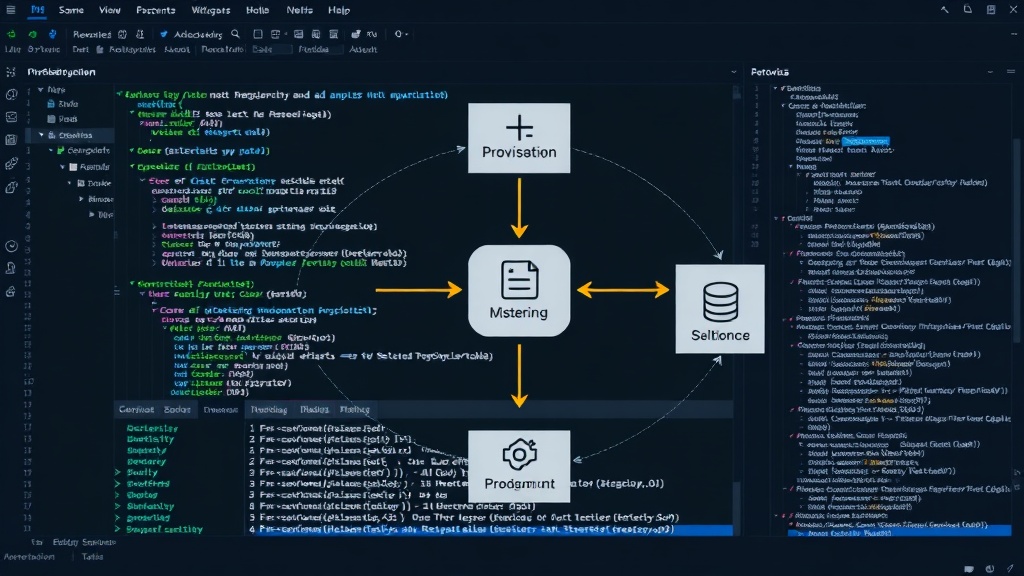
The benefits of IaC-driven provisioning are manifold:
- Speed: Infrastructure can be provisioned in minutes or hours, not days or weeks.
- Consistency: Eliminates configuration drift and human error, ensuring environments are identical.
- Reproducibility: Easily spin up identical environments for development, testing, staging, and production.
- Auditability: Version control for infrastructure provides a clear history of changes.
- Cost Efficiency: By automating resource allocation and configuration, manual labor costs are reduced.
Decommissioning: Retiring with Confidence
Decommissioning is the 'retirement' phase. Its primary goal is to securely remove all residual presence of a system to eliminate costs and security risks. This is as critical as provisioning, yet often more challenging to execute perfectly. The core actions include:
- Resource Termination: Safely shutting down and deleting all allocated resources.
- Data Sanitization: Ensuring any sensitive data is securely wiped from storage media.
- Dependency Removal: Identifying and removing network configurations, firewall rules, and access controls related to the retired system.
- Verification: Confirming that all components have been removed and no lingering resources or costs remain.
IaC is equally vital for decommissioning. Just as code defines how to build, it can define how to dismantle. A decommissioning script or Terraform configuration can be written to target specific resources managed by the IaC tool. When executed, it systematically tears down the infrastructure, deallocates resources, and, importantly, can trigger data wiping procedures. This ensures that no 'ghost resources' are left running, incurring unnecessary costs or posing security vulnerabilities. This is like a meticulously planned demolition; every support is removed in the correct sequence, and the site is cleared completely, leaving no trace.
The importance of robust decommissioning cannot be overstated:
- Cost Savings: Eliminates ongoing charges for unused cloud resources or hardware.
- Security: Prevents unauthorized access to retired systems or data remnants.
- Compliance: Meets regulatory requirements for data destruction and asset disposal.
- Resource Management: Frees up capacity and enables better utilization of available infrastructure.
The IaC Imperative for Full Lifecycle Management
The synergy between provisioning and decommissioning, both driven by IaC, forms the backbone of effective Infrastructure Lifecycle Management. Without IaC, these processes are prone to manual errors, inconsistencies, and security gaps. Provisioning might be done quickly but without proper documentation, leading to a 'black box' infrastructure. Decommissioning, if performed manually, might miss critical components, leaving services running and costing money, or worse, leaving data exposed.
IaC provides the necessary automation, version control, and declarative state management to bridge these two phases. It allows teams to treat infrastructure as a disposable, manageable asset. This means that when a service is no longer needed, it can be retired as cleanly and reliably as it was deployed. This holistic approach is essential for organizations aiming for agility, security, and cost-effectiveness in their IT operations.
What nobody has addressed yet is the long-term impact of full IaC lifecycle management on the skills required within IT operations teams. As manual configuration and troubleshooting diminish, will teams need to pivot towards more strategic IaC development, auditing, and security policy enforcement roles? The shift demands continuous learning and adaptation, moving from reactive problem-solving to proactive code-based system design and governance.
Conclusion
Provisioning and decommissioning are not independent events but integral parts of a continuous infrastructure lifecycle. Infrastructure as Code is the enabling technology that brings order, consistency, and security to both. By embracing IaC for the entire journey—from the first line of code that provisions a server to the final script that tears it down—organizations can achieve greater operational efficiency, reduce risk, and optimize costs. This disciplined approach is fundamental for any modern, cloud-native or hybrid infrastructure strategy.