
The Challenge of Ensemble Forecasting
Ensemble methods are a cornerstone of modern machine learning, combining multiple models to achieve superior predictive performance compared to any single model. This principle is widely applied in areas like image recognition and natural language processing. However, when it comes to time-series forecasting, simply averaging predictions from various models often falls short. The temporal dependencies inherent in time-series data introduce unique challenges. A key difficulty lies in selecting which models to include in the ensemble and how to weight their contributions. Traditional methods might focus on model accuracy alone, but this can lead to ensembles where all models make similar errors, failing to capture the full spectrum of potential outcomes.
The goal of an effective ensemble is not just to reduce variance but also to increase the ensemble's ability to represent uncertainty. If all ensemble members are too similar, they are likely to fail in the same ways during unforeseen events or shifts in the data distribution. This is where information theory offers a powerful lens through which to understand and improve ensemble construction.
Information Theory's Role in Model Diversity
Information theory, pioneered by Claude Shannon, provides a mathematical framework for quantifying information. Concepts like entropy, mutual information, and Kullback-Leibler divergence are crucial. In the context of ensemble modeling, these concepts help us measure the relationships between different models and the target variable.
Mutual information, in particular, quantifies the statistical dependence between two variables. It measures how much information one variable provides about another. For ensemble forecasting, we can use mutual information to assess:
- The mutual information between each individual model's forecast and the actual future values. This helps gauge the relevance of a model.
- The mutual information between pairs of models in the ensemble. High mutual information between two models suggests they are making similar predictions and are redundant. Low mutual information indicates diversity.
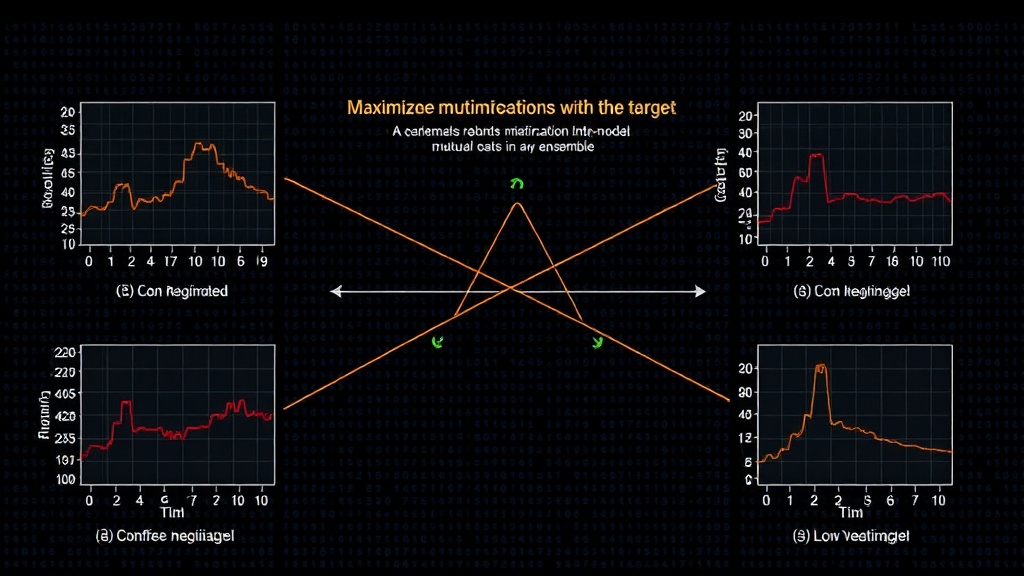
The core idea is to build an ensemble that maximizes the total information captured about the true future values (sum of mutual information of each model with the target) while minimizing redundancy among the models (low mutual information between model pairs). This is analogous to assembling a team of experts, each with unique insights, rather than a group of individuals who all think alike.
Applying Information Theory to Time-Series Ensembles
Several research directions are exploring how to operationalize these information-theoretic principles for time-series forecasting.
Feature Selection and Model Pruning
Information gain, a concept derived from mutual information, can be used as a criterion for selecting the most informative features for a forecasting model. Similarly, when building an ensemble, information theory can guide the pruning of redundant models. A model might be highly accurate on historical data, but if its predictions are highly correlated with other models already in the ensemble, its marginal contribution to the overall ensemble's predictive power might be low. By quantifying this redundancy, we can make more informed decisions about which models to keep.
Quantifying Forecast Uncertainty
Beyond point forecasts, understanding forecast uncertainty is critical for decision-making. Information theory can help in constructing ensembles that better represent this uncertainty. By selecting diverse models, the ensemble can span a wider range of plausible future outcomes. Entropy, a measure of randomness or uncertainty in a probability distribution, can be used to characterize the uncertainty of the ensemble's combined forecast. An ensemble that captures more information about the true process is expected to have a more accurate representation of its own uncertainty.
Beyond Simple Averaging
Instead of simple averaging or weighted averaging based on past performance, information theory suggests more sophisticated combination strategies. For instance, one could use techniques that explicitly seek to minimize the mutual information between ensemble members while maximizing their collective information about the target. This might involve optimizing weights or even selecting subsets of models based on information-theoretic criteria.
The Unanswered Question: Scalability and Computational Cost
While the theoretical underpinnings are compelling, a significant challenge remains: how to scale these information-theoretic approaches to very large numbers of candidate models or extremely long time series. Calculating pairwise mutual information can be computationally intensive, especially for high-dimensional data or when dealing with continuous variables where estimation becomes more complex. Developing efficient algorithms and approximations for these information-theoretic measures will be key to their widespread adoption in practical time-series ensemble forecasting systems.
Implications for Practitioners
For data scientists and machine learning engineers working with time-series data, embracing information-theoretic principles in ensemble construction offers a path to more robust and reliable forecasts. It moves beyond simply picking the models that performed best in isolation and focuses on building a synergistic collection of models. This approach is particularly valuable in domains where accurate uncertainty quantification is paramount, such as financial forecasting, energy load prediction, or supply chain management. By actively managing model diversity through information-theoretic metrics, practitioners can build ensembles that are less susceptible to catastrophic failures and provide a richer understanding of potential future outcomes.