
The Inertia Dilemma: Serving Both Views and APIs
Developers often fall in love with Inertia.js, a framework designed to streamline the development of modern, single-page applications (SPAs) using server-side routing and rendering. Inertia bridges the gap between traditional server-rendered applications and full-blown SPAs, allowing developers to leverage their existing backend frameworks like Laravel or Rails while providing a rich, dynamic frontend experience. However, this elegance can become complicated when the need arises to serve not only Inertia-based responses for a frontend application but also standard JSON API responses for external services, mobile apps, or other clients.
The common pain point emerges when integrating Inertia into an existing Laravel API project, or conversely, when a project that started as an Inertia SPA needs to expose data as a public API. The naive solutions typically involve either cluttering controllers with conditional logic like if ($request->wantsJson()) checks, or the more egregious sin of maintaining two entirely separate sets of routes and controllers that ultimately return the exact same data. Both approaches lead to code duplication, increased maintenance overhead, and a less elegant codebase. This is where the need for a more harmonious solution becomes apparent.
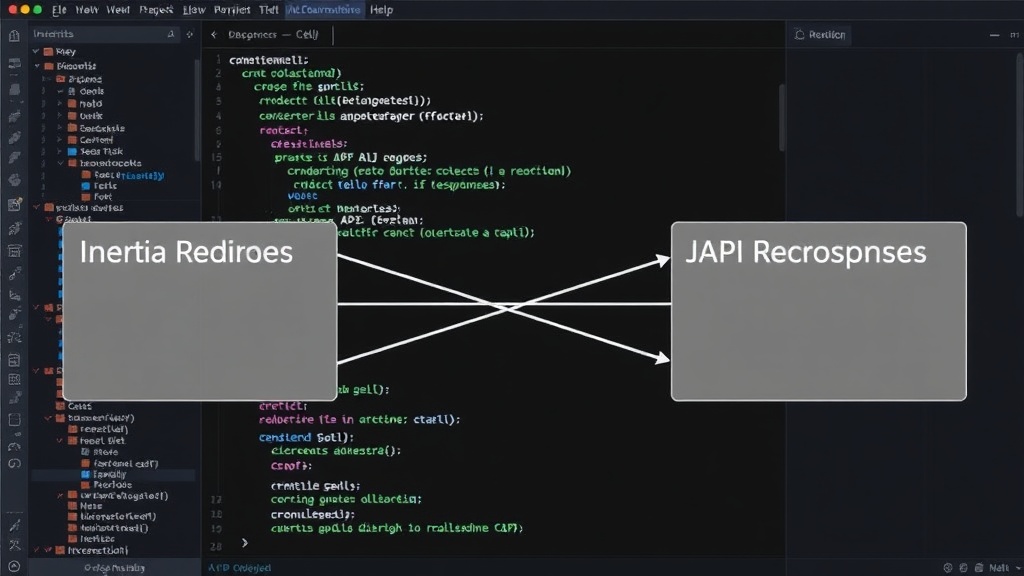
The core of the problem lies in the fundamental difference in how Inertia and traditional APIs respond. Inertia responses are special redirects that carry component data and props, designed to be intercepted by the Inertia JavaScript adapter on the frontend. API responses, on the other hand, are typically direct JSON payloads. Trying to shoehorn both into the same controller method without a proper strategy results in a messy, hard-to-manage system. Developers find themselves fighting the framework, rather than leveraging its strengths.
Introducing inertia-split: A Unified Solution
To address this common challenge, a new approach, encapsulated by the inertia-split package, offers a cleaner way to manage both Inertia and JSON responses from a single controller. The philosophy behind inertia-split is simple: let your controllers serve both types of requests without compromise. This means a single controller action can gracefully handle a request from an Inertia-enabled frontend, returning the necessary component and props, while simultaneously responding to a direct JSON request with the same underlying data.
Consider a scenario where you have a ProjectController in a Laravel application. Traditionally, if you wanted to serve Inertia, you might have a method like show(Project $project) that returns Inertia::render('Projects/Show', ['project' => $project]). If you then needed an API endpoint for this same project, you would likely create another method, perhaps apiShow(Project $project), returning response()->json($project). This duplication is precisely what inertia-split aims to eliminate.
Serving Both from the Same Controller Method
The power of inertia-split lies in its ability to detect the type of request and adapt its response accordingly. When a request comes in, the package checks if it's an Inertia request. If it is, it formats the response as an Inertia `render` call, passing along the component name and the data as props. If the request is not from Inertia (i.e., it's a standard HTTP request expecting JSON), it formats the data as a JSON response.
Here's how a controller using inertia-split might look:
use Inertia\Inertia;
use App\Models\Project;
use Illuminate\Http\Request;
use Kopp\InertiaSplit\Response as InertiaSplitResponse;

class ProjectController extends Controller
{
    public function show(Request $request, Project $project)
    {
        // Fetch your data here, e.g., eager loading relationships
        $project->load('tasks', 'users');

        // Use InertiaSplitResponse to conditionally render
        return new InertiaSplitResponse(
            $request,
            'Projects/Show', // Inertia component name
            [
                'project' => $project->toArray(), // Pass data as array for JSON, or as object for Inertia props
                // ... other data
            ]
        );
    }
}
In this example, when an Inertia request is made, the 'Projects/Show' component will be rendered with the project data passed as props. If a standard API request is made to the same route, the same project data will be returned as a JSON object. The inertia-split package abstracts away the conditional logic, making the controller code cleaner and more focused on data retrieval and preparation.
Benefits and Considerations
The primary benefit of this approach is code consolidation. By using a single controller action and a unified response mechanism, developers significantly reduce redundancy. This leads to easier maintenance, fewer opportunities for bugs arising from out-of-sync data between API and Inertia responses, and a more streamlined development workflow. It allows teams to build applications that are both a rich, interactive SPA and a robust API without a significant architectural overhead.
However, it's important to consider the nuances. While inertia-split handles the basic dual-response scenario effectively, complex API requirements might still necessitate specific controller logic. For instance, if your API needs to return different data structures or include additional metadata not relevant to the Inertia frontend, you might still need to augment the controller with more specific checks or even separate methods. The package provides a strong foundation, but it doesn't eliminate the need for thoughtful API design.
The package is essentially a wrapper around Inertia's response capabilities, intelligently determining whether to return an Inertia response or a JSON response based on the incoming request. This makes it feel like a natural extension of the Inertia ecosystem rather than an external, bolted-on solution. For developers already invested in Inertia.js and Laravel, this package offers a compelling way to extend their application's reach without sacrificing code quality or developer experience.
What remains to be seen is how this pattern scales for extremely complex applications where the data shape for an API consumer might diverge significantly from what's needed for an Inertia frontend. While this solution elegantly handles the common case, future iterations or alternative packages might explore more sophisticated strategies for managing highly divergent data requirements across different response types.