The AI Job Market Discrepancy Revealed
A significant gap exists in how Artificial Intelligence (AI) skills are advertised in Indonesian IT job postings compared to the global remote job market. Data compiled in May 2026 by a job aggregator specializing in Indonesian and global remote work highlights a 28x difference, suggesting a vastly different perceived demand for AI expertise in these two segments.
The analysis involved two distinct datasets: 1,039 Indonesian IT listings sourced from JobStreet Indonesia and Loker.id, and a global pool of 2,517 remote job listings. The methodology was consistent across both datasets: a simple keyword scan of job titles for any mention of 'AI'. This direct, keyword-based approach ensures a fair comparison, minimizing the potential for algorithmic bias and focusing purely on explicit employer signaling.
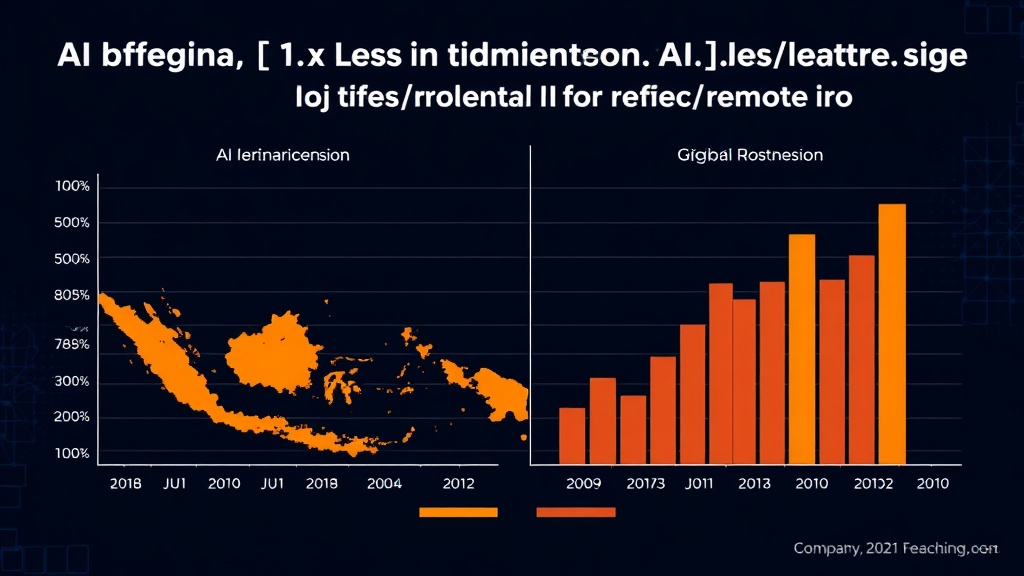
The findings are stark. In the global remote job market, 8.6% of all listings, equating to 216 out of 2,517, explicitly mentioned AI in their job titles. This suggests that a notable portion of companies hiring remotely worldwide are actively seeking candidates with AI-related skills or experience, making it a visible requirement in their recruitment efforts. In sharp contrast, within the Indonesian IT job market, only 0.3% of listings—a mere 3 out of 1,039—included an AI signal in their titles. This minuscule percentage points to a substantial underrepresentation of AI in local job advertisements.
The resulting disparity is a factor of approximately 28. This means that for every job posting mentioning AI in Indonesia, there are roughly 28 such postings in the global remote market. This discrepancy is more than just a statistical anomaly; it carries significant implications for both employers and developers operating within or targeting these respective markets.
Implications for Hiring and Career Development
For companies hiring within Indonesia, this data sends a clear, albeit potentially concerning, signal. The visible demand for AI talent that competitors in the global remote market are broadcasting is almost entirely absent in local Indonesian IT job advertisements. This could lead to a perception gap, where local employers may not be fully aware of the burgeoning demand for AI skills globally, or they may not be prioritizing these skills in their immediate hiring strategies. It raises the question of whether Indonesian companies are inadvertently missing out on talent that is globally recognized for its AI capabilities, or if the local industry simply has different immediate needs.
Conversely, for Indonesian developers looking to secure remote roles in the global market, the implications are equally profound. The global market is clearly valuing and advertising for AI skills more prominently. Developers in Indonesia who possess AI expertise or are looking to cultivate it may find that their skills are more readily recognized and sought after in international remote positions than in domestic ones. This could steer talented individuals towards pursuing opportunities outside of Indonesia, potentially contributing to a brain drain of AI expertise if local opportunities do not evolve.
This difference in emphasis could also reflect varying stages of AI adoption and integration within the IT sectors of Indonesia and the global market. While global companies may be actively integrating AI into their core operations and product development, Indonesian companies might still be in earlier stages of AI exploration or application, focusing on foundational IT roles rather than specialized AI functions. It's also possible that AI-related roles in Indonesia are being advertised under different, more traditional titles, masking the true demand for AI competencies. For instance, roles in data science, machine learning engineering, or even advanced software development might implicitly require AI knowledge but not explicitly state 'AI' in the title.
The Broader AI Talent Landscape
The data prompts a crucial consideration: is the Indonesian IT job market lagging in its recognition and advertisement of AI skills, or does it reflect a different set of immediate priorities and skill demands? The global remote market's higher AI mention rate could be driven by sectors that are more aggressively adopting AI, such as fintech, advanced analytics, autonomous systems, and generative AI applications. These fields often require specialized AI knowledge, from model development and deployment to ethical AI practices and AI-driven product management.
What remains unaddressed is the specific breakdown of AI-related roles within the global remote market. Are these predominantly AI research positions, or do they span a wider range of engineering, development, and operational roles? Understanding this distribution would provide a clearer picture of where AI integration is most prevalent and what types of AI skills are in highest demand globally. Without this granular detail, it's challenging to pinpoint the exact nature of the global demand beyond a general 'AI signal'.
Furthermore, the Indonesian job market's lower AI mention rate does not necessarily mean a complete absence of AI work. It could indicate that AI skills are embedded within broader roles, or that the market is still developing its AI talent pipeline. Companies might be focusing on upskilling existing employees or hiring for roles that build the foundational infrastructure upon which AI applications will later be built. The rapid evolution of AI technologies means that job market trends can shift quickly, and this snapshot from May 2026 may only represent a moment in time.
The disparity also raises questions about the education and training landscape in Indonesia. Are educational institutions and training providers adequately preparing students and professionals for AI-centric roles that are in demand globally? If the local job market is not yet reflecting this demand, there is a risk of misalignment between the skills being developed and the opportunities available, both domestically and internationally.
Ultimately, this data serves as a critical indicator for stakeholders in Indonesia’s tech ecosystem. For employers, it’s a call to evaluate their recruitment strategies and consider the global trends in AI talent demand. For developers, it highlights potential areas for skill development and career advancement, particularly if targeting international remote opportunities. The gap is significant, and bridging it will require a concerted effort from industry, education, and individuals to ensure Indonesia remains competitive in the rapidly evolving global AI landscape.