The Problem with AI Cloud Wrappers
The current AI landscape is saturated with what developer Alex Johnson calls "cloud wrappers." These aren't true applications but thin UIs layered over cloud-based AI models. Users pay a subscription, interact through a simple interface, and their data is processed on remote servers. Johnson, an indie developer, found this model restrictive and data-intrusive, prompting him to build an alternative.
The core issue, as Johnson sees it, is the inherent limitation of one-on-one AI conversations. "Every AI chat feels the same. You ask a question, it answers, repeat. Useful? Yes. Alive? No." He questioned why AI tools exclusively offered a solitary conversational experience, failing to leverage the potential of multiple AI agents interacting simultaneously. This led to the conceptualization of a space where AI personas could engage with each other and the user, all while operating locally.
Introducing Bob's Bar: A Collaborative Multi-Persona Sandbox
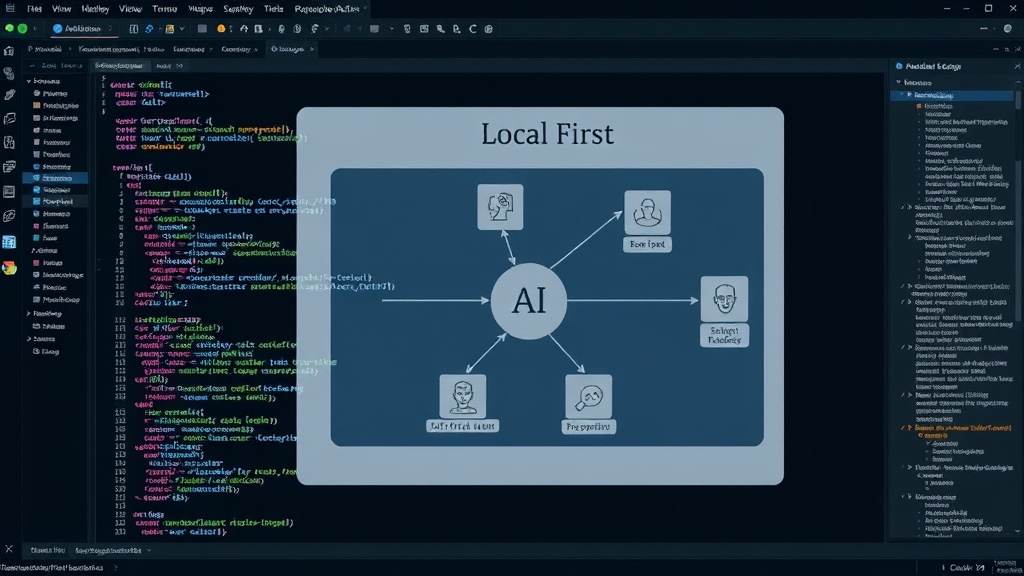
To address this gap, Johnson developed Bob's Bar, the first Collaborative Multi-Persona Sandbox (CMPS). This platform is designed from the ground up to run entirely on local hardware. This local-first architecture means users retain full control over their data and avoid the recurring costs associated with cloud hosting. The system allows multiple AI personas to coexist, converse with the user, and importantly, converse with each other.
The vision behind Bob's Bar is to create a more dynamic and engaging AI interaction. Instead of a linear Q&A, users can observe and participate in a multi-agent dialogue. This setup is ideal for complex brainstorming, creative writing, or exploring multifaceted problems where diverse AI perspectives can offer richer insights. The platform aims to shift AI interaction from a passive consumption model to an active, collaborative exploration.
Technical Architecture and Local-First Design
The decision to build a local-first system was driven by Johnson's experience as an indie developer. "I don’t have a server farm, and I don’t want to pay AWS just to host my own brainstorming sessions." This constraint necessitated an architecture that prioritizes efficiency and minimal resource consumption on the user's machine. While specific technical details about the underlying AI models or the exact local deployment strategy are not extensively detailed in the initial announcement, the emphasis is on self-hosting and client-side processing.
This approach contrasts sharply with the prevalent SaaS model. Cloud wrappers often abstract away the underlying AI, charging for access and convenience. Bob's Bar, conversely, empowers users by providing the tools and the environment to run advanced AI collaborations without external dependencies. This implies that users will need to manage their own AI model deployments, potentially leveraging open-source models or local inference engines. The platform acts as an orchestrator, enabling these local models to interact in a structured, collaborative manner.
Implications for AI Development and Usage
Bob's Bar represents a significant departure from the current trend of cloud-centric AI applications. For developers, it opens up possibilities for creating truly independent AI tools that are not beholden to large cloud providers. It democratizes the creation of sophisticated AI applications by lowering the barrier to entry in terms of infrastructure costs.
For users, particularly those concerned about data privacy and cost, a local-first CMPS offers a compelling alternative. It allows for more experimentation and deeper engagement with AI without the fear of data leakage or escalating subscription fees. The collaborative aspect also promises a more engaging and productive user experience, moving beyond the limitations of single-agent AI chats. The challenge for widespread adoption will likely lie in the technical expertise required to set up and manage local AI models, but the underlying principle offers a potent vision for the future of personal AI tools.
What remains to be seen is how easily users can integrate their preferred local AI models into Bob's Bar and what performance benchmarks can be achieved on typical consumer hardware. The success of such a platform hinges on its ability to balance user-friendliness with the power and flexibility of local AI deployment.