
The ₹1 Problem: A Cliff in Progressive Taxation
Progressive tax systems are designed to be fair, taxing higher incomes at higher rates. The textbook implementation involves iterating through tax slabs, calculating tax for each band, and summing the results. This approach, often reduced to a dozen lines of code, appears straightforward. However, a common pitfall emerges when tax rebates are introduced, creating unexpected “cliff-edge” effects where a minor increase in income triggers a disproportionately large jump in tax liability. This is precisely the issue encountered when modelling India's new tax regime.
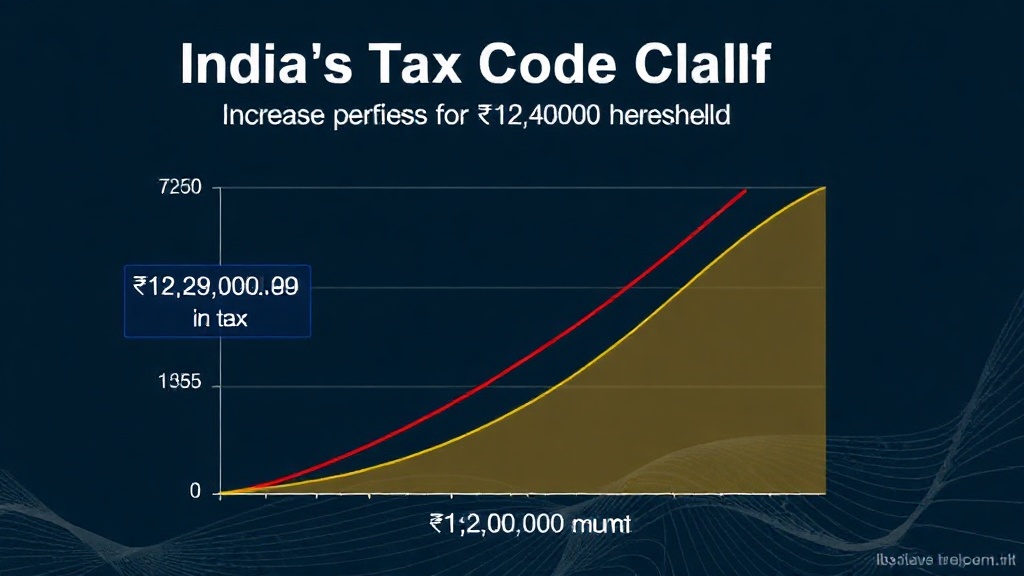
In India's current tax structure, taxable income up to ₹12,00,000 attracts zero tax. This is not due to the slab rates themselves yielding zero, but because a rebate mechanism effectively cancels out any calculated tax liability below this threshold. A naive implementation might correctly calculate zero tax for an income of ₹12,00,000. However, for an income of ₹12,00,001, the same naive function can output a tax liability of approximately ₹62,400. This means a single additional rupee of income can result in an extra ₹62,400 in tax – a behaviour that deviates significantly from the law’s intent.
This discontinuity was identified by Monu Kumar while developing a tool to compare different tax regimes. The challenge lay not just in identifying these anomalies, but in devising a robust solution. The core problem stems from three specific discontinuities within the Indian tax code that break simple, linear slab calculations. Addressing these requires more than just closed-form algebraic solutions; it often necessitates numerical methods.
Understanding the Discontinuities
The Indian tax system, particularly its new regime, presents several points where the tax calculation method shifts abruptly. The primary discontinuity, as highlighted, is the rebate threshold at ₹12,00,000. For income just below this, the tax is effectively zero due to the rebate. For income just above, the rebate no longer fully applies, and the tax calculation reverts to the standard slab rates, leading to a sudden spike in liability. This is not a smooth, gradual increase in tax burden but a step function.
Another critical point is the standard deduction available under the new regime. While it simplifies the tax calculation by reducing taxable income, its application can also create minor discontinuities if not handled precisely. The interaction between the standard deduction and the rebate threshold needs careful modelling. For instance, if the standard deduction reduces income to a point where the rebate fully applies, it creates a smoother transition. However, if the income, after deduction, hovers around the rebate limit, the cliff effect can still manifest.
A third area of complexity arises from potential surcharges or cess that might apply at higher income levels, though these are typically less prone to the sharp cliff-edge bugs seen with rebates. Nevertheless, any tax system with tiered rates and special provisions like rebates or deductions introduces the potential for non-linear behaviour. The key is that these non-linearities are often localized around specific income thresholds, creating these “bugs” in otherwise progressive structures.
The Binary Search Solution
Traditional algebraic methods struggle with these sharp discontinuities because they rely on continuous functions. When a function has a sudden jump, like the tax liability at ₹12,00,000, standard differentiation and integration techniques become problematic. The exact income point where the rebate ceases to fully offset the tax liability is difficult to pinpoint with a simple formula, especially when other deductions are involved.
Kumar’s solution involves a small binary search. Instead of trying to find a direct formula for the exact taxable income that results in a specific tax liability (or the tax liability for a specific income), the binary search iteratively narrows down the range. The function being evaluated is the tax calculation itself, which takes a potential taxable income and returns the computed tax liability. The goal is to find the income value that precisely triggers the discontinuity or to accurately calculate the tax for an income value that falls on the problematic side of a threshold.
Consider the ₹12,00,001 income. A binary search can start with a wide range of possible tax liabilities (e.g., ₹0 to ₹62,400). It then tests a midpoint. If the tax calculated for that midpoint income is too low, it searches in the upper half; if too high, it searches in the lower half. This process repeats, converging rapidly on the correct tax amount. This method effectively treats the tax calculation as a black box and uses its output to find the correct input (income) or to confirm the output for a given input, bypassing the need for a perfect analytical model of the entire tax function’s piecewise behaviour.
This approach is particularly useful when dealing with complex, multi-tiered systems where the exact thresholds for rebates, deductions, and surcharges interact in non-obvious ways. It’s a practical application of numerical methods to solve a real-world financial calculation problem that eludes simple analytical solutions. The code, written in TypeScript, is designed to be framework-agnostic, making it adaptable for use in various financial planning tools or tax comparison software.
Broader Implications for Financial Software
The ₹62,400 cliff-edge bug is a stark reminder that even seemingly simple financial calculations can harbor hidden complexities. For developers building financial modelling tools, tax calculators, or payroll systems, this highlights the critical need for rigorous testing around threshold values. Relying solely on textbook progressive tax logic without accounting for rebates, deductions, and their interactions can lead to significant errors.
The use of numerical methods like binary search, while perhaps less elegant than a closed-form solution, offers a robust way to handle piecewise functions and discontinuities. This principle extends beyond tax calculations to other domains in finance and technology where thresholds and conditional logic create similar non-linear behaviours. For instance, modelling tiered pricing, dynamic resource allocation, or even complex game mechanics can benefit from similar iterative refinement techniques when analytical solutions are intractable.
The surprise here is not that such bugs exist – they are common in complex financial systems. The surprise is the magnitude of the penalty for a single rupee of income, and the fact that a standard programming pattern (iterating through slabs) can so easily overlook it without specific safeguards. If you are building any software that calculates taxes based on income slabs, you must examine your rebate and deduction logic around key thresholds. The cost of a bug here isn't just a few cents; it can be tens of thousands of rupees.