
AI's Modest Impact on Indian IT Productivity
The narrative around artificial intelligence driving a productivity boom in India's massive IT services sector is potent, fueling earnings calls and investor confidence. However, a closer look at seven years of revenue-per-employee data, analyzed by firms like UnearthInsight, suggests a more nuanced reality. While AI is indeed contributing to efficiency gains, its impact is significantly less than often portrayed. The primary driver behind the reported increases in revenue per employee remains, for the most part, workforce rationalization – a strategy as old as business itself.
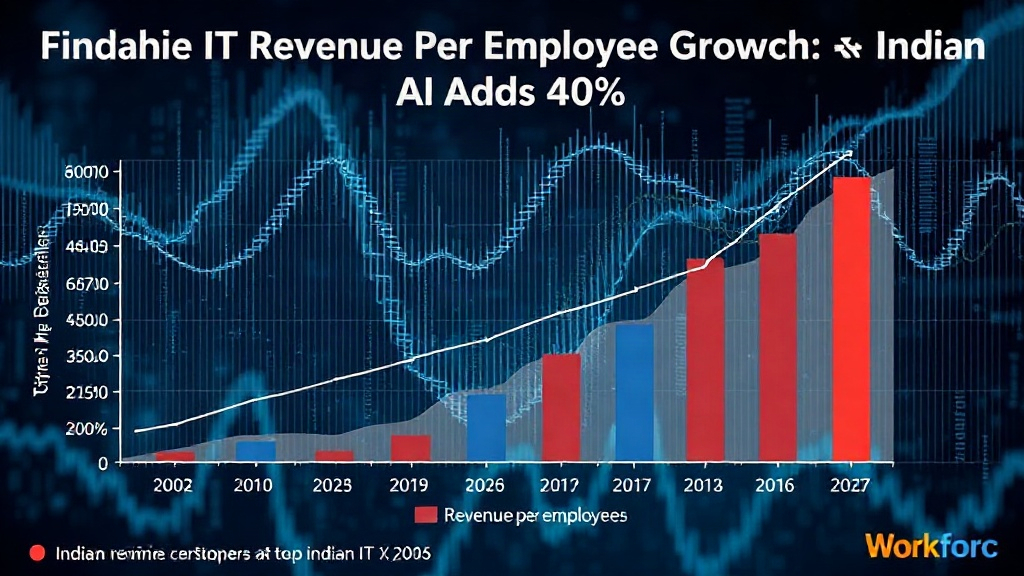
In Q1 FY27 (April–June 2026), India's five largest IT majors – Tata Consultancy Services (TCS), Infosys, HCLTech, Wipro, and Tech Mahindra – collectively reported higher dollar revenue per employee compared to the previous year. This combined revenue reached $25.6 billion for the quarter. Yet, UnearthInsight's analysis attributes approximately 60% of this improvement to workforce optimization and cost-cutting measures, with only about 40% stemming from genuine AI-driven efficiency enhancements. This suggests that while AI is a growing factor, it has not yet delinked the sector's revenue growth from its headcount in a substantial way.
Seven Years of Stagnant Growth
Examining the longer trend over the past seven years provides a clearer picture. Revenue per employee for the sector's biggest players has seen minimal growth, fluctuating between an annual rate of -1.45% and +2.47%. This near-flat trajectory indicates that, in aggregate, the sector has struggled to achieve significant per-employee productivity gains through technological advancements alone. The data challenges the prevailing narrative that AI is single-handedly transforming the industry's operational efficiency and decoupling revenue from human capital.
The implication is that companies are leveraging multiple strategies to boost their top-line figures relative to their workforce size. AI tools and platforms are being deployed, undoubtedly contributing to faster project completion, automated testing, and streamlined operations in specific areas. However, these gains are being overshadowed by a more aggressive reduction in overall employee numbers, particularly in roles that are either being automated or are deemed less critical in the current economic climate. This strategy, while effective in boosting short-term financial metrics, raises questions about long-term innovation and the sector's ability to absorb future technological shifts.
The AI Factor: Real, But Not Dominant
It's crucial not to dismiss AI's role entirely. The technology is demonstrably helping. Generative AI is being used for code generation, debugging, and documentation. Robotic Process Automation (RPA) continues to automate repetitive tasks. AI-powered analytics are providing deeper insights into project performance and client needs. These advancements allow individual employees to be more productive, handle more complex tasks, or manage larger project portfolios. For instance, a developer using an AI coding assistant might complete coding tasks 10-20% faster, which, when aggregated across thousands of employees, can lead to noticeable efficiency improvements.
However, the scale of these gains needs to be contextualized. The IT services industry is characterized by large workforces and complex, often labor-intensive, project delivery models. For AI to fundamentally alter the revenue-per-employee equation, its efficiency gains would need to be so profound that they could offset the cost and complexity of managing a large workforce. The current data suggests that while AI is a valuable tool in the efficiency toolkit, it is not yet the primary engine of profit. The efficiency gains from AI are real but are being amplified by a deliberate strategy of headcount reduction.
Workforce Rationalization: The Oldest Lever
The strategy of workforce rationalization, often euphemistically termed 'optimizing headcount' or 'right-sizing the workforce,' has been a consistent theme in the corporate world for decades. For Indian IT firms, this involves a combination of measures: reducing hiring, managing attrition more strategically, and in some cases, implementing targeted layoffs. The goal is to ensure that the revenue generated by the company grows faster than its employee-related costs. When revenue per employee increases, it often signals that the company is either generating more revenue from the same number of people or is generating the same revenue with fewer people.
The UnearthInsight report indicates that the latter is the more dominant force at play. This approach can lead to improved profit margins and a more attractive financial profile for investors. However, it also presents potential challenges. A continuously shrinking workforce might strain existing employees, potentially leading to burnout. It could also impact the industry's capacity to take on new, large-scale projects or to invest in the deep talent pools necessary for future innovation. The balance between efficiency through technology and efficiency through headcount reduction is a delicate one, and the current data suggests Indian IT is leaning heavily on the latter.
What This Means for the Future
The findings present a critical juncture for the Indian IT sector. While the adoption of AI is undeniable and its potential is vast, the current reliance on workforce rationalization to boost revenue-per-employee metrics is a short-term solution. The long-term sustainability of this strategy is questionable. As AI capabilities mature and become more integrated into core business processes, its contribution to productivity is expected to grow. However, the industry needs to shift its focus from simply reducing headcount to strategically redeploying talent and investing in upskilling to truly harness AI's transformative power.
The question for industry leaders, developers, and founders is how to navigate this evolving landscape. For developers, it means staying ahead of the curve with AI skills and understanding how to leverage these tools to increase their own productivity and value. For founders, it means reassessing growth strategies to ensure they are not solely reliant on cost-cutting but are building sustainable models that integrate AI for genuine value creation. The AI productivity boom is not a myth, but its current manifestation in India's IT sector is far more complex and human-driven than the headlines suggest.