
The Challenge of Software Supply Chain Integrity
The modern software development landscape relies heavily on complex supply chains. Developers integrate code from numerous open-source libraries, third-party dependencies, and internal microservices. Each of these components represents a potential attack vector. A compromise at any point in this chain can have cascading effects, leading to vulnerabilities, data breaches, and system failures. Traditional security measures often focus on the perimeter of an organization or the final artifact, leaving the intricate web of dependencies vulnerable.
Securing this chain requires a shift from simply scanning for known vulnerabilities to actively verifying the provenance and integrity of every piece of software that goes into a final product. This means knowing not just *what* is in your software, but *how* it got there, *who* built it, and *that* it hasn't been tampered with along the way. The problem is that without a standardized approach, this verification is ad-hoc, difficult to scale, and often relies on trust rather than verifiable evidence.
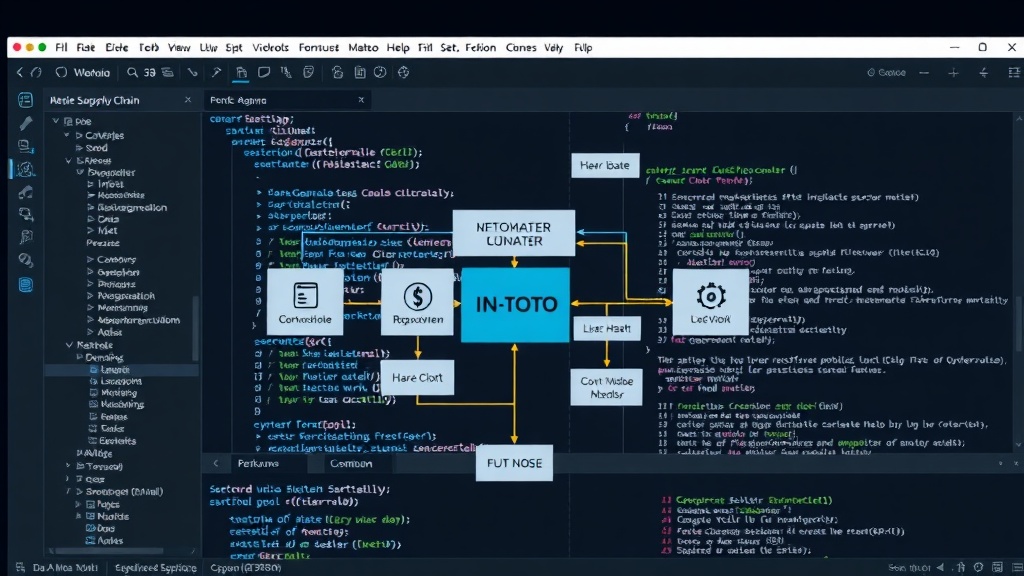
Introducing In-toto: A Standardized Approach
In-toto, an open-source framework, addresses this challenge by providing a standardized way to create and verify the integrity of software artifacts. The name itself, derived from the Malay word for 'all' or 'entire,' reflects its goal of securing the entire software lifecycle.
At its core, in-toto operates on the principle of verifiable provenance. It enables developers and organizations to establish and enforce policies about how software is built, tested, and deployed. This is achieved by recording a series of 'attestations'—signed statements of fact about an artifact—at various stages of the supply chain. These attestations are cryptographically signed by trusted entities, creating an immutable audit trail.
Key Concepts of In-toto
Understanding in-toto involves grasping a few fundamental concepts:
- Artifacts: These are any digital assets involved in the software supply chain, such as source code, container images, compiled binaries, configuration files, or test reports.
- Materials: These are the inputs used to produce an artifact. For example, source code might be a material for a compiled binary.
- Products: These are the outputs of a build or process. The compiled binary is the product of compiling source code.
- Steps: These represent individual operations or processes within the supply chain, such as compiling code, running tests, or signing a container image.
- Signatures: Cryptographic signatures are used to authenticate attestations and ensure their integrity. Keys for these signatures are managed by the entities performing the actions.
- Layouts: These are policy documents that define the expected steps and controls for a given supply chain. A layout specifies which steps are required, which materials are needed, and which products are generated. It also defines the expected signing policies for each step.
- Attestations: These are signed records that describe events or facts about an artifact or a process. An attestation typically includes information about the step, the materials used, the products generated, and metadata about the environment and the builder.
How In-toto Works in Practice
Imagine a typical software build process. Before in-toto, an organization might have a CI/CD pipeline that compiles code, runs tests, and pushes an artifact to a registry. The integrity of this process is often implicit or relies on the security of the CI/CD system itself.
With in-toto, this process is instrumented to produce verifiable evidence. A build step, for instance, would not only produce the compiled artifact but also generate an attestation detailing:
- The specific commit hash of the source code used (material).
- The version of the compiler and build tools (environment metadata).
- The command-line arguments used for the build.
- The resulting compiled binary (product).
- A cryptographic signature from the build system or authorized builder, attesting to the successful completion of this step.
This attestation, along with the artifact, is then passed to the next stage, perhaps a testing stage. The testing stage would also generate its own attestation, referencing the compiled binary as a material and detailing the tests performed, their results, and its own signature.
Crucially, before any artifact is deployed or consumed, an in-toto verifier can check the chain of attestations against a pre-defined layout. The layout acts as a policy, ensuring that all required steps were performed, by the correct entities, and that the artifacts were produced according to specifications. If any attestation is missing, invalid, or fails to meet the policy defined in the layout, the verification fails, preventing the deployment of potentially compromised software.
The Power of Verifiable Provenance
The key benefit of in-toto is its ability to provide tamper-evident, verifiable provenance. This is not about trusting a single entity or system, but about verifying a chain of cryptographically signed evidence. This approach offers several advantages:
- Enhanced Security: It makes it significantly harder for attackers to inject malicious code or tamper with artifacts without detection.
- Improved Auditing: It provides a detailed, immutable log of how software was produced, which is invaluable for compliance and incident response.
- Supply Chain Visibility: It offers unprecedented insight into the complex dependencies and build processes that constitute a software supply chain.
- Standardization: By providing a common framework, in-toto allows different tools and organizations to interoperate, fostering a more secure ecosystem.
In-toto and Related Projects
In-toto is part of a broader movement to secure software supply chains. It often works in conjunction with other tools:
- SLSA (Supply-chain Levels for Software Artifacts): In-toto provides the mechanisms for generating and verifying the provenance data that SLSA requires to define levels of assurance.
- Tekton Chains: This project integrates in-toto signing and verification into Tekton pipelines, enabling Kubernetes-native provenance.
- Sigstore: While Sigstore focuses on signing and key management for container images, in-toto provides the framework for attesting to the build process itself.
The surprising detail here is not the complexity of the framework itself, but the potential for it to become a de facto standard, much like TLS did for web security. Its open-source nature and alignment with broader security initiatives like SLSA position it to be a foundational component of future software development practices.
What’s Next for In-toto?
The in-toto project is actively developing its specification and tooling. As adoption grows, we can expect to see tighter integrations with popular CI/CD platforms, container registries, and cloud provider services. The focus will likely remain on making the framework easier to adopt and integrate into existing workflows, lowering the barrier to entry for organizations seeking to bolster their software supply chain security.
For teams building and deploying software, understanding in-toto is no longer a niche concern. It represents a critical step towards establishing trust in the software they use and the software they produce.