The Agent Trust Problem
In a world increasingly reliant on autonomous agents, the ability for these agents to communicate and collaborate securely is paramount. However, a critical vulnerability is emerging: prompt injection attacks that scale across agent networks. When an agent receives a message, it often processes it without a mechanism to evaluate the sender's trustworthiness. This lack of inherent trust allows a single compromised agent to poison an entire swarm, leading to data breaches, malicious collaborations, or financial fraud. The current landscape of agent-to-agent (A2A) communication, often relying on self-declared 'Agent Cards' for peer discovery, is insufficient. An agent card is merely a claim – 'I am Agent X, I can do Y, I am located at Z' – and any entity can publish one, regardless of its veracity. This open door allows malicious actors to impersonate legitimate agents, making it difficult to distinguish genuine requests from fraudulent ones.
The consequences are severe. Imagine an agent responsible for managing financial transactions receiving a seemingly legitimate request from a compromised peer agent. Without a trust verification layer, it could execute a fraudulent transaction, leading to significant financial loss. Similarly, an agent tasked with data analysis could be fed poisoned data, corrupting its outputs and undermining any decisions based on that data. The problem isn't just about individual agent security; it's about the integrity and reliability of entire agent networks and the systems they operate within.
Introducing the Agent Trust Transport Protocol (ATTP)
To address this escalating threat, the Internet Engineering Task Force (IETF) has published draft-sharif-attp-00, the Agent Trust Transport Protocol (ATTP). This new protocol is designed to introduce a robust trust layer directly into agent communication. ATTP moves beyond simple self-declarations by implementing a five-dimension trust scoring model. This model incorporates cryptographic identity verification, ensuring that agents can cryptographically prove who they are. It also includes mechanisms for defining spend limit tiers, which can restrict the scope of actions a trusted agent can perform based on its verified trust level. Furthermore, ATTP integrates anomaly detection, allowing agents to identify unusual or suspicious communication patterns that might indicate a compromise or malicious intent.
The core innovation of ATTP is its approach to trust. Instead of relying on an agent's subjective assessment or an external, potentially fallible reputation system, ATTP formalizes trust as a protocol layer. This means that trust is not an optional add-on but a fundamental aspect of agent communication. When Agent A sends a message to Agent B, ATTP provides Agent B with verifiable data points about Agent A's identity, its operational history, and its adherence to predefined trust parameters. This allows Agent B to make an informed decision about how much to trust the incoming message and the sender, before any sensitive operations are performed.
How ATTP Verifies Trust
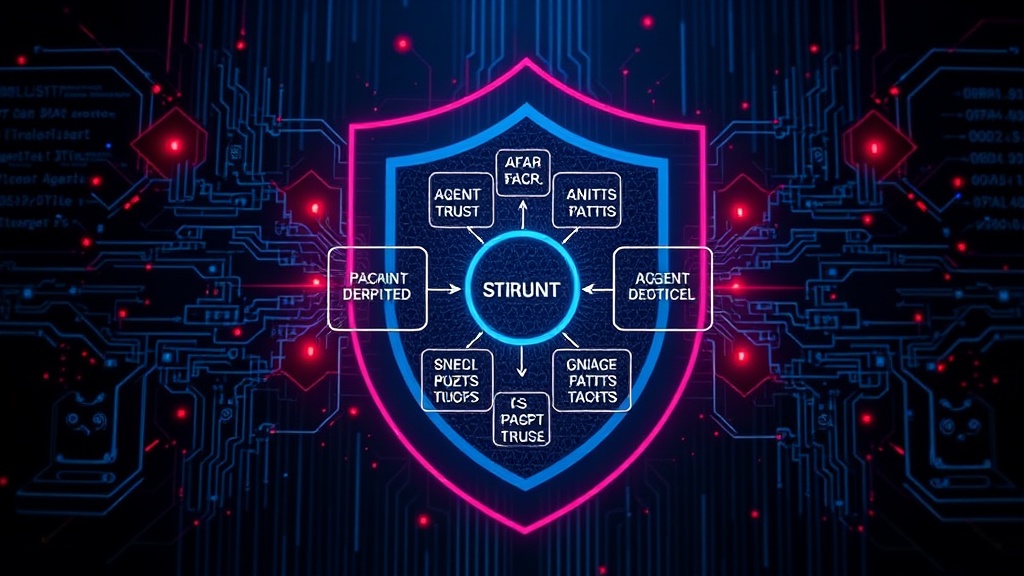
ATTP's five-dimension trust scoring model is the engine that drives its security capabilities. While the specific dimensions are detailed within the draft, the general principles aim to create a comprehensive picture of an agent's trustworthiness. Cryptographic identity verification is foundational. This likely involves public-key cryptography where agents possess unique digital certificates that can be validated against trusted authorities or a decentralized identity system. This prevents spoofing and ensures that an agent is indeed who it claims to be.
Spend limit tiers introduce a crucial control mechanism. For instance, a newly onboarded agent might have a very low spend limit for financial transactions, while a long-standing, highly verified agent could have a significantly higher limit. This compartmentalizes risk; even if a low-tier agent is compromised, the potential damage is contained. Anomaly detection acts as a real-time security guard. It monitors communication patterns, message content for unusual keywords or structures, and interaction frequencies. If Agent A suddenly starts sending messages at an unprecedented rate, or requests data it has never shown interest in before, the anomaly detection system can flag this as suspicious, prompting further scrutiny or even blocking the communication.
The protocol also considers the context of the interaction. For example, an agent that typically requests read-only data might be flagged if it suddenly attempts to initiate a write operation without explicit authorization or a pre-established trust relationship for such actions. This layered approach, combining verifiable identity, controlled permissions, and intelligent monitoring, aims to create a resilient system that can adapt to evolving threats.
Implications for Agent Networks and Beyond
The Agent Trust Transport Protocol represents a significant step forward for the security and reliability of autonomous agent systems. For developers building agent networks, ATTP offers a standardized framework for managing inter-agent trust, reducing the burden of implementing bespoke security solutions. It provides a clear pathway to mitigate prompt injection attacks and prevent the cascading failures that can occur when a single agent is compromised. This protocol is not just about securing existing agent architectures; it's about enabling the development of more complex and ambitious multi-agent systems, such as decentralized autonomous organizations (DAOs), sophisticated AI-driven marketplaces, and coordinated robotic systems.
The broader implications extend to any system where autonomous or semi-autonomous entities need to interact. This could include IoT devices, smart contracts, or even future AI assistants that operate on behalf of users. By establishing a verifiable trust layer, ATTP lays the groundwork for a more secure and dependable digital ecosystem. The challenge now lies in the widespread adoption and implementation of this protocol by agent developers and platform providers, ensuring that trust is not an afterthought but a foundational element of agent communication moving forward.