
Scaling AI-Powered Construction Automation
Hyperion Robotics, a Finnish company focused on physical AI for infrastructure construction, announced today it has secured $7.4 million in a growth funding round. The capital infusion is earmarked for scaling the company’s robotic micro-factory solutions, aiming to accelerate the adoption of automated manufacturing processes in the construction sector. The company's approach leverages AI and robotics to create on-site or near-site manufacturing hubs that can produce construction components with increased efficiency and precision.
The construction industry, notoriously slow to adopt new technologies, faces persistent challenges related to labor shortages, project delays, and cost overruns. Hyperion Robotics positions its technology as a direct solution to these issues. By digitizing and automating aspects of material production, the company seeks to bring manufacturing-like predictability and quality control to the often unpredictable environment of a construction site.
The funding round was led by a significant European venture capital firm, with participation from existing investors. This influx of capital signals strong confidence in Hyperion's vision and its ability to disrupt traditional construction methods. The company's proprietary software platform integrates AI algorithms for design optimization and robotic control, enabling the production of complex structural elements.
Think of Hyperion's micro-factories less like a traditional concrete batching plant and more like a highly specialized, automated workshop that can be deployed where it's needed most. This modular approach allows for localized production, reducing transportation costs and the associated environmental impact. It also means that components can be manufactured closer to the project timeline, potentially cutting down on lead times.
Technology and Market Opportunity
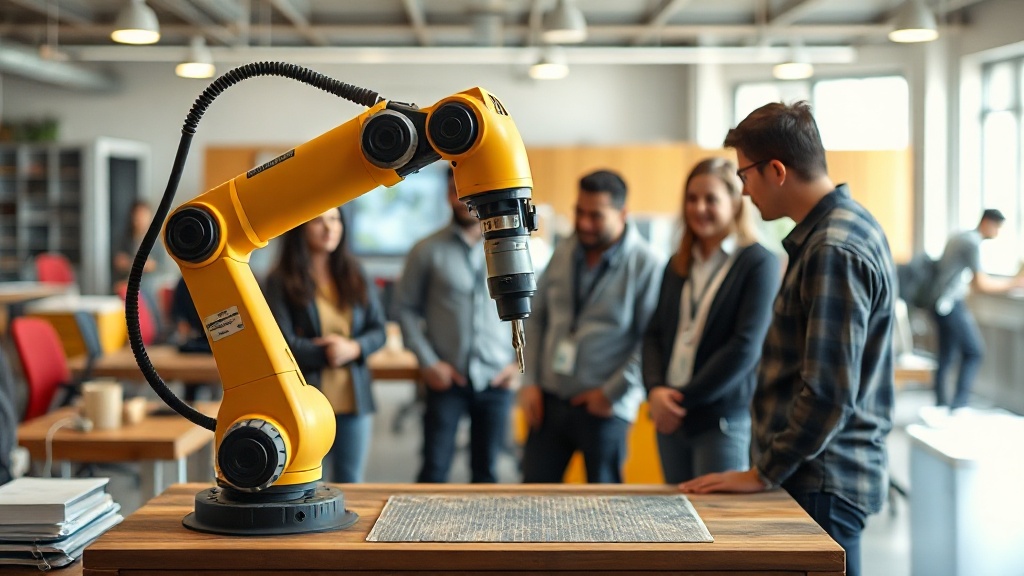
At its core, Hyperion Robotics' technology involves advanced robotic arms equipped with specialized end-effectors capable of handling various construction materials, including concrete and composites. AI plays a crucial role in optimizing the robotic path planning, ensuring material deposition accuracy, and managing the overall production workflow. This allows for the creation of customized components that can be difficult or uneconomical to produce using conventional methods.
The company's initial focus has been on infrastructure projects, such as bridges, retaining walls, and custom architectural elements. The ability to produce these components on-demand and with high precision addresses a critical bottleneck in the industry. The construction sector is a massive global market, and the push towards sustainability and efficiency is creating a fertile ground for innovative solutions like Hyperion's.
The surprising detail here is not just the funding amount, but the specific focus on 'physical AI' for construction. While AI has permeated software and data analysis, its application to heavy-duty physical manufacturing in construction is still nascent. Hyperion is betting that the future of building involves more automation and less manual labor, driven by intelligent machines.
Strategic Use of Funds
With the $7.4 million in new funding, Hyperion Robotics plans to significantly expand its engineering and sales teams. A key objective is to scale up the production and deployment of its robotic micro-factories. This includes investing in further research and development to enhance the capabilities of their AI platform and robotic systems, making them adaptable to a wider range of construction materials and project types.
The company also intends to forge strategic partnerships with construction firms and material suppliers. These collaborations will be vital for integrating Hyperion's technology into existing construction workflows and demonstrating its value proposition in real-world projects. The goal is to move beyond pilot projects and into widespread commercial adoption.
The competitive landscape for construction technology is heating up, with various companies exploring automation, prefabrication, and digital twins. Hyperion's integrated approach, combining AI, robotics, and a micro-factory model, offers a distinct advantage. However, the inherent conservatism of the construction industry means that widespread adoption will require sustained effort in education, pilot programs, and clear ROI demonstrations.
What remains to be seen is how quickly Hyperion can navigate the regulatory hurdles and site-specific challenges inherent in construction. Each project site presents unique conditions, and adapting automated manufacturing to these variables will be a continuous engineering challenge.
Future Outlook
Hyperion Robotics is positioning itself at the forefront of a significant shift in the construction industry. The company's ability to deliver on its promise of efficient, precise, and localized manufacturing could redefine how infrastructure is built. The successful deployment of their technology at scale will not only benefit Hyperion but could also pave the way for broader automation across the built environment.
The construction sector has long been a laggard in productivity growth compared to other industries. Technologies that promise to bridge this gap, particularly those that combine advanced software intelligence with physical automation, are likely to see substantial interest. Hyperion's latest funding round is a strong indicator of this trend.