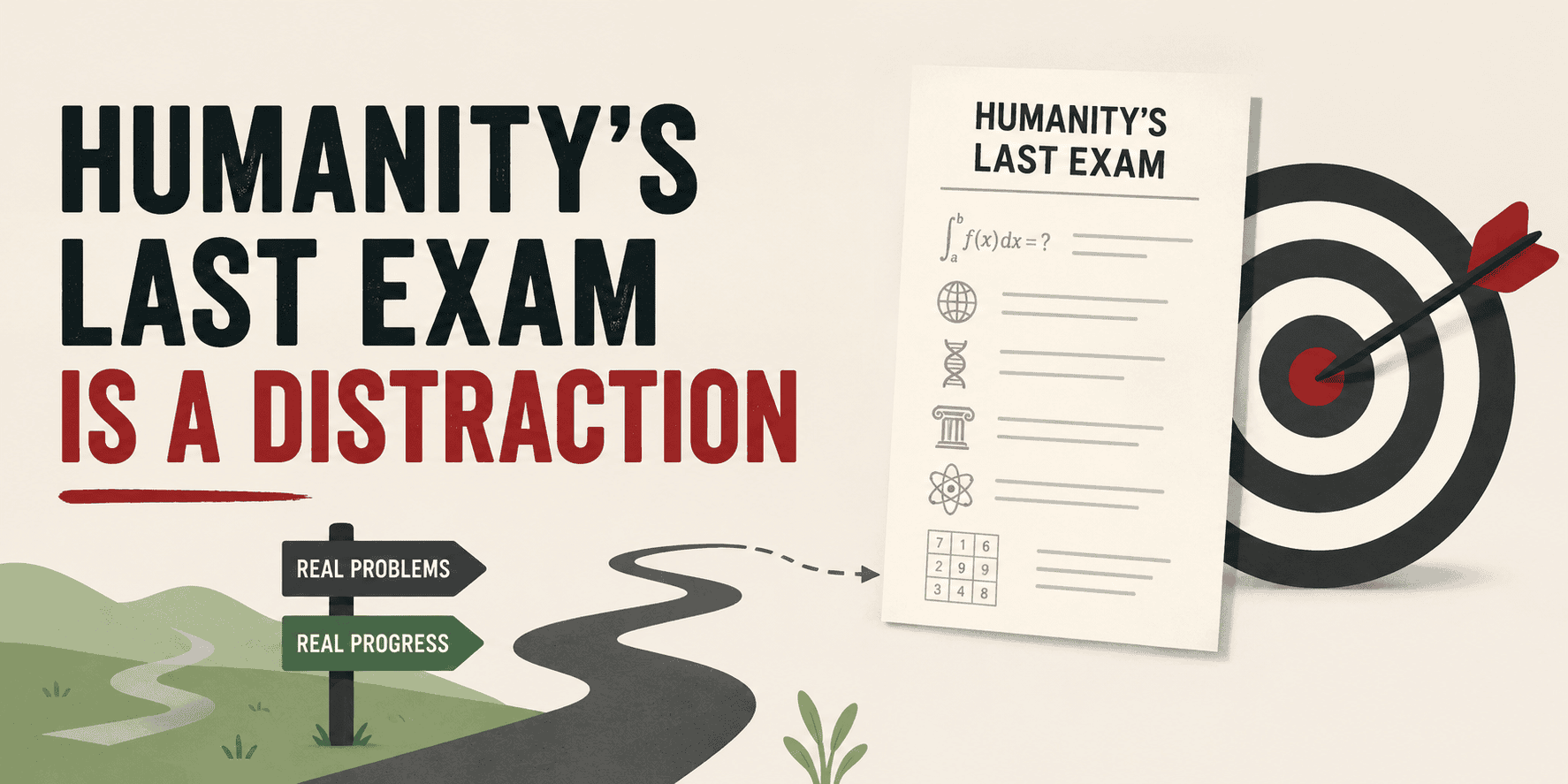
The Premise of Humanity's Last Exam
The concept of an AI benchmark designed to evaluate artificial general intelligence (AGI) has long been a theoretical pursuit. Humanity's Last Exam (HLE), proposed by researchers from the AI Safety Institute and Google DeepMind, aims to bridge this gap. The benchmark is framed as a comprehensive test, drawing inspiration from human exams like the GRE and SAT, but adapted for AI. Its stated goal is to gauge an AI's ability to understand, reason, and adapt across a wide range of cognitive tasks, simulating a broad spectrum of human knowledge and problem-solving capabilities. The initiative seeks to move beyond narrow AI capabilities and assess a more generalized form of intelligence, a critical step in understanding and potentially controlling advanced AI systems.
The benchmark's design is ambitious, encompassing multiple-choice questions, essay writing, and even coding challenges. It aims to cover domains from mathematics and history to ethics and law. The underlying assumption is that a sufficiently advanced AI should, in principle, be able to perform competently across these diverse areas. This approach is intended to be a more holistic measure of intelligence than previous benchmarks, which often focused on specific skills like image recognition or natural language processing. The hope is that HLE can provide a standardized way to compare different AI models and track progress towards AGI, while also highlighting potential safety concerns by probing the AI's understanding of complex, nuanced topics.
However, the very ambition of HLE has drawn significant criticism from within the AI research community. Many experts argue that the benchmark, while well-intentioned, is fundamentally flawed and potentially counterproductive. They contend that evaluating AGI is an extraordinarily complex challenge, and that a test designed to mimic human exams is a reductive and perhaps even misleading approach. The concern is that focusing on such a benchmark could divert resources and attention from more pressing, practical issues in AI development and safety.
Criticisms and Counterarguments
One of the primary criticisms leveled against Humanity's Last Exam is its reliance on a human-centric evaluation framework. Critics argue that AGI, if it ever emerges, may not manifest intelligence in a way that is directly comparable to human cognition. Trying to force AI performance into the mold of human exams might overlook novel forms of intelligence or create a false sense of understanding. Dr. Eleanor Vance, a leading AI ethicist, commented, "We're trying to measure something we don't fully understand using tools designed for a different kind of intelligence. It’s like trying to gauge a fish's ability to climb a tree." This analogy highlights the concern that the benchmark might be fundamentally misaligned with the nature of advanced AI.
Furthermore, there's a significant concern that HLE could lead to a form of 'teaching to the test' for AI systems. If the benchmark becomes the de facto standard for evaluating AGI, developers might optimize their models specifically to perform well on HLE, rather than to achieve genuine, robust general intelligence. This could result in AI systems that appear intelligent within the confines of the test but lack true understanding or adaptability in real-world scenarios. The risk is creating sophisticated 'parrots' that can mimic the answers without genuine comprehension, a problem that has already plagued some large language models.
Another point of contention is the feasibility of truly evaluating AGI with current technology. Many researchers believe that we are still far from developing AI systems that could be considered generally intelligent. Therefore, creating a benchmark for AGI now might be premature. The resources and effort invested in developing and administering HLE could, in the view of some, be better spent on more immediate AI safety challenges, such as bias mitigation, robustness, interpretability, and the control problem for existing powerful models.
Expert Opinions and the Verdict
The reception to Humanity's Last Exam has been mixed, with a significant portion of the AI community expressing skepticism. While some acknowledge the intent behind the benchmark – to provide a standardized method for assessing advanced AI capabilities – many find its premise flawed. Dr. Kenji Tanaka, a researcher specializing in AI alignment, stated, "The idea of a single 'exam' for AGI is an oversimplification. Intelligence is multifaceted and emergent, not something that can be captured in a set of questions, however comprehensive."
The consensus emerging from discussions and expert commentary, as curated by KDnuggets, suggests that HLE is viewed more as a thought experiment or a placeholder than a definitive measure of AGI. Many believe it serves a purpose in stimulating discussion about AI evaluation, but it is not the ultimate answer. The benchmark's creators themselves acknowledge that it is an iterative process and may evolve. However, the core criticism remains: that focusing on such a test distracts from the more immediate and pressing concerns surrounding the development and deployment of current AI technologies.
The widely accepted verdict, therefore, is that while the pursuit of evaluating AGI is crucial, Humanity's Last Exam, in its current form, is a premature and potentially misleading distraction. The true challenge lies not in designing a single test, but in developing a holistic understanding of AI capabilities, safety, and alignment as these systems continue to advance at an unprecedented pace. The focus, many argue, should remain on building safe, reliable, and beneficial AI, rather than on creating an artificial 'final exam' for a hypothetical future intelligence.
Referenced Sources
- verified