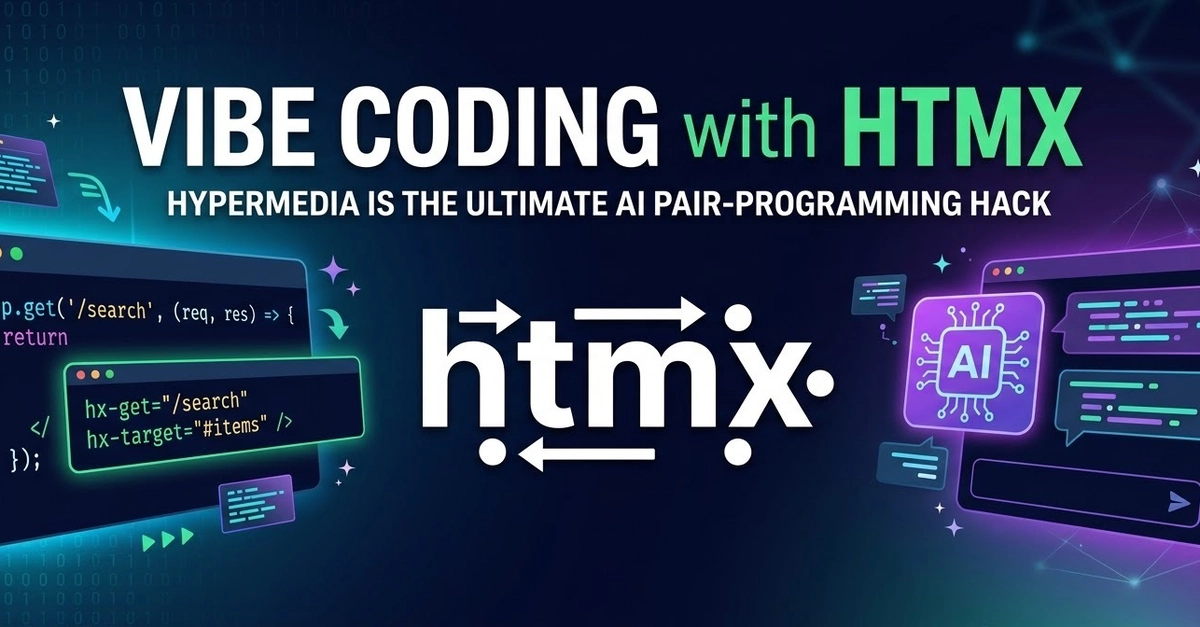
The Promise and Peril of AI-Assisted Development
The concept of "vibe coding"—where developers prompt a Large Language Model (LLM) for code, accept the output, test it, and ship—promises a future of accelerated development. It feels like magic, bypassing the tedious boilerplate and allowing focus on core features. However, this dream quickly dissolves when confronted with the complexities of modern Single-Page Application (SPA) architectures. Stacks built on React, Next.js, intricate state machines, and client-side caching often buckle under the weight of AI-generated code, leading to a cascade of new problems.
The core issues are familiar to anyone who has wrestled with complex frontend frameworks. First, state synchronization hell. AI models, while powerful, can easily generate infinite loops or excessive rerenders, especially within the reactive paradigms of SPAs. A subtly incorrect useEffect hook can trigger dozens of UI updates, grinding development to a halt. Second, context bloat. To generate meaningful code, LLMs require extensive context: component schemas, type definitions, API actions, UI token libraries, and even framework-specific configurations. This input quickly consumes valuable context window space, leaving little room for the actual business logic or feature requests. Finally, ghost bugs emerge. The AI might miss crucial edge cases, like failing to invalidate a client-side cache after a server mutation. These subtle errors are hard to detect and debug, undermining the confidence that vibe coding aims to build.
HTMX: A Return to Hypermedia Principles
This is where HTMX enters the picture, offering a compelling alternative by embracing hypermedia principles. Instead of building complex client-side state management, HTMX shifts the burden back to the server. The core idea is simple: HTML attributes on elements trigger AJAX requests, and the server responds with HTML fragments that directly update parts of the DOM. This approach sidesteps the entire SPA complexity.
Consider the SPA pain points through an HTMX lens. State synchronization hell evaporates because the server maintains the definitive state. When a user interacts with an HTMX-enabled element, a request goes to the server. The server processes the request, updates its state, and returns the necessary HTML to update the relevant part of the UI. There are no complex client-side state machines to synchronize or multiple layers of cache to invalidate. The browser's natural navigation and form submission mechanisms are leveraged, augmented by targeted AJAX updates.
Context bloat is also drastically reduced. The LLM doesn't need to understand the intricacies of your frontend framework's hydration lifecycle or the nuances of your client-side routing. Instead, it needs to understand your server-side rendering logic and your API endpoints. The prompt can focus on generating server-side logic that produces HTML snippets, or it can generate HTML fragments directly. This is a far more constrained and manageable problem for an LLM than understanding a full SPA's client-side architecture. If you're prompting an AI to build a new user profile section, you tell it to generate the server endpoint that returns the updated profile HTML, not to orchestrate React component updates, state dispatches, and client-side cache invalidations.
Ghost bugs related to client-side state management become far less frequent. Since the server is the source of truth, and updates are driven by server-generated HTML, the complexity of client-side caches and their invalidation is largely removed. The interaction model is more straightforward: user action -> server request -> server response (HTML) -> DOM update. This direct, server-authoritative flow naturally leads to fewer emergent bugs related to asynchronous client-side state.
Vibe Coding with HTMX: A Practical Workflow
The practical implication for vibe coding is profound. Imagine this workflow:
- Define the Feature: You describe a new feature to your LLM. Instead of specifying React component props or Redux actions, you describe the desired UI change and the server-side logic required to achieve it. For example, "Add a button to the user profile page that allows changing the avatar. When clicked, it should show a file upload modal and update the avatar image once uploaded."
- AI Generates Server Logic & HTML: The LLM generates the necessary server-side code (e.g., a route handler in Python/Flask or Node.js/Express) that accepts the file upload, processes it, updates the user record, and returns an HTML fragment containing the updated user profile section, including the new avatar image. It might also generate the HTMX attributes needed for the initial button and the file input.
- Integrate and Test: You integrate this generated code into your existing server application. Because the output is primarily server logic and HTML, it fits into a more traditional web application structure. Testing involves hitting the endpoint and verifying the HTML output and the state change on the server.
- Ship: With fewer client-side synchronization issues and a more constrained problem space for the AI, the cycle from prompt to production becomes significantly smoother and more reliable.
This isn't about ditching modern tooling entirely. HTMX can coexist with backend frameworks and even sprinkle in client-side JavaScript for enhanced interactivity where needed. However, it fundamentally reorients the architecture, making it more amenable to AI-driven development by reducing the surface area of client-side complexity.
The Future of AI-Assisted Development
The friction encountered when using SPAs for AI-assisted development highlights a critical tension: the desire for rapid iteration versus the inherent complexity of many modern frontend architectures. HTMX, by championing hypermedia, offers a path back to simplicity. It’s a reminder that the web's original architecture—server-rendered HTML, hypermedia links, and progressive enhancement—might be the most resilient and efficient foundation for the next wave of AI-powered coding.
What remains to be seen is how LLMs themselves will adapt. Will future models be better tuned to generate hypermedia-driven responses, or will developers need to become expert prompt engineers for server-side HTML generation? The shift to HTMX suggests that the most effective AI pair-programming hacks might not be about the AI itself, but about the architecture it's paired with.