The Bottleneck in AI Model Deployment
The exponential growth of large language models (LLMs) and other sophisticated AI systems has created a new class of computational challenges. While advancements in processing power, particularly with GPUs, have been rapid, the efficiency of accessing and managing the massive datasets and model weights required for training and inference remains a significant bottleneck. Storing and retrieving these multi-gigabyte or even terabyte-sized model parameters can consume a disproportionate amount of time and energy, slowing down the entire AI development lifecycle. Traditional storage solutions, designed for general-purpose computing, often struggle with the specific access patterns and bandwidth demands of modern AI workloads. This is where High-Bandwidth Flash (HBF) storage emerges as a critical innovation.
HBF is not simply an incremental improvement on existing NAND flash technology. Instead, it represents a fundamental architectural shift aimed directly at the needs of high-performance computing, with a particular focus on AI. The core problem HBF addresses is the latency and throughput limitations inherent in how data is moved from storage to compute units. In AI, especially during training, the model weights are read repeatedly. If the storage system cannot supply these weights fast enough, the powerful GPUs sit idle, waiting for data. This is akin to having a Formula 1 engine but feeding it fuel through a garden hose. HBF aims to replace that garden hose with a fire hydrant, ensuring the compute resources are always saturated with the data they need.
Architectural Innovations of High-Bandwidth Flash
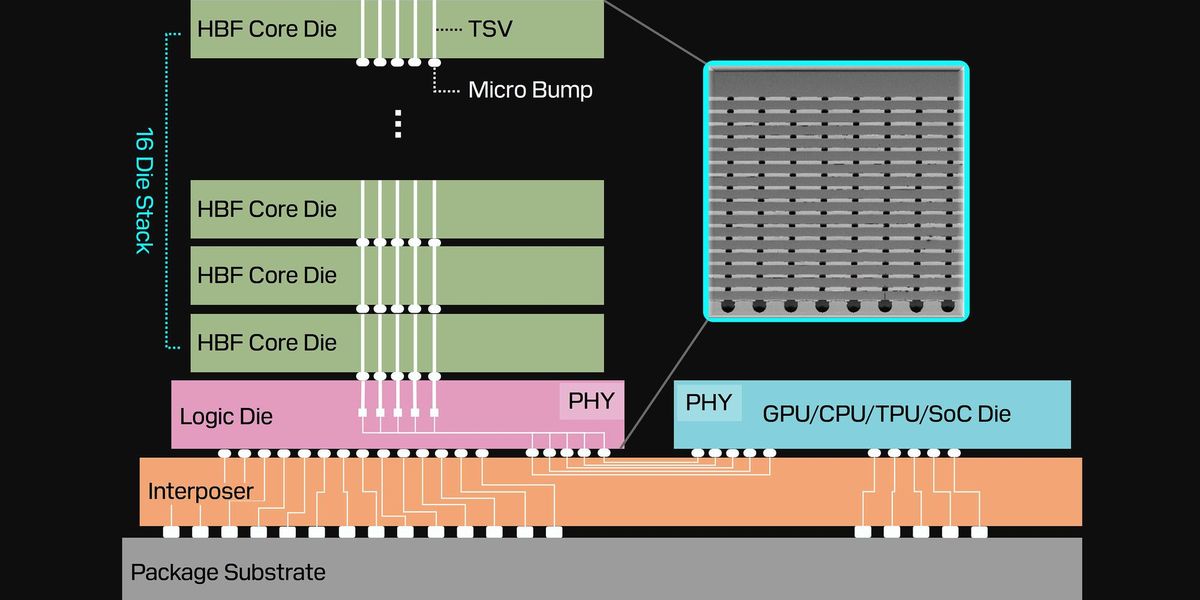
The key to HBF's efficiency lies in its redesigned architecture, which prioritizes direct, high-speed access to data. Unlike conventional SSDs that rely on complex controllers and interfaces like NVMe or SATA, HBF often bypasses some of these layers. This is achieved through several innovations:
- Direct Memory Access (DMA) Enhancements: HBF systems are engineered to allow compute units to access data directly from the flash memory with minimal overhead. This bypasses traditional host controllers and operating system layers that can introduce latency. Think of it like having a dedicated, express lane directly from the warehouse (flash storage) to the factory floor (AI accelerator), rather than using the public highway system with all its traffic lights and intersections.
- Optimized Data Layout: The physical and logical layout of data on HBF media is tailored for sequential and random reads of large contiguous blocks, which are characteristic of AI model weight access. This contrasts with general-purpose storage that must optimize for a wide variety of access patterns, including small, random writes.
- Reduced Protocol Overhead: HBF interfaces are designed to minimize the protocol overhead associated with data transfers. This means less time is spent on communication handshake, command processing, and status reporting, and more time is spent actually moving the model weights.
- Higher Parallelism: HBF architectures often incorporate increased parallelism at the chip and die level, allowing multiple data channels to operate simultaneously. This significantly boosts the aggregate bandwidth and the number of operations per second (IOPS) that can be sustained.
These architectural changes collectively aim to reduce the read latency and increase the read throughput by an order of magnitude compared to existing high-end enterprise SSDs. For AI workloads, this translates directly into faster training times and more responsive inference. When training a massive model, the difference between waiting seconds or milliseconds for a batch of weights can accumulate into hours or even days saved over the entire training run. Similarly, for real-time AI applications, reducing inference latency is paramount for user experience and system usability.
Impact on AI Training and Inference
The implications of HBF for the AI ecosystem are profound. During the training phase, where models learn from vast datasets, the ability to feed data to GPUs at maximum speed is crucial. If the storage system becomes the bottleneck, expensive GPU clusters can be underutilized, leading to wasted compute cycles and increased operational costs. HBF promises to keep these accelerators fed, enabling researchers and engineers to iterate faster on model architectures and hyperparameter tuning.
For inference, the process of using a trained model to make predictions, latency is often the critical metric. Applications like real-time language translation, autonomous driving, and interactive chatbots require near-instantaneous responses. By reducing the time it takes to load model weights into memory and access them for computation, HBF can significantly lower inference latency. This could enable new classes of AI applications that were previously impractical due to storage I/O limitations.
Consider a scenario where an LLM needs to load its parameters to answer a query. A traditional system might take several seconds to load the necessary weights from disk. With HBF, this loading time could be reduced to milliseconds, making the interaction feel much more fluid and immediate. This is not just about speed; it's about making AI more practical and accessible for a wider range of applications and users.
The Broader Ecosystem and Future Outlook
The development and adoption of HBF are likely to spur further innovation in related areas. As storage becomes less of a bottleneck, there will be increased pressure on compute architectures and interconnects to keep pace. We might see a convergence of storage and compute in novel ways, with memory technologies blurring the lines between where data is stored and where it is processed. Furthermore, the energy efficiency gains from reduced data movement could also contribute to more sustainable AI development and deployment.
However, HBF is not without its challenges. The technology is currently specialized and likely to be more expensive per gigabyte than traditional NAND flash. Its adoption will initially be concentrated in high-performance computing environments where the performance gains justify the cost. Software stacks will also need to evolve to fully leverage the capabilities of HBF, requiring optimizations in data management, file systems, and AI frameworks. The question for many developers will be how seamlessly they can integrate HBF into their existing workflows and what new paradigms it unlocks.
What remains to be seen is the long-term impact on the broader storage industry. Will HBF become a distinct category of storage, or will its innovations be integrated into mainstream SSDs over time? The speed at which AI workloads continue to scale suggests that solutions like HBF will be essential for unlocking the next generation of artificial intelligence capabilities.