The Peril of Silence in AI Communication
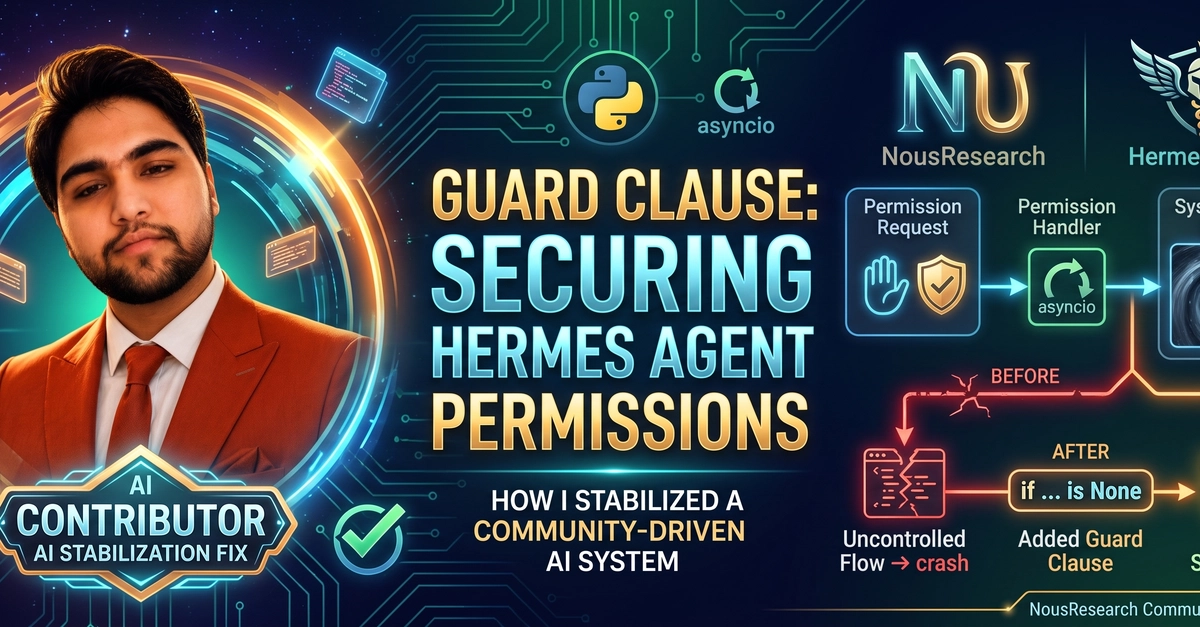
Software that fails to respond can be as disruptive as outright errors. For AI agents, which rely on a complex chain of commands and approvals, a silent failure—a lack of response where one is expected—can be catastrophic. This is precisely the issue Aniruddha Adak encountered and resolved in the open-source Hermes Agent project, an AI system designed to run locally.
Adak’s contribution targeted the agent’s permission system. Typically, when Hermes needs to execute a command that requires user consent, it sends a request to an approval mechanism. This mechanism is expected to return a clear ‘approve’ or ‘deny’ signal. However, communication glitches can occur, leading to a complete absence of a response. In Python, this void is represented by None. If the agent doesn't anticipate or handle this None value, it can lead to unexpected behavior, ranging from minor glitches to a full system freeze or crash.
The problem stems from a fundamental principle in robust software development: always account for the unexpected. In human interaction, a blank stare can be awkward, but in software, it can halt operations entirely. Adak's fix addresses this by ensuring that the Hermes Agent doesn't just freeze when it encounters this non-response, but instead gracefully handles the situation.
The Fix: Graceful Handling of Null Responses
Adak identified that the core of the issue lay in how the Hermes Agent processed responses from its approval system. When the system failed to return a definitive approval or denial, the agent received None. The existing code, however, did not have a specific check for this None value before attempting to use it, leading to errors or freezes. The fix involved adding two simple lines of Python code to explicitly check if the response was None. If it was, the agent would then proceed with a default safe action, such as denying the command or logging the issue without crashing.
This approach is akin to having a backup plan for a conversation. If someone doesn't answer your question directly, you don't just stand there silently; you might rephrase, ask if they heard you, or move on. Similarly, the code now has a defined fallback behavior for when the expected communication channel yields silence.
The specific implementation details, as shared by Adak, involve conditional logic that intercepts the None response. This prevents the program from attempting to interpret a non-existent value as a valid command status. By introducing this check, the agent can now distinguish between an explicit denial and a communication failure, treating the latter as a condition that requires a safe, predefined reaction rather than a critical error.
Why Handling Empty Responses Matters
The significance of this fix extends beyond the Hermes Agent project. In any distributed system, especially those involving asynchronous communication or multiple microservices, the possibility of a component failing to respond is a constant threat. These failures can occur due to network issues, temporary service outages, or bugs in the responding service itself. If the calling service isn't designed to handle these timeouts or null responses gracefully, the entire system’s stability can be compromised.
Consider a financial trading system. If a component responsible for confirming a trade fails to respond, the system might erroneously assume the trade was rejected, or worse, it might halt all operations, leading to significant financial losses. In AI, where agents can autonomously execute actions, an unhandled null response could lead to unintended and potentially harmful operations, or simply render the agent useless.
Adak’s contribution highlights a common pitfall: focusing solely on expected outcomes and neglecting edge cases. The ‘happy path’ of software development is where everything works perfectly. But robust software must also account for the ‘unhappy paths’—the scenarios where things go wrong. Handling None is a basic, yet critical, aspect of this.
Broader Implications for AI Development
The Hermes Agent project is an example of how open-source AI development fosters collaboration and iterative improvement. By making the agent runnable on local machines, it allows developers to contribute directly to its stability and functionality. Adak’s bug fix is a testament to the power of community-driven development, where individual contributions can have a tangible impact on the reliability of complex systems.
This incident also underscores the importance of defensive programming in AI. As AI agents become more integrated into our daily lives and critical infrastructure, their reliability is paramount. Developers building and contributing to these systems must prioritize error handling, especially for communication failures. The two-line fix for Hermes is a simple yet powerful reminder that sometimes, the most critical improvements come from addressing the most basic potential points of failure. It is not about complex algorithms, but about meticulous attention to detail in how components interact and how the system behaves when those interactions break down.
What remains to be seen is how widely this specific pattern of handling null responses will be adopted across other AI agent frameworks. While it is a fundamental programming concept, the explicit nature of AI agent interactions might necessitate more standardized approaches to ensure universal robustness. For now, the Hermes Agent is more stable thanks to a sharp eye and a few lines of code.