Building an MVP Research Wiki with Hermes Agent and Gonka Router
A recent blog post outlines a practical approach to creating a Minimum Viable Product (MVP) for a research wiki, leveraging open-source AI models for cost-effective inference. The author, Elina Berz, details a system built using Hermes Agent for natural language processing tasks and Gonka Router for efficient request handling. This setup aims to provide AI-powered features like summarization and question answering without incurring the high costs typically associated with commercial AI services.
The core challenge addressed is making AI capabilities accessible for smaller projects and individual developers. Traditional cloud-based AI APIs can quickly become prohibitively expensive, especially during the development and testing phases. By opting for self-hosted, open-source models, developers can maintain control over costs and infrastructure while still accessing powerful AI functionalities. This approach is particularly relevant for building internal tools, research platforms, or specialized applications where budget is a significant constraint.
The Role of Hermes Agent
Hermes Agent, a key component in this setup, is described as an AI model capable of understanding and generating human-like text. In the context of a research wiki, Hermes can be employed for several crucial functions. For instance, it can automatically summarize lengthy research papers or articles, providing users with a quick overview of the content. It can also power a question-answering system, allowing users to query the wiki’s knowledge base and receive concise, relevant answers derived from the stored information.
The author emphasizes the importance of choosing an AI model that balances performance with computational requirements. While larger, more sophisticated models might offer superior accuracy, they often demand substantial hardware resources, negating the cost-saving benefit. Hermes, positioned as a more accessible option, allows for deployment on less powerful hardware, making it suitable for a wider range of users, including those with limited access to high-end GPUs or cloud computing instances. This democratization of AI tools is central to the project's philosophy.
Gonka Router for Efficient Request Management
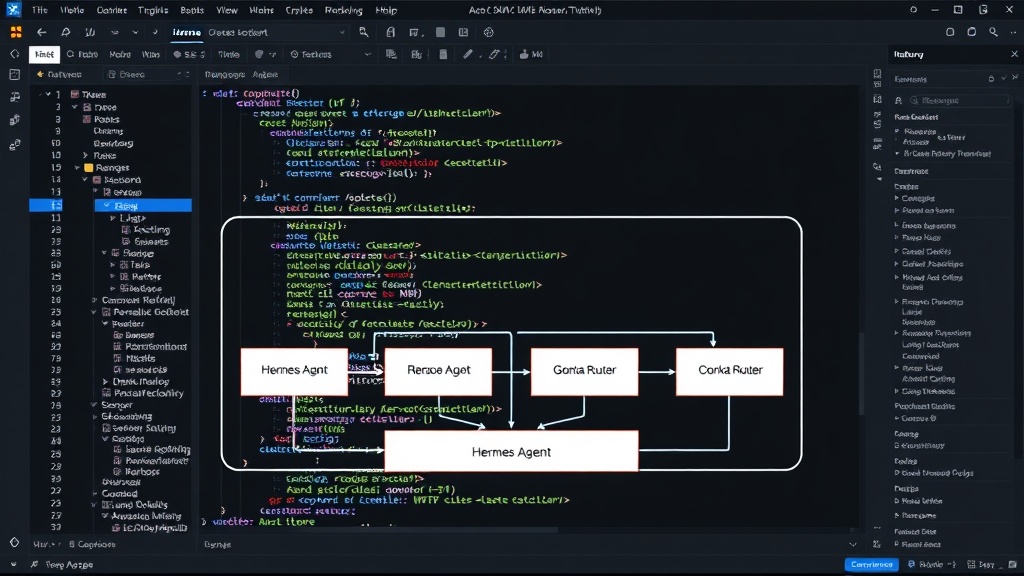
Complementing Hermes Agent is Gonka Router. In this architecture, Gonka Router acts as the traffic manager, directing incoming user requests to the appropriate AI model or service. For a research wiki, this means efficiently handling queries for summarization, question answering, or other AI-driven features. The router ensures that requests are processed swiftly and accurately, preventing bottlenecks and maintaining a responsive user experience.
The benefit of using a dedicated router like Gonka is its ability to manage multiple AI models or tasks simultaneously. This is particularly useful as the research wiki grows and more complex AI functionalities are integrated. Gonka can intelligently route requests, perhaps sending specific types of queries to specialized Hermes model variants or other AI services if they are introduced later. This modular design allows for scalability and flexibility, ensuring that the system can adapt to future needs without requiring a complete overhaul.
Building the MVP Research Wiki
The blog post walks through the steps involved in setting up this MVP. It covers the initial configuration of the AI models, the integration of Hermes Agent and Gonka Router, and the development of a user interface for the research wiki. The focus is on a lean, functional implementation that can be deployed quickly. This MVP approach allows for rapid iteration and feedback, enabling the project to evolve based on real-world usage.
A significant aspect of the development process highlighted is the cost efficiency. By avoiding proprietary AI services, the operational costs for running the wiki are drastically reduced. This makes the project sustainable for individuals or small teams. The author implicitly suggests that this model can be a blueprint for others looking to build AI-powered applications on a budget. The choice of open-source tools is critical here, as it removes licensing fees and provides transparency into the underlying technology.
Implications for Affordable AI Development
The approach detailed in the blog post has broader implications for the AI development community. It demonstrates that building sophisticated AI-powered applications does not necessarily require massive budgets or reliance on large cloud providers. By understanding and utilizing open-source models and efficient routing mechanisms, developers can create powerful tools that are both accessible and cost-effective.
This strategy is particularly pertinent for startups and researchers who need to validate ideas quickly without significant upfront investment. The ability to deploy AI features for summarization, content generation, or intelligent search using affordable inference makes AI more attainable. The success of this MVP research wiki project serves as a compelling case study for the power of combining open-source AI models with smart infrastructure choices. The question that remains is how this model scales as the volume of data and user queries increases exponentially.