
The Problem with Duplicate Files
Every digital workspace accumulates duplicate files. Think of those redundant photo backups, repeated downloads of large archives, cloned Git repositories, or identical ISOs. These files silently consume gigabytes of valuable storage, especially on expensive SSDs. A naive approach to finding these duplicates involves reading every file and comparing its hash. However, on large drives, this method suffers from two critical flaws:
- Performance Bottleneck: Hashing thousands of files is inefficient. Most files have unique sizes and therefore cannot possibly be duplicates. This process wastes significant CPU cycles and disk I/O when it could be avoided entirely for a vast majority of files.
- Memory Crashes (OOM): Reading multi-gigabyte files entirely into memory using methods like
fs.readFileSynccan easily overwhelm the Node.js event loop, leading to out-of-memory errors and application crashes.
To address these issues, Mahdy Yarmonfared developed HashDup, a command-line interface tool designed for speed and memory safety. HashDup leverages native Node.js streams and a smart, two-phase scanning engine to efficiently identify duplicate files without succumbing to the common pitfalls of simpler scripts.
The 2-Phase Scanning Architecture
HashDup employs a sophisticated two-phase scanning architecture to optimize the duplicate detection process. This strategy dramatically reduces unnecessary work and memory pressure.
Phase 1: Size-Based Filtering
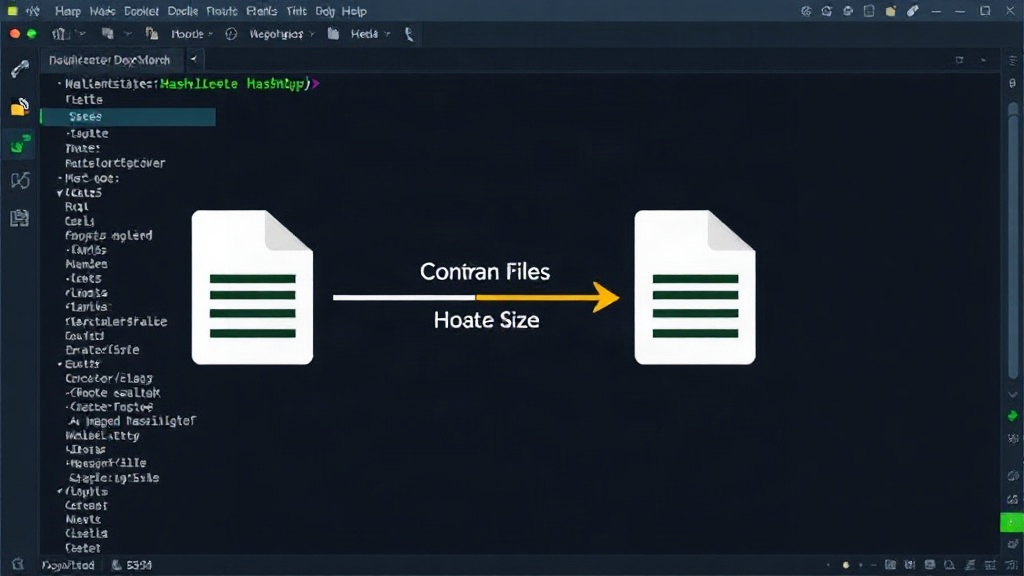
The first phase focuses on file sizes. Instead of immediately hashing every file, HashDup reads the size of each file encountered. It then groups files by their size. Files with unique sizes are immediately discarded as potential duplicates. This is a critical optimization: if two files have different sizes, they cannot possibly be identical. This step alone filters out a massive number of files, leaving only those with identical sizes for further scrutiny. This significantly reduces the number of files that need to undergo the more computationally intensive hashing process.
Phase 2: Hashing and Comparison
Once files are grouped by identical sizes, HashDup moves to the second phase. For each group of files with the same size, the tool proceeds to calculate their cryptographic hashes (e.g., SHA-256). Crucially, HashDup uses Node.js streams to read these files. Streams process data in chunks rather than loading the entire file into memory at once. This stream-based approach is what makes HashDup memory-safe, even when dealing with very large files. As each chunk is read, its hash is computed, and the final hash for the entire file is generated. Files within the same size group that share the same hash are identified as duplicates. This phase ensures accuracy by verifying the content of the files, not just their metadata.
Leveraging Node.js Streams for Efficiency
The core of HashDup's memory-safe design lies in its use of Node.js streams. Unlike reading an entire file into a buffer, streams allow data to be processed piece by piece. This is analogous to how a factory assembly line works: raw materials (file data) are processed in stages (chunks) without needing to store the entire product (full file content) in one place at any given time. This makes the process highly scalable and prevents the application from crashing due to memory limitations, even on systems with modest RAM or when scanning terabytes of data.
The CLI is built using standard Node.js modules, specifically the fs module for file system operations and the crypto module for hashing. By combining these with the stream API, Yarmonfared created a tool that is both performant and robust. The output of HashDup clearly lists duplicate files, often grouped by the original file they are a copy of, along with their paths, making it easy for users to identify and remove redundant data.
Why This Approach Matters
Traditional duplicate finders often fall into the trap of either being too slow or too memory-intensive. Simple scripts that hash everything are slow. Tools that load files into memory risk crashing. HashDup's two-phase approach, combined with stream processing, offers a compelling solution. It prioritizes efficiency by performing the cheapest check (file size) first, and then uses a memory-conscious method (streaming) for the more expensive check (hashing). This architecture is particularly beneficial for developers and power users who manage large datasets or frequently work with development environments where disk space is at a premium.
The choice of Node.js is also significant. While often associated with web development, Node.js's strong asynchronous I/O capabilities and its robust stream API make it surprisingly well-suited for system-level utilities like file management. HashDup demonstrates that with the right architecture, Node.js can be a powerful platform for building fast, efficient command-line tools that rival native applications.
Future Considerations
While HashDup provides an efficient solution, potential future enhancements could include support for more advanced hashing algorithms, parallel processing of file groups (where multiple CPU cores could hash different size groups concurrently), and perhaps even a GUI wrapper for users less comfortable with the command line. However, as it stands, HashDup represents a significant step forward in efficient duplicate file detection for the Node.js ecosystem.