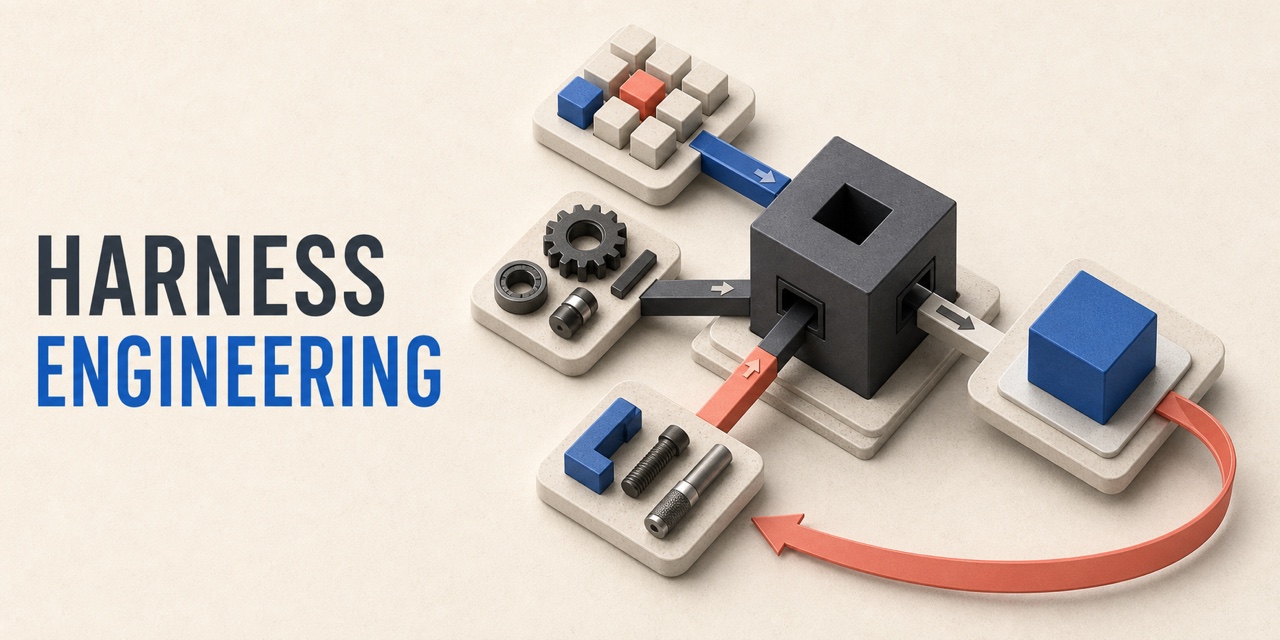
The Core Concept of Harness Engineering
Harness Engineering, at its heart, is a theoretical framework that seeks to optimize the design and implementation of complex systems by treating the system's interactions and dependencies as a primary focus. Unlike traditional engineering disciplines that might concentrate on individual components or isolated functions, Harness Engineering views the entire system as an interconnected web. The goal is to proactively manage these connections, ensuring stability, efficiency, and predictability under various operating conditions. Think of it less like building individual bricks for a wall and more like designing the mortar, the scaffolding, and the blueprint that ensures the wall stands strong and serves its purpose over time, even when subjected to external forces.
This approach is particularly relevant in fields like software development, aerospace, and large-scale infrastructure projects where the failure of a single interaction can cascade into catastrophic system failure. The principles of Harness Engineering emphasize understanding the 'shape' of these interactions—how data flows, how control signals propagate, and how energy or resources are exchanged between subsystems. By mastering this, engineers can design 'harnesses'—metaphorical or literal—that guide, constrain, or enhance these interactions to achieve desired system-level outcomes.
The genesis of such a concept often arises from observing recurring patterns of failure in complex systems. When systems fail, it's rarely due to a single component's defect; it's more often the result of unexpected interactions between seemingly robust parts. Harness Engineering aims to shift the engineering paradigm from component-centric design to interaction-centric design, fostering a more holistic and resilient approach to building and maintaining technology.
Principles and Methodologies
Several key principles underpin Harness Engineering. Firstly, Interaction Modeling is paramount. This involves creating detailed models that capture the dynamic relationships between system components. These models go beyond static diagrams, attempting to simulate the behavior of interactions under different loads, environmental conditions, and failure scenarios. This allows engineers to predict potential bottlenecks or points of fragility before they manifest in the physical or digital realm.
Secondly, Constraint-Based Design is crucial. Instead of allowing components to interact freely and then dealing with the consequences, Harness Engineering advocates for designing explicit constraints on these interactions. These constraints can take many forms: strict timing protocols, defined data formats, resource allocation limits, or even explicit fail-safe mechanisms that sever connections under duress. This is akin to designing safety rails on a bridge; they guide traffic and prevent catastrophic falls.
Thirdly, Feedback Loop Optimization is central. Harness Engineering recognizes that complex systems are rarely static. They evolve, and their interactions change. Therefore, continuous monitoring and adaptive control mechanisms are essential. This involves designing systems with robust feedback loops that can detect deviations from expected interaction patterns and automatically adjust system behavior to maintain stability or achieve optimal performance. This principle is vital for systems that operate in dynamic environments, such as autonomous vehicles or adaptive power grids.
The methodologies employed can vary widely. In software, this might translate to rigorous API design, strict protocol definitions, and sophisticated event-driven architectures. In hardware, it could involve designing specialized communication buses, implementing robust error detection and correction codes at the interface level, or developing integrated control systems that manage inter-component resource sharing. The common thread is a proactive, systematic approach to managing the 'glue' that holds systems together.
Applications and Implications
The implications of Harness Engineering are far-reaching. In software development, for instance, it could lead to more stable microservices architectures, where the inter-service communication is as rigorously designed and tested as the services themselves. This could significantly reduce the 'distributed monolith' problem, where microservices become so tightly coupled that they behave like a single, unwieldy application.
In aerospace, Harness Engineering principles could be applied to the complex interplay of flight control systems, engine management, and navigation. Ensuring that the communication channels and control signals between these critical subsystems are inherently resilient and predictable is vital for flight safety. Imagine an aircraft's flight computer needing to seamlessly adapt to sudden atmospheric turbulence; Harness Engineering provides a framework for designing such adaptive resilience.
The concept also has profound implications for the Internet of Things (IoT). With billions of devices needing to communicate and cooperate, managing the vast network of interactions is a monumental challenge. Harness Engineering offers a pathway to designing more robust, secure, and interoperable IoT ecosystems by focusing on the communication protocols and interaction patterns between devices, rather than just the devices themselves.
Challenges and Future Directions
Despite its potential, Harness Engineering faces significant challenges. Developing accurate interaction models for highly dynamic and emergent systems is computationally intensive and requires novel analytical techniques. Furthermore, shifting the engineering mindset from component-centric to interaction-centric requires significant cultural and educational changes within engineering teams. The tools and metrics used in traditional engineering may not be sufficient to evaluate the effectiveness of a 'harness' for system interactions.
One of the most pressing questions is how to standardize the principles of Harness Engineering across different domains. While the core concepts are universal, their specific implementation will vary drastically between, say, biological systems and distributed computing networks. Developing a common language and a set of transferable best practices will be crucial for widespread adoption.
Looking ahead, the integration of AI and machine learning could be a game-changer for Harness Engineering. AI could automate the process of interaction modeling, identify novel interaction patterns, and even design adaptive control mechanisms. This synergy could unlock new levels of system complexity and resilience, enabling the creation of truly autonomous and self-optimizing systems.