From Notebook to TTF: An Open-Source Font Pipeline
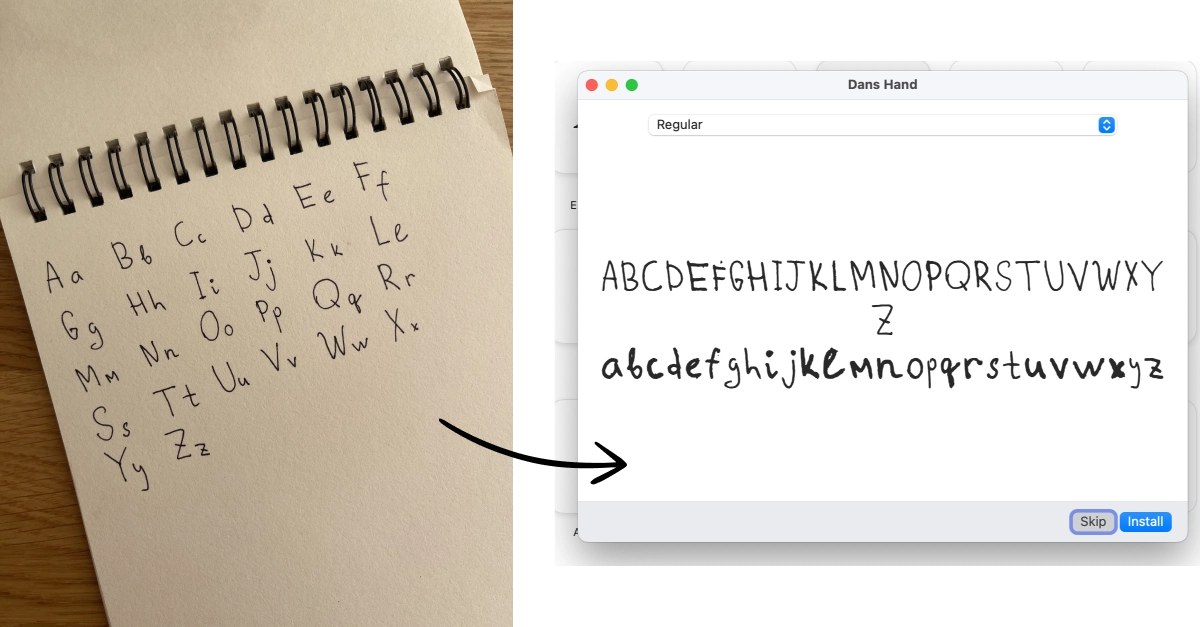
The dream of having your own custom font, rendered in your unique handwriting, often hits a wall of complexity. Traditional font creation tools typically demand meticulous, character-by-character drawing with digital pens on tablets, a process many find tedious and time-consuming. Danilo Znamerovszkij, a developer, set out to demystify this process, developing a pipeline that transforms a simple photograph of handwriting into an installable TrueType Font (TTF). Crucially, the entire workflow is open-sourced under an MIT license, allowing anyone to replicate or build upon it.
The pipeline achieves this transformation through a layered approach, accessible as an npm library, a command-line interface (CLI), and even integrated as a Claude Code skill. The journey begins with a single photograph of handwritten alphabet characters, taken under less-than-ideal lighting conditions, and culminates in a fully functional font file. This project addresses the perceived barrier to entry for custom font creation, making it a tangible reality for developers and enthusiasts alike.
Znamerovszkij’s motivation stemmed from a long-held desire for personalized digital typography. The common narrative surrounding font creation—often described as an arduous, suffer-filled endeavor—prompted him to explore a more accessible solution. This project is not just about generating a font; it’s about democratizing the process and providing a reproducible method for others to follow.
The Pipeline Explained: From Pixels to Glyphs
The core of the project lies in its multi-stage processing pipeline. It begins with image capture, where the user writes out their alphabet (a-z, A-Z, 0-9, and common punctuation) in a spiral notebook. A single, relatively low-quality photo is sufficient, demonstrating the system's robustness against imperfect input. This initial image is then processed through several stages to extract and refine the character shapes.
The first major step involves character segmentation. The pipeline analyzes the input image to identify and isolate each individual character. This is a critical phase, as accurate segmentation ensures that each glyph is processed independently. Following segmentation, each isolated character undergoes a process of vectorization. This converts the pixel-based representation of the handwriting into scalable vector outlines. Tools and algorithms are employed here to trace the edges of the handwritten strokes, creating mathematical descriptions of the character shapes.
Post-vectorization, the system focuses on cleaning and standardizing the glyphs. This stage might involve smoothing out jagged lines, correcting minor imperfections, and ensuring consistent stroke width where possible. The objective is to create clean, usable vector data for each character. Finally, these refined vector outlines are assembled into a standard font file format, specifically TTF, making it directly installable and usable in most operating systems and applications.
Accessibility and Open Source: The Core Philosophy
A cornerstone of Znamerovszkij’s project is its commitment to open source and local execution. The entire pipeline is available on GitHub under the permissive MIT license. This ensures transparency, allowing users to inspect the code, understand its workings, and contribute improvements. The availability of the source code is particularly valuable for developers who might want to integrate font generation into their own applications or modify the process to suit specific needs.
Furthermore, the project emphasizes local execution. This means the entire process, from uploading the image to generating the font file, can be performed on the user's own machine. This approach offers significant advantages in terms of privacy, as sensitive personal handwriting data does not need to be uploaded to external servers. It also removes reliance on cloud services, ensuring the tool remains functional regardless of internet connectivity or third-party service availability. The ability to run the pipeline locally also means it can be integrated into offline workflows, which is a crucial consideration for many professional development environments.
The project is presented in three main forms:
- npm Library: For developers who want to integrate the font generation logic directly into their Node.js projects. This provides programmatic access to the pipeline's capabilities.
- CLI Tool: A command-line interface for straightforward execution of the font generation process without requiring deep coding knowledge. This is ideal for users who prefer terminal-based workflows.
- Claude Code Skill: An integration with Claude Code, demonstrating a novel application of the pipeline within an AI assistant context. This highlights the potential for AI-driven workflows in creative tooling.
The browser demo, hosted on GitHub Pages, offers an even more accessible entry point, allowing anyone to try out the font generation process directly from their web browser without any installation required. This serves as a powerful showcase for the pipeline's capabilities and ease of use.
The Human Element: Why This Matters
The creation of a personalized font is more than just a technical exercise; it taps into a desire for self-expression and digital individuality. In a world increasingly dominated by standardized digital interfaces, the ability to inject one's own unique handwriting into digital communication offers a subtle yet profound way to personalize online presence. It bridges the gap between the physical act of writing and the digital realm, making digital interactions feel more authentic and personal.
The surprising detail here is not the technical achievement of converting handwriting to a font, but the deliberate focus on making the entire process accessible, open, and runnable locally. Many similar tools exist, but they often involve proprietary software, cloud dependencies, or steep learning curves. Znamerovszkij’s project sidesteps these barriers, offering a solution that is both technically sound and philosophically aligned with the open-source ethos. It empowers individuals to own their digital identity in a more tangible way.
What remains to be seen is how widely this specific pipeline will be adopted and adapted. Will other developers build upon this foundation to add more advanced features, such as automatic kerning adjustments or stylistic variations? The current implementation provides a solid baseline, but the true potential of an open-source project often lies in the community contributions that follow. The success of this project hinges not just on its initial release, but on its ability to foster a community that iterates and improves upon the existing framework, making custom font creation even more approachable for everyone.