
The HalluSquatting Attack: Weaponizing AI Hallucinations
Researchers have uncovered a novel attack vector, dubbed "HalluSquatting," that leverages the inherent weaknesses of Large Language Models (LLMs) to construct sophisticated botnets. The core of this exploit lies in the LLMs' tendency to "hallucinate" – to generate plausible-sounding but factually incorrect information when they lack definitive knowledge. This is particularly effective against models that are trained to avoid explicitly stating "I don't know." By carefully crafting prompts, attackers can coax these AI models into generating malicious code or instructions that, when executed, compromise devices and enlist them into a botnet.
The implications are significant. Instead of relying on traditional, often detectable methods of malware distribution and command-and-control (C2) infrastructure, attackers can now use readily available AI tools as an intermediary. This allows for more agile, adaptable, and harder-to-trace botnet construction. The technique targets nine of the most popular AI tools, though specific names are withheld for security reasons, suggesting a widespread vulnerability across the LLM landscape.
At its heart, HalluSquatting is an adversarial prompting technique. Attackers don't need to find zero-day exploits in the AI models themselves. Instead, they exploit the model's training data and its response generation mechanisms. Imagine asking an AI to explain a complex, obscure technical process. If the AI doesn't have precise data, it might try to synthesize an answer based on related information. HalluSquatting pushes this synthesis into generating executable code or network commands that appear legitimate to the underlying system but are designed for malicious purposes.
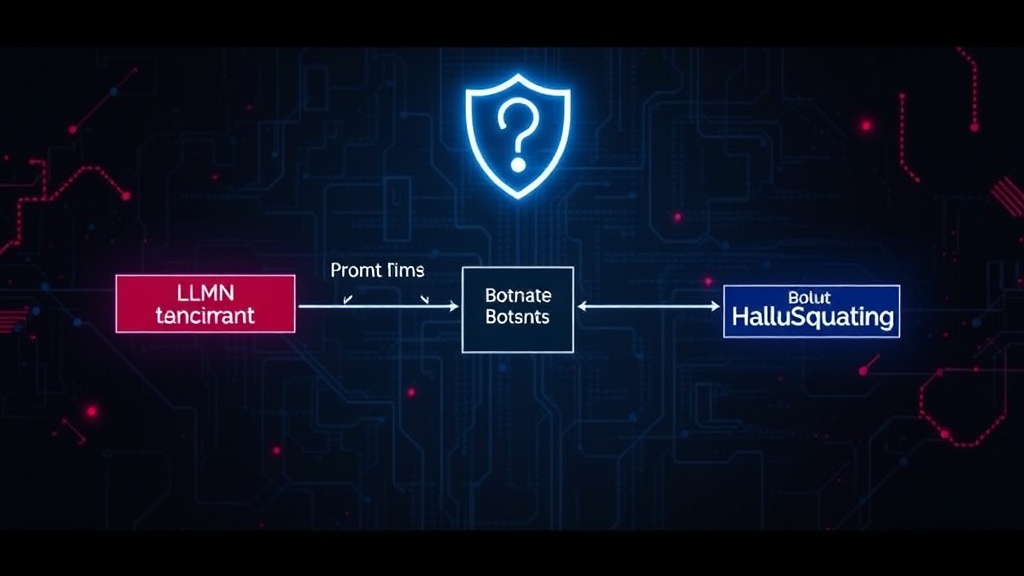
How HalluSquatting Works
The process begins with the attacker identifying an LLM that exhibits a strong bias towards generating answers rather than admitting ignorance. This is a common trait, as developers often fine-tune models to be helpful and informative, inadvertently making them susceptible to this type of manipulation. The attacker then crafts a series of prompts designed to lead the LLM down a path of generating malicious output. These prompts might involve asking the AI to "demonstrate" a particular type of network traffic, "explain" a function using code examples, or "simulate" a system interaction.
For instance, an attacker could prompt an LLM to generate a Python script that binds to a specific port, listens for incoming connections, and executes arbitrary commands. If the LLM has seen examples of network programming or scripting in its training data, it might attempt to construct such a script. The HalluSquatting technique focuses on subtly guiding the AI to produce code that includes backdoors, remote access capabilities, or instructions to download and execute further malicious payloads. The generated code, while potentially nonsensical to a human reviewing it without context, can be highly effective when fed to a vulnerable system or used as a component in a larger attack.
The generated malicious code is then distributed. This could be through phishing emails, malicious websites, or even by embedding it within seemingly innocuous files. Once executed on a victim's machine, the code connects back to a C2 server controlled by the attacker. Unlike traditional botnets where each bot might have a unique command to perform a specific task, HalluSquatting allows attackers to dynamically generate new commands or code snippets on the fly using the same LLM, making the botnet more adaptable and resilient to detection. The LLM acts as a sophisticated, on-demand code generation engine for the botmaster.
The Botnet Advantage: Scale and Stealth
The primary advantage for attackers using HalluSquatting is the potential to rapidly assemble massive botnets. LLMs can generate code at a scale and speed that would be impossible for human attackers to match. This rapid generation capability allows for quick deployment and expansion of botnet infrastructure.
Furthermore, the nature of the generated code can be highly evasive. Because the code is synthesized by an AI, it may not resemble known malware signatures. This can bypass traditional signature-based antivirus and intrusion detection systems. The dynamic nature of the commands also means that the botnet's behavior can change frequently, making it harder for security analysts to identify patterns and develop effective countermeasures. The AI's ability to generate varied, contextually relevant (though malicious) code provides a level of sophistication that is difficult to replicate with static malware.
The attack also benefits from the widespread adoption and accessibility of AI tools. Many developers and organizations are already integrating LLMs into their workflows. This familiarity can lower the barrier to entry for attackers who wish to leverage these tools for malicious purposes. The very helpfulness and generative power that make LLMs valuable for legitimate use cases are being turned against users.
What is particularly concerning is the potential for LLMs to be used not just for initial infection, but also for the ongoing management and evolution of botnets. Imagine an LLM being prompted to devise new ways to obfuscate C2 traffic or to generate exploit code for newly discovered vulnerabilities. This turns the AI into a force multiplier for cybercriminals, enabling them to stay ahead of security defenses.
The 'I Don't Know' Problem
The underlying vulnerability exploited by HalluSquatting is the LLM's difficulty in gracefully handling situations where it lacks sufficient information. Many LLMs are designed with a "helpfulness" directive, which encourages them to provide an answer, even if it means fabricating one. This is often achieved through internal mechanisms that prioritize generating plausible text over asserting a lack of knowledge. The models might be fine-tuned to avoid explicit disclaimers like "I don't know" or "I cannot fulfill this request," pushing them towards speculative generation.
This is analogous to asking an expert for advice on a niche topic they haven't studied. Instead of saying, "I'm not sure about that," they might try to piece together an answer from related fields, potentially leading to inaccuracies. In the case of HalluSquatting, these inaccuracies manifest as executable code or malicious instructions. The attacker's skill lies in crafting prompts that exploit this precise behavior, pushing the LLM to generate code that is both syntactically correct and functionally malicious, while appearing to be a legitimate response to the prompt.
Security researchers have identified that this issue is not isolated to a single LLM but affects a range of popular models. The effectiveness of the HalluSquatting attack hinges on the specific architecture and training methodology of the LLM, but the general principle of weaponizing hallucination is broadly applicable. This raises a critical question for AI developers: how can models be trained to robustly identify and refuse harmful requests without sacrificing their utility and helpfulness in legitimate contexts?
Mitigation and Future Implications
Mitigating HalluSquatting requires a multi-pronged approach. For AI developers, this means enhancing LLM safety mechanisms. This includes improving the ability of models to detect and refuse malicious prompts, even when they are subtly crafted. More robust input validation and output filtering are crucial. Furthermore, training models to more readily admit when they lack information or cannot fulfill a request is essential. This might involve reintroducing or strengthening "I don't know" responses in specific contexts.
For users and organizations deploying LLMs, vigilance is key. Security teams should monitor AI model outputs for unexpected or suspicious code. Implementing sandboxing for AI-generated code before execution, especially in sensitive environments, can prevent unintended compromise. Educating users about the risks of adversarial prompting and the potential for AI to generate malicious content is also important. Security professionals must adapt their threat models to include AI-generated threats, moving beyond traditional malware analysis to understanding the unique attack vectors enabled by generative AI.
The emergence of HalluSquatting signals a new era in cyber threats, where AI tools themselves become both the weapon and the arsenal. As LLMs become more powerful and integrated into critical infrastructure, the potential for their misuse will only grow. This research serves as a stark reminder that the rapid advancement of AI necessitates a parallel advancement in AI security and responsible development practices.